The Matter of Energy Density with Building Fuel Sources
An exploration of how fuel density affects heat output
.webp?t=1769542063)
It was a cold winter night... and I was staying in a house being heated solely by a wood-burning stove. For anyone who has ever managed a fire, it quickly becomes clear that there is a correlation between the weight of certain wood species and the longevity of the combustion process (e.g., oak logs apparently pack a lot more "punch" than pinewood).
On this particular evening, this concept sent me down a rabbit hole comparing the volumetric density (i.e., pounds per cubic feet) to the energy density (British thermal units per pound) of common fuel sources—some solids, some liquids, some gases. (How do you spend your evenings by a fireplace?)
The data I gathered confirmed my empirical observations. Hardwoods are markedly heavier than softwoods. Most wood species found in the U.S. exhibit a relatively narrow band of energy density (i.e., Btu/lb); but the higher weight per unit volume of hardwoods means they pack more units of thermal energy in a log of similar size to that of softwoods.
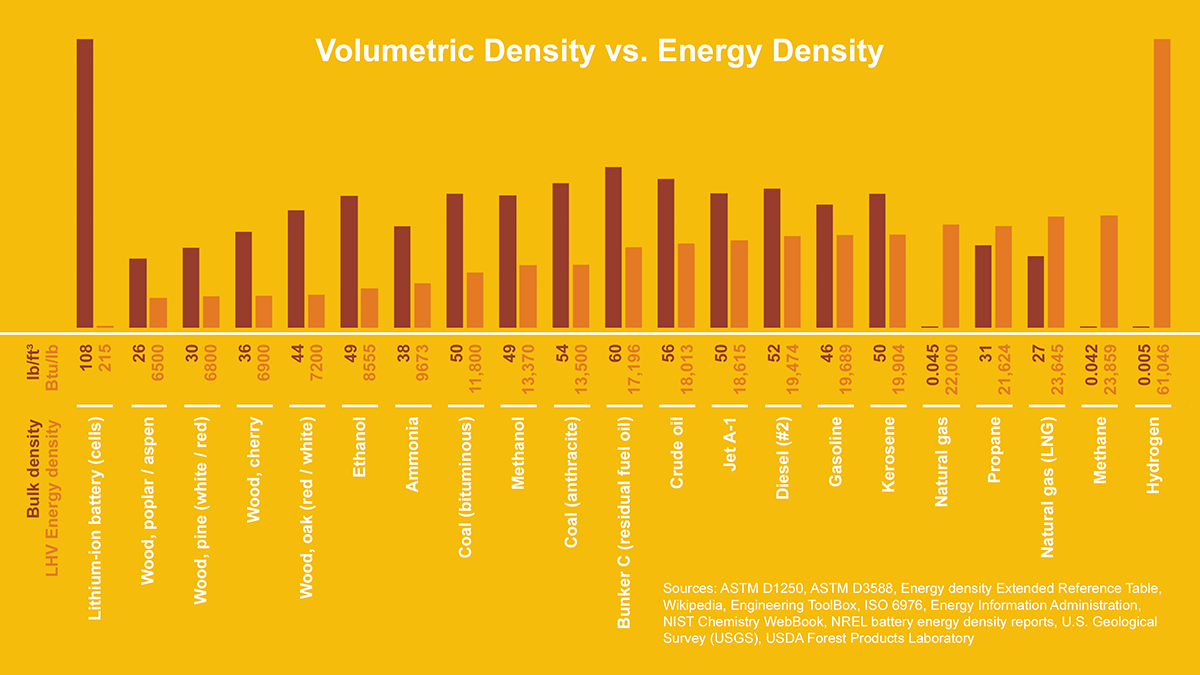 |
Comparison of volumetric density and energy density with common fuel sources. Figure by Daniel Overbey. |
However, the general comparison volumetric and energy densities across other common fuel sources brought other observations to bear.
Fuels beat batteries by one to two orders of magnitude on an energy per mass basis.
Lithium-ion batteries are extremely heavy per unit of energy compared to chemical fuels. That’s not a flaw in the table. Rather, it is a fundamental physics and chemistry reality.
A combustion engine car might carry 90 pounds of gasoline, not 9,000 pounds of batteries.
Moreover, it is worth noting that batteries don’t store chemical energy. Rather, they store electrochemical potential. They contain heavy solid materials (e.g., metals, salts, and ceramics). Only a small fraction of battery mass actually participates in energy storage.
However, electricity is higher quality energy. Whereas a combustion engine converts fuel to heat, which is used to produces work, which can generate electricity (along with a lot of losses in the process), batteries deliver electricity directly.
Hydrogen gas looks amazing on paper and then the notion falls apart when you try to use it in buildings.
Hydrogen does have enormous energy per pound. The reason buildings do not use it is that mass-based energy density is almost irrelevant for buildings. Buildings care much more about volume than weight. For example, hydrogen gas has ~1/3 the energy per cubic foot of natural gas at the same pressure:
- Natural gas ≈ 1,000–1,050 Btu/ft³ (LHV or lower heating value)
- Hydrogen (H₂) gas ≈ 270–300 Btu/ft³ (LHV)
Therefore, the building would require:
- 3 × the pipe flow
- 3 × the storage volume
- Larger meters, regulators, burners, etc.
Buildings are volume-constrained, not weight-constrained.
The most viable building fuels cluster tightly.
Once you look volumetrically, wood, coal, oil, propane, gasoline, kerosene all exist in surprisingly narrow band. This explains why buildings historically switched fuels easily (e.g., tank sizes did not change much; as a result, distribution systems evolved smoothly).
Though they hold the promise for combustion-free energy systems in buildings, hydrogen and batteries sit far outside this historical brand. Buildings care about volume, simplicity, cost, and efficiency and current hydrogen fuel cell technologies have face challenges on all four fronts; and batteries have still have issue on volume and cost.
Only time will tell if nascent technologies can close the gap on these challenges to realize economically viable solutions that will usher a breakthrough in the market and catalyze efforts to decarbonize the building sector.
