Getting to Know the Common Materials Framework
The building design and construction industry has come a long way toward advancing how project teams design and specify products and materials that are healthier for both humans and the environment

The building design and construction industry has come a long way toward advancing how project teams design and specify products and materials that are healthier for both humans and the environment, reduce greenhouse gas emissions, and advance the circular economy. In the early days of LEED a quarter of a century ago, emphasis was placed on single-attribute assessments using criteria such as pre- and post-recycled content, percentage of rapidly renewable content, and proximity of extraction and manufacture from the project site. Sounds a bit rudimentary? That was simply where we were as an industry—and at the time, we knew it was better than nothing.
With the launch of LEED v4 a decade ago, the industry began to pivot toward multi-attribute assessments. The three Building Product Disclosure and Optimization (BPDO) credits prompted teams to aggregate collections of third-party verified Environmental Product Declarations (EPDs) and transparency reports regarding raw material sourcing and building product ingredients. The credits attempted to leverage such documentation to push the industry to consider the impacts specific to any particular building product or material.
While collecting "disclosure" documents proved easy enough for project teams, it turned out that LEED v4 was a bit ahead of the curve on the "optimization" side. Frankly, the industry lacked a common framework to facilitate rigorous, standardized, and streamlined workflows to achieve optimization. Simply put, the industry was not quite ready.
It is ready now.
The mindful MATERIALS Common Materials Framework
Pulling together over 30 years of collective action, the Common Materials Framework (CMF) is a first-of-its-kind industry-aligned structure that organizes and standardizes sustainability information for building products across five key impact areas:
- Human Health
- Climate Health
- Ecosystem Health
- Social Health & Equity
- Circularity
Curated by mindful MATERIALS (mM), which is a charitable, public-benefit organization, and developed collaboratively by manufacturers, architects, designers, and sustainability experts, the CMF provides a shared language that can facilitate the translation of the industry's diverse range of certifications, disclosures, and product data into a consistent, comparable format.
For the first time, the building design and construction industry is seeking alignment around material health—and the CMF is serving as the common language.
At its core, building design and construction professionals can think of the Common Materials Framework as the industry's shared language for sustainable building products. As announced at the 2026 Greenbuild International Conference & Expo, USGBC, IWBI, ILFI, BRE, and AIA acknowledged a collective effort to alignment their respective rating systems and climate action programs around the CMF—and that is just the tip of the iceberg. The CMF is available to manufacturers as well and by organizing the industry's various ecolabels and standards into a common framework, duplication and redundancy will be mitigated and standardized workflow can fulfill multiple requests.
The full CMF is comprehensive, but without some sort of prioritization its inherent complexity could be overwhelming. To help establish an actionable starting point, mindful MATERIALS' CMF Prioritization Task Force developed the CMF Prioritization v1.0, which is basically a curated subset of information that highlights what is considered to be the most relevant, widely used, and requested ecolabels and standards now and over the next two to three years.
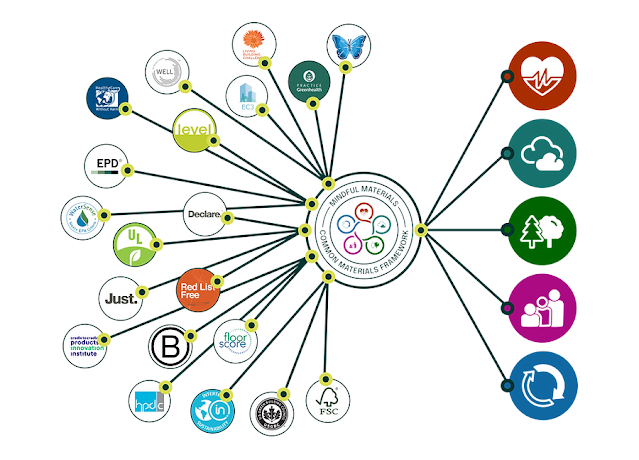 The Common Materials Framework is designed to serve as the industry’s shared language for sustainable building products, fostering clarity, consistency, and connection across programs and partners. Figure property of mindful MATERIALS; all rights reserved.
Sounds like a lot? There are tools to help.
For all of its richness and depth, to the initiated the CMF may prove a bit intimidating or overwhelming. However, there are a number of tools available to meet any building project team where they are such that they can leverage the CMF in practical and streamlined matter. This list is not meant to be comprehensive.
mindful MATERIALS CMF Implementation Toolkit
To help manufacturers, architects, designers, and data platforms apply the CMF consistently across their respective workflows, mindful MATERIALS developed the CMF Implementation Toolkit. This is a comprehensive guidance package that includes:
Definitions and structure: including Detailed explanation of all five impact categories along with sub-attributes, criteria, and terminology. It also includes a descriptions of how each attribute links to common building product and material disclosure documents.
Mapping guidance: including decision trees and logic guidelines, examples of correctly categorized product attributes, and clarifications regarding ambiguous or less standardized claims.
Data quality and verification recommendations: including requirements for acceptable forms of evidence, rules for third-party verification, and guidance on how to handle missing or partial data.
Implementation workflows: including step-by-step instructions for different user groups (i.e., manufacturers, software developers, design teams).
Case studies and application examples: including best-practice workflows for project teams, before-and-after examples of product listings, and information on how CMF-aligned data improves comparisons and reporting.
The aforementioned CMF Prioritization v1.0 serves as the foundation for all tools, resources, and guidance within the CMF Implementation Toolkit.
Ecomedes
A mindful MATERIALS Technology Partner, Ecomedes offers a cloud-based platform that allows AEC/O personnel to find, compare, and document sustainable building products. It is essentially a product transparency and sustainability database, designed to simplify compliance with various green building programs including LEED, WELL, Fitwel, Living Building Challenge, and Phius. Ecomedes maps building product data to the CMF categories and allows users to filter through its database by criteria aligned with CMF.
Sustainable Minds (SM) Transparency Catalog and Project Builder / Configuration & Library
As part of their role as a mindful MATERIALS Technology Partner, Sustainable Minds (SM) has integrated the CMF directly into their Project Builder / Configurator & Library. The platform automatically classifies building product transparency documents (e.g., EPDs, HPDs, Declare, C2C) by the five CMF impact areas and sub-criteria. Because everything is mapped to CMF, the Project Builder / Configurator & Library can allow users to filter products by CMF criteria. Moreover, it can produce CMF-aligned product reports to facilitate project-level AIA Materials Pledge reporting. Streamlined documentation for the Building Product Selection and Procurement credit under LEED v5 BD+C is also in the works.
LEED v5 BD+C Building Product Selection and Procurement Credit
LEED v5 BD+C reconceives of the last version's multi-attribute assessment by leveraging the CMF. Achievement under the Building Product Selection and Procurement credit is demonstrated through eligible compliant manufacturer product documentation, which includes third-party product certifications, ecolabels, declarations, and standards. USGBC established a multi-attribute scoring system within the credit. A single building product document can demonstrate multiple benefits and/or achievement levels, or it can earn multi-attribute criteria through a combination of separate eligible product documents.
The following table is from a LEED v5 additional guidance document regarding the Building Product Selection and Procurement credit under BD+C and ID+C. It demonstrates how various third-party assessment documents are valued across the five CMF impact areas. In theory, this approach will provide project teams with an "easy button" to leverage commonly encountered (and easily specified) product documentation to implement the CMF into a project with or without more robust (and perhaps complex) tools and resources.
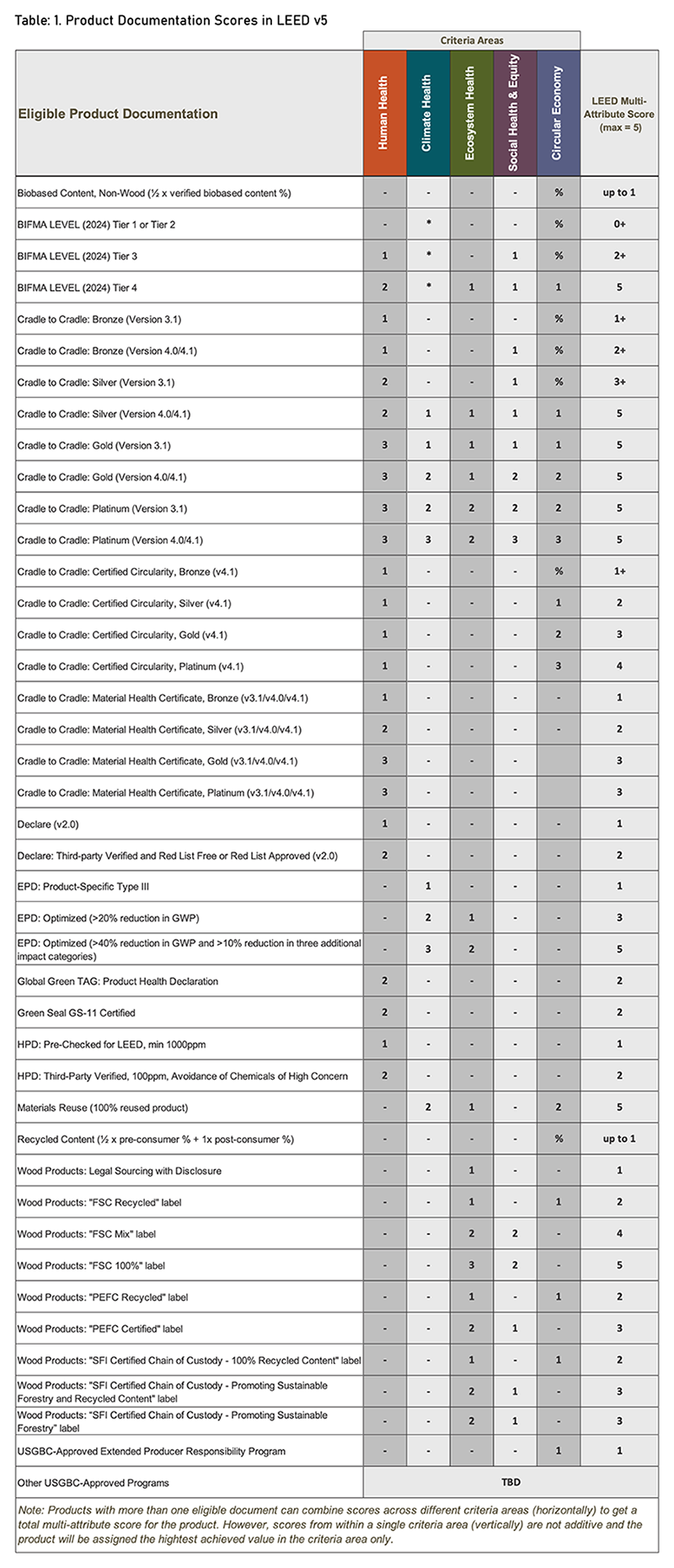 Product Documentation Scores in LEED v5 from the BPSP Criteria Areas and Achievement Levels in LEED v5 (BD+C and ID+C), Version 1.2, November 2025. Table property of the U.S. Green Building Council; all rights reserved.
But wait—there's more!
Currently, mindful MATERIALS notes nine Technology Partners—only two of which were highlighted here to offer a sense of the kinds of tools available in the marketplace today. The other seven companies also offer unique platforms to assist project teams toward implementing the CMF:
Leveraging the Common Materials Framework has never been easier—nor has it ever been more important. If your team is looking for an actionable sustainability initiative, perhaps the time is right to establish a workflow to optimize and track healthier material and product selections across your portfolio moving forward.
