Key Highlights of Greenbuild 2025
Five major themes emerged that encapsulate the current discourse in "green building" and where the AEC is heading with regard to sustainability
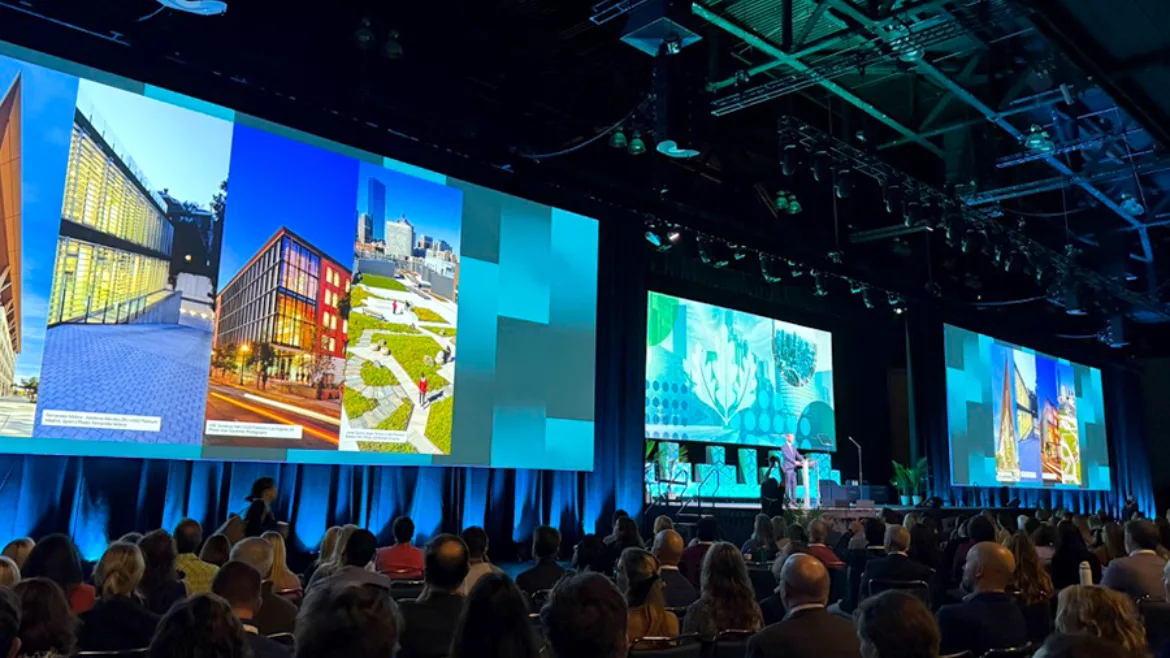
The 2025 Greenbuild International Conference and Expo touted roughly 15,000 attendees, 250 vendors, and over 100 education sessions and workshops. It was the 25th consecutive year for the event and the third time that the conference was hosted in Los Angeles, California. Photo by Daniel Overbey.
The 2025 Greenbuild International Conference and Expo convened at the Los Angeles Convention Center from November 4-7. Unofficially, the event touted roughly 15,000 attendees, 250 vendors, and over 100 education sessions and workshops. It was the 25th consecutive year for the event and the third time that the conference was hosted in Los Angeles, California (2016, 2007).
The offerings at this year's Greenbuild covered a wide range of topics from the building design and construction industry's leading professionals. However, five major themes emerged that encapsulate the current discourse in "green building" and where the AEC is heading with regard to sustainability.
Decarbonization
Much of the conference agenda emphasized strategies and tools to achieve ultra-low operational greenhouse gas (GHG) emissions across the building sector. Decarbonization is deeply embedded in LEED v5 and the strategies on display at Greenbuild ranged from high-performance design to low-carbon product and material procurement, solutions for peak load reduction, grid interactivity, and renewable energy resources.
There was also an emphasis on retrofits and adaptive reuse projects, which can preserve a community's history while saving multitudes of resources and embodied carbon. To this end, just prior to the kick-off Greenbuild, USGBC released the LEED v5 Materials Reuse Calculator, which addresses the on-site reuse of existing structures and enclosure materials, including materials left in-situ and those procured off-site and incorporated into the building.
Industry Alignment around Material Health
Conference offerings related to materials innovation, circular economy, embodied carbon reduction, and supply-chain transparency underscored an emerging theme around material health. Several sessions highlighted how building material choices impact climate, ecosystems, and human health. Specifically, a broader effort is underway to harmonize and align disparate efforts toward greater material health around the Common Materials Framework (CMF) from mindful MATERIALS. Representatives for LEED v5, WELL v2, and LBC 5.0 acknowledged a collective alignment of the rating systems around the CMF and BREEAM v7 is advancing an accompanying CMF crosswalk resource.
mindful MATERIALS and their strategic partners have aggregated over 30 years of collective progress to develop the Common Materials Framework Implementation Toolkit, which is now available.
Moreover, AIA emphasized that the AIA Material Pledge, one of the institutes premiere climate action initiatives, is also aligned with the CMF, as apparent in the latest AIA Materials Pledge by the Numbers report, which was released in advance of Greenbuild.
 Image courtesy of Daniel Overbey.
 Technology, Data Analytics, and Artificial Intelligence
Another clear theme at Greenbuild was the intersection of the building design and construction industry with emerging trends in automation, data analytics, and artificial intelligence (AI). This year's conference explored how emerging technologies are being leveraged to support high-performance building outcomes. With the rise of advanced building monitorization through an increasingly sophisticated network of sensors deployed across projects, an unprecedented level of quantitative and qualitative inputs can be analyzed by building management systems, lending facility managers the ability to leverage data analytic tools to optimize performance and quickly identify and address performance concerns.
Such data networks, further enhanced by various Internet of Things (IoT) sensors, can be used to create a dynamic, real-time virtual replica of a building asset—known as a digital twin. Whereas building information modeling (BIM) revolutionized design and coordination, it remains largely static and unable to validate real-time performance once a building is occupied. Digital twins extend BIM into this realm as they allow real-time assessments.
Going one step farther, the conference exhibited instances of AI-powered data analytics of digital twins being used for asset management and various types of sustainability assessments. At scale, AI-powered digital twins hold the potential to allow investors, asset managers, and owners to align capital flows with high-performance/healthy buildings. They may also profoundly change the future of building monitorization and green building certification. Once advanced beyond individual buildings to campuses, districts, or even entire cities, AI-powered digital twins will have a profound impact on how we engage the built environment around us.
Resilient Design and Climate Adaptation
A significant portion of this year's Greenbuild focused on the escalating reality of climate-driven hazards and the pressing need for buildings that do not just perform well today but endure and adapt for the future. Using emerging tools and frameworks (such as the LEED v5 Climate Resilience Assessment prerequisite), project teams can systematically assess site- and building-specific climate risks and then integrate design solutions of operational strategies to maintain occupant safety and functional continuity under acute and/or chronic stressors. Session content offered technical deep‐dives into real-world hazard mitigation—from heat‐wave cooling strategies and flood resilience to wildfire risk reduction—emphasizing not only immediate performance, but the long-term adaptive capacity and cost-savings that resilient design can unlock.
LEED v5
Of course, the latest version of LEED was a focal point of this year's Greenbuild. The latest edition of the rating system is harmonized around three impact areas: decarbonization, quality of life, and ecological conservation and restoration.
Much of the educational content at this year's conference focused on lessons learned from various LEED v5 case studies along with emerging tools and resources for project teams looking to pursue certification under the latest edition of the rating system.
At Greenbuild, three important LEED v5 announcements were made:
- Arc is ready for v5. LEED v5 certification functionality is now open in the new Arc platform. In addition to registering and setting up their projects, teams can use Arc to explore credit forms and upload documentation toward certification.
- New calculators are available. The LEED v5 credit library now includes dozens of USGBC-created calculators to support credit documentation and reduce the need for bespoke calculation methods.
- LEED addenda update. USGBC announced LEED v5 reference guide addenda issued on November 3.
The Reference Guides for LEED v5 BD+C, ID+C, and O+M are now available at usgbc.org/resources/leed-v5-reference-guides
Need a LEED v5 crash course? We have you covered.
Get up to speed on the next evolution of LEED. Join us on December 17 for "Future-Ready Design: Navigating the LEED v5 Rating System," a one-hour webinar in which we will run through the LEED v5 BD+C: New Construction rating system, including its structure, goals, and credits.
Greenbuild is coming to New York City in 2026
The 2026 Greenbuild will be in New York City for the first time. The conference will be held at the Jacob K. Javits Convention Center. For more information, please visit informaconnect.com/greenbuild