Building Enclosure logo
search
cart
facebook twitter linkedin youtube instagram Spotify Podcasts Apple Podcasts Spotify Podcasts Apple Podcasts
  • Sign In
  • Create Account
  • Sign Out
  • My Account
Building Enclosure logo
  • NEWS
    • Breaking News
  • SECTIONS
    • Columns
    • Project Profiles
    • Trade Shows
    • Sponsor Insights
  • SYSTEM DESIGNS
    • Low-Slope Roofs
    • Pitched Roofs
    • Metal Roofing Materials
    • Waterproofing
    • Sustainability
    • Insulation
    • Exterior Claddings
    • Wall Systems
    • Building Envelope
  • BLOG
    • The BE Blog
  • MEDIA
    • Podcasts
    • Webinars
    • Quiz
    • Videos
    • Polls
    • Interactive Spotlights
    • Newsletter
    • Photo Galleries
  • DIRECTORIES
    • Directory: Blue Book
    • Directory: Roofing Resource
  • PRODUCTS
  • TECHNICAL
    • Codes
      • Waterproofing
      • Roofing
    • Details
      • Waterproofing
      • Roofing
  • CONTINUING ED
  • ABOUT
    • Advertise
      • Editorial Calendar
    • Contact
    • eMag Archive Issues
  • SIGN UP!

Top Five Benefits of Self-Adhered Products in Modular Construction
By Clinton Holmes
GCP Applied Technologies
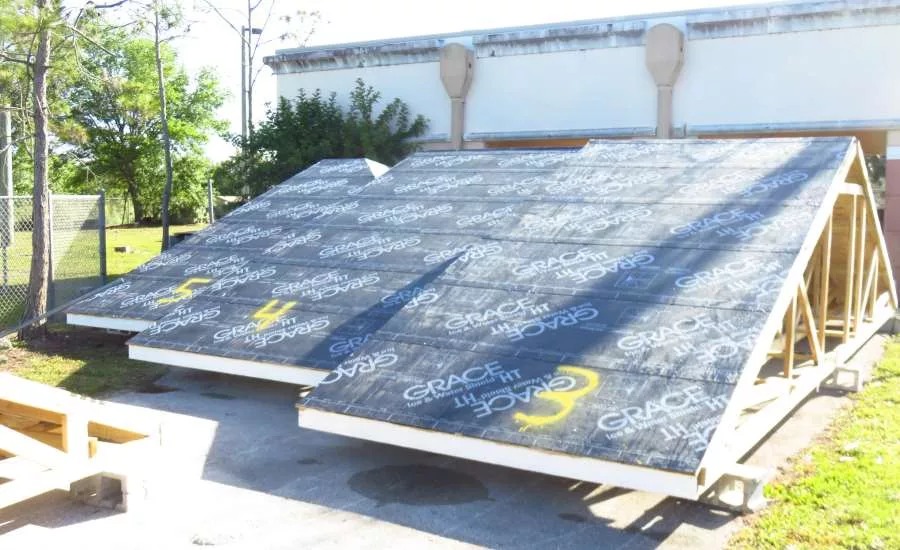
Photo courtesy of GCP Applied Technologies.
February 8, 2021

Modular construction has grown rapidly as it provides many benefits. The process is greener, faster, and smarter than conventional building methods. When construction professionals choose modular construction for a project it is often those key benefits that attract them. It produces less waste, a more airtight construction, is safer for the crew due to the indoor construction environment, and reduces the project timeline due to weather delays.

What if you could accelerate those benefits even further? Well, you can. With the right products, modular construction can be even more efficient.

A product category that is often overlooked when it comes to modular construction but fits seamlessly into the process is self-adhered building products. Their ease of application eliminates laborious and time-consuming fastening, taping, and detailing procedures, among other benefits. Here are the top five reasons to use self-adhered building products in modular construction:

  1. Weight Matters - As the building is constructed off-site and then transported to the building site, weight is a significant consideration in modular construction to keep costs down. A procedure called “light weighting” is often conducted to shrink every ounce of the truck's weight to improve the miles per gallon. Using self-adhered products eliminates the need for fasteners, making the modules lighter. The lower weight equals lower transportation costs. These savings are typically much greater than the marginal additional cost of self-adhered products. 
  2. Windproof - Self-adhered products stand up to winds during transport. They don’t blow around or get destroyed. For instance, GCP’s VYCOR enV-S fully adhered weather barrier seals to the substrate, solving this transportation challenge of the modular delivery process. Truck drivers have put VYCOR enV-S weather barrier to the test by driving at highway speeds and the weather barrier survived nicely in transit.  Standard building wraps can pull away from the sheathing, like sails in the wind, and often end up on the roadway, requiring rework on the jobsite.
  3. One Person Application - Self-adhered products can often be applied by one person. Most house wraps are provided in 48 inch rolls, but GCP’s VYCOR enV-S weather barrier comes in 40 inch rolls, and GRACE ICE & WATER SHIELD self-adhered roofing underlayment comes in 36 inch rolls. These shorter lengths combined with the self-adhesive application can help make it easier for one person to apply them at a modular station. This is extremely useful currently, as it meets COVID-19 social distancing guidelines.
  4. Eliminate Steps - Traditional house wraps are applied with nails or fasteners that could create leaks at every hole. In the field you are then supposed to tape over those seams. VYCOR enV-S weather barrier does not require mechanical fasteners to install, and thus does not require laborious taping of seams onsite. It also can be installed on most wood substrates without aid of any special primer materials, eliminating steps.
  5. Reduce Tools & Costs - Self-adhered building products do not require nail guns, tape, cap fasteners, and other products for application. All that is needed is the product itself, extracting three to five tools from the process. Eliminating this expensive equipment not only makes the application easier, but it also reduces the budget and application time while also freeing up inventory space.


The features of self-adhered building products complement the modular construction process. They are independently and easily applied in the workshop, and eliminate steps and tools needed. As modular construction continues to grow, it is important to evaluate how to improve and innovate the process. Utilizing premium products that accelerate the benefits of modular construction is one way to do so, increasing the efficiency of the building process and quality of the completed structure.

KEYWORDS: housewrap modular system WRB (weather resistant barrier)

Share This Story

Clinton Holmes is SBM Marketing Manager at GCP Applied Technologies. Clinton has 10 years of experience researching the product development cycle. He has held senior positions at Procter & Gamble and SharkNinja. Clinton has a Bachelor of Science from Northeastern University.

Recent Comments

These are actually very helpful tips. It is...

This is the most beneficial blog for all...

This blog is a great resource for anyone...

Thank you for sharing this important information. I...

This is a very interesting subject of the...

Manage My Account
  • Sign up for the Newsletter
  • Online Registration
  • Manage My Preferences
  • Registration Customer Service

More Videos

Sponsored Content

Sponsored Content is a special paid section where industry companies provide high quality, objective, non-commercial content around topics of interest to the Building Enclosure audience. All Sponsored Content is supplied by the advertising company and any opinions expressed in this article are those of the author and not necessarily reflect the views of Building Enclosure or its parent company, BNP Media. Interested in participating in our Sponsored Content section? Contact your local rep!

close
  • HITT Construction headquarters
    Sponsored byBuilding Composites® LLC

    Pushing the Envelope

  • 2 construction workers and a DEXcell panel
    Sponsored byDEXcell Roof Boards

    Designing Low-Slope Roofs for Resilience

  • Bell Bank headquarters in Fargo, North Dakota
    Sponsored bySto Corp.

    Drained and Back-Ventilated Rainscreens vs Pressurized-Equalized Rainscreens

Popular Stories

Open vs. closed cell foam in an attic

Open-Cell vs. Closed-Cell Spray Foam

graphic shows white arrows pointing to the right on a light green background

A Breakdown of Air Leakage Testing in LEED v5 BD+C

graphic shows a building destoryed by tornados with information on the amount of torandos in 2026 in the US

Record-Breaking Tornado Activity in Illinois Signals New Challenges for Architects

Building Enclosure Newsletter

BE Poll

Events

April 9, 2026

Strategies for High-Performance Below-Grade Waterproofing

Credits: 1 AIA LU/HSW ; 1 IIBEC CEH; 0.1 IACET CEU

On-Demand Designing a high-performance building enclosure requires more than just surface-level protection; it demands a rigorous, performance-based mastery of below-grade water and gas mitigation. This discussion will provide an expert-level analysis of below-grade waterproofing within the comprehensive framework of the high-performance building enclosure.

April 28, 2026

Roof Design Considerations That Prevent Installation Failures and Change Orders

Credit: 1 AIA LU/HSW; 1 IIBEC CEH; 0.1 ICC CEU

On-Demand This course provides visual examples of actual field conditions. Some good, some not so good; along with design suggestions that can cut installation costs and reduce construction change orders. Upon completion of this course, you will have a better understanding of the requirements the roofing contractor must meet to provide the specified roofing system warranty, and long-term value to the owner.

View All Submit An Event

Products

Plaster and Drywall Assemblies Manual

Plaster and Drywall Assemblies Manual

This is a comprehensive manual that goes beyond codes and standards, providing expert guidance in design, detailing, material selection and troubleshooting for plaster and drywall.

See More Products
×

Enhance your expertise with unparalleled insights.

Join thousands of building professionals today. Shouldn’t you know what they know?

SUBSCRIBE TODAY!
  • RESOURCES
    • Advertise
    • Contact Us
    • Store
    • Want More
  • SIGN UP TODAY
    • Create Account
    • Newsletter
    • Customer Service
    • Manage Preferences
  • SERVICES
    • Marketing Services
    • Reprints
    • Market Research
    • List Rental
    • Survey/Respondent Access
  • STAY CONNECTED
    • LinkedIn
    • Facebook
    • Instagram
    • YouTube
    • X
  • PRIVACY
    • PRIVACY POLICY
    • TERMS & CONDITIONS
    • DO NOT SELL MY PERSONAL INFORMATION
    • PRIVACY REQUEST
    • ACCESSIBILITY

Copyright ©2026. All Rights Reserved BNP Media, Inc. and BNP Media II, LLC.

Design, CMS, Hosting & Web Development :: ePublishing