How to Convert Site to Source Energy
Buildings use different mixes of energy. The mixes may including electricity, natural gas, fuel oil, district steam, and other sources. Each source will have its own unit of measure (e.g., kilowatt-hours, therms, etc.); however, to effectively evaluate the energy performance for a building, we would need to express all of the expended energy in a single common unit.
As attest to by the U.S. Environmental Protection Agency (EPA), source energy is the most equitable unit of evaluation as it enables a complete assessment of energy efficiency.
Often on-site energy consumption is expressed as site energy, which is the amount of heat and electricity consumed by a building as reflected in utility bills. In other words, site energy is the energy used "on-site" as indicated by the building's energy meters.
Site energy may be delivered to a facility in one of two forms:
Primary energy: the raw fuel source that is expended to create electricity and/or heat (e.g., natural gas or fuel oil).
Secondary energy: the energy "product" created from a raw fuel (e.g., electricity from the grid, or heat from a district steam system).
Comparing primary and secondary energy is flawed. They are not directly comparable because primary energy represents a raw fuel input and secondary energy indicates the converted product (which is subject to conversion losses through generation and delivery).
Convert site energy to source energy
Site energy lends to a simplistic comparison of relative energy consumption from one project to another, but the comparison is incomplete. By instead comparing source energy, we will account for generation and delivery losses, thus enabling a more complete thermodynamic assessment.
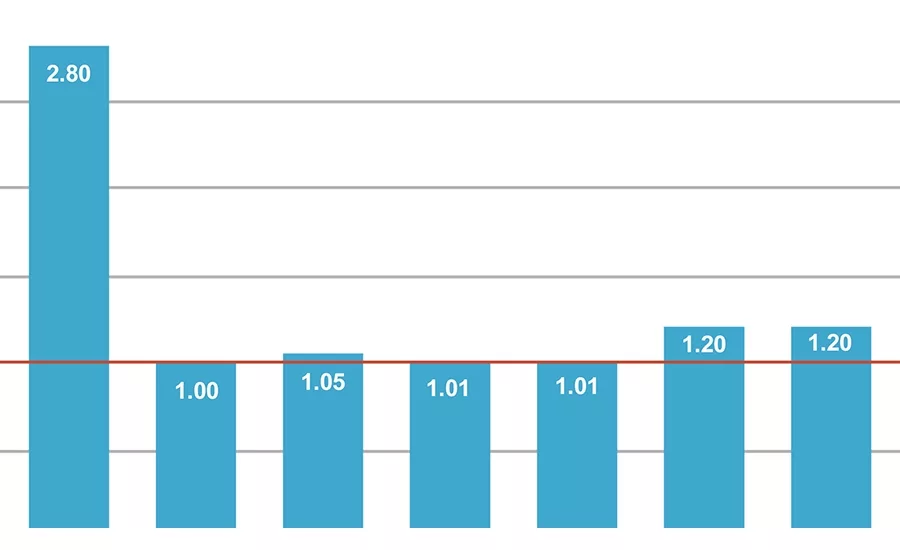
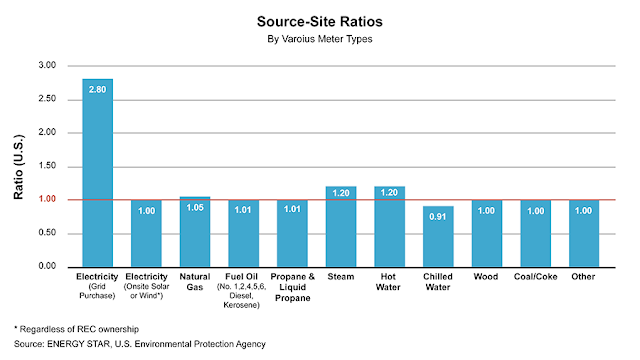
In order to determine a project's source energy, we need to determine the units of site energy for each meter (fuel) type. The figure below illustrates the source-site ratios (specific to the United States) by various meter types as determined and utilized by the EPA for the ENERGY STAR Portfolio Manager tool.
|
|
|
Figure: Source-Site Ratios. |
The tale of two metrics
Consider the following alternative heating scenarios offered by the EPA. In each instance, 1000 MBtu are required to heat the project's interior volume.
Building Scenario A uses a natural gas-fired boiler with a 90 percent combustion efficiency and an 80 percent system efficiency.
- Site energy: 1250 MBtu
- Natural Gas: 1 unit site = 1.05 units source
- Source energy: 1313 MBtu
Building Scenario B uses district steam with a 95 percent system efficiency.
- Site energy: 1053 MBtu
- Steam: 1 unit site = 1.20 units source
- Source energy: 1264 MBtu
Building Scenario C uses electricity to power an air-source heat pump with COP of 2.5.
- Site energy: 400 MBtu
- Electricity: 1 unit site = 2.80 units source
- Source energy: 1120 MBtu
Building Scenario D uses electric resistance heat.
- Site energy: 1000 MBtu
- Electricity: 1 unit site = 2.80 units source
- Source energy: 2800 MBtu
A more complete comparison
Site energy tells an incomplete story. If we evaluated these heating options based solely on site energy, we would conclude that electric resistance heat is more energy-efficient than district steam or a gas-fired boiler. However, by evaluating the options based on source energy, we clearly see that electric resistance heat requires more energy input than the district steam and natural gas options combined.
Simply put, source energy is a more equitable comparative metric than site energy. Using source energy allows for a whole-building assessment that combines all fuels fairly.
Buildings use different mixes of energy. The mixes may including electricity, natural gas, fuel oil, district steam, and other sources. Each source will have its own unit of measure (e.g., kilowatt-hours, therms, etc.); however, to effectively evaluate the energy performance for a building, we would need to express all of the expended energy in a single common unit.
As attest to by the U.S. Environmental Protection Agency (EPA), source energy is the most equitable unit of evaluation as it enables a complete assessment of energy efficiency.
Often on-site energy consumption is expressed as site energy, which is the amount of heat and electricity consumed by a building as reflected in utility bills. In other words, site energy is the energy used "on-site" as indicated by the building's energy meters.
Site energy may be delivered to a facility in one of two forms:
Primary energy: the raw fuel source that is expended to create electricity and/or heat (e.g., natural gas or fuel oil).
Secondary energy: the energy "product" created from a raw fuel (e.g., electricity from the grid, or heat from a district steam system).
Comparing primary and secondary energy is flawed. They are not directly comparable because primary energy represents a raw fuel input and secondary energy indicates the converted product (which is subject to conversion losses through generation and delivery).
Convert site energy to source energy
Site energy lends to a simplistic comparison of relative energy consumption from one project to another, but the comparison is incomplete. By instead comparing source energy, we will account for generation and delivery losses, thus enabling a more complete thermodynamic assessment.
In order to determine a project's source energy, we need to determine the units of site energy for each meter (fuel) type. The figure below illustrates the source-site ratios (specific to the United States) by various meter types as determined and utilized by the EPA for the ENERGY STAR Portfolio Manager tool.
|
|
|
Figure: Source-Site Ratios. |
The tale of two metrics
Consider the following alternative heating scenarios offered by the EPA. In each instance, 1000 MBtu are required to heat the project's interior volume.
Building Scenario A uses a natural gas-fired boiler with a 90 percent combustion efficiency and an 80 percent system efficiency.
- Site energy: 1250 MBtu
- Natural Gas: 1 unit site = 1.05 units source
- Source energy: 1313 MBtu
Building Scenario B uses district steam with a 95 percent system efficiency.
- Site energy: 1053 MBtu
- Steam: 1 unit site = 1.20 units source
- Source energy: 1264 MBtu
Building Scenario C uses electricity to power an air-source heat pump with COP of 2.5.
- Site energy: 400 MBtu
- Electricity: 1 unit site = 2.80 units source
- Source energy: 1120 MBtu
Building Scenario D uses electric resistance heat.
- Site energy: 1000 MBtu
- Electricity: 1 unit site = 2.80 units source
- Source energy: 2800 MBtu
A more complete comparison
Site energy tells an incomplete story. If we evaluated these heating options based solely on site energy, we would conclude that electric resistance heat is more energy-efficient than district steam or a gas-fired boiler. However, by evaluating the options based on source energy, we clearly see that electric resistance heat requires more energy input than the district steam and natural gas options combined.
Simply put, source energy is a more equitable comparative metric than site energy. Using source energy allows for a whole-building assessment that combines all fuels fairly.
