Building Enclosure logo
search
cart
facebook twitter linkedin youtube instagram Spotify Podcasts Apple Podcasts Spotify Podcasts Apple Podcasts
  • Sign In
  • Create Account
  • Sign Out
  • My Account
Building Enclosure logo
  • NEWS
    • Breaking News
  • SECTIONS
    • Columns
    • Project Profiles
    • Trade Shows
    • Sponsor Insights
  • SYSTEM DESIGNS
    • Low-Slope Roofs
    • Pitched Roofs
    • Metal Roofing Materials
    • Waterproofing
    • Sustainability
    • Insulation
    • Exterior Claddings
    • Wall Systems
    • Building Envelope
  • BLOG
    • The BE Blog
  • MEDIA
    • Podcasts
    • Webinars
    • Quiz
    • Videos
    • Polls
    • Interactive Spotlights
    • Newsletter
    • Photo Galleries
  • DIRECTORIES
    • Directory: Blue Book
    • Directory: Roofing Resource
  • PRODUCTS
  • TECHNICAL
    • Codes
      • Waterproofing
      • Roofing
    • Details
      • Waterproofing
      • Roofing
  • CONTINUING ED
  • ABOUT
    • Advertise
      • Editorial Calendar
    • Contact
    • eMag Archive Issues
  • SIGN UP!

Toward a Decarbonized Built Environment
By Daniel Overbey
carbon emissions
March 2, 2020

The building design and construction industry is at the cusp of sea change in how we quantify and consider carbon emissions in the built environment. Any strategy toward reducing the greenhouse gas (GHG) contributions of the building sector will require a rigorous, comprehensive approach to carbon emissions. Toward this end, I offer five considerations.


Project teams should become familiar with the emerging carbon intensity metrics.

The units by which we measure the equivalent carbon emissions contributions of our buildings can be confusing. The units are unfamiliar to many professionals and they are inconsistently applied. On a per unit area basis, the two most common metrics are:

        kg CO2e/m2 = kilograms of carbon dioxide equivalent emitted per square meter

        lbs CO2e/ft2 = pounds of carbon dioxide equivalent emitted per square foot


Conversion factors are as follows:

        1 kg/m2 = 0.204816 lb/ft2

        1 lb/ft2 = 4.88243 kg/m2  


There is no silver bullet to fixing the problem, but existing buildings are close.

Embodied carbon matters now more than ever and as Carl Elefante, FAIA, 2018 AIA President has stated, “The greenest building is … one that is already built.”

Larry Strain, FAIA, recently put the carbon contribution of existing buildings into perspective. Currently, about six billion square feet of new construction are built every year in the U.S. By Stain's estimate, if we make reasonable assumptions about this new, code-compliant, energy-efficient component of our total building stock, it will generate the equivalent GHG emissions of about 40 million tons of CO2 every year—less than one percent of total annual U.S. emissions across all sectors.

The embodied carbon of six billion square feet of new construction will generate something on the magnitude of 350 million tons of equivalent carbon emissions—just over a third of the total annual US emissions.

However, according to Strain, the operating emissions from our existing building stock is currently around 2.3 billion tons per year—more than a third of U.S. annual emissions; a daunting contribution which presents a staggering opportunity. If we do not effectively address operating carbon from existing buildings, reduced embodied carbon in new buildings will not matter much.

Figure 1: Annual Carbon Emission (Millions of Tons): 6 Billion Square-Feet of New Construction / 310 Billion Square-Feet of Existing Building

Adapted from Larry Strain, "Time Value of Carbon" (2017)


Anyone should gather a sense of what their project's carbon intensity is—and how it may be reduced.

The building design and construction industry is beginning to realize the relative carbon intensity of different building types. The Carbon Leadership Forum is doing some truly amazing work. The Embodied Carbon Benchmark (ECB) Study by principal investigator K. Simonen and others is giving the industry insights into the embodied carbon of various building types throughout their life cycles. The initial phase of the ECB study revealed that over 95 percent of the buildings assessed had an initial carbon intensity under 1,000 kg CO2e/m2 (or about 205 lbs CO2e/ft2) and nearly 75 percent of the office buildings assessed were less than 500 kg CO2e/m2.  

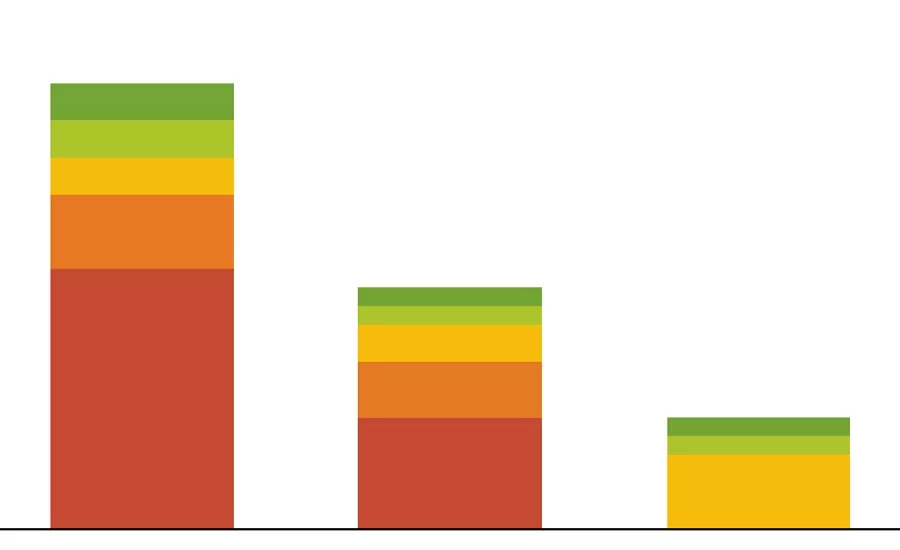
Strain also outlined the relative carbon intensity of basic building types and their constituent materials/systems categories. The bottom line: foundations and structures are huge carbon contributors. Building smaller, lighter structures saves carbon emissions over larger, heavier buildings. Moreover, when a project team can renovate an existing building, the embodied carbon of foundations, structures and exterior cladding for new construction are spared—saving tremendous amount of GHG emissions from new construction.

Figure 2: Carbon Emissions by Building Type and Material

Adapted from Larry Strain, "Time Value of Carbon" (2017)


There are limitations to our resources and tools.

There are limitations to embodied carbon data and other life cycle assessment (LCA) reporting resources and tools. Namely, the carbon intensity of on-site operations during construction and ongoing maintenance is oftentimes missing. Please be cautious of this when comparing and working with various resources and tools.


Biogenic carbon should be factored in.

Biogenic carbon is a term used to describe the carbon contained in biomass (such as wood) that is accumulated during plant growth. Researchers are making considerable progress toward quantifying biogenic carbon, but many LCA frameworks adopt a neutrality assumption regarding biogenic carbon and, therefore, do not take it into consideration. Emerging resources and tools are now leveraging biogenic carbon in order to realize a more complete inventory with regard to the life cycle carbon intensity of buildings.  

KEYWORDS: carbon reduction decarbonization

Share This Story

Overbey   head shot 2020 3

Daniel Overbey, AIA, NCARB, LEED Fellow (LEED AP BD+C, ID+C, O+M), WELL AP is an Assistant Professor of Architecture at Ball State University and the Director of Sustainability for Browning Day in Indianapolis, Ind. His work focuses on high-performance building design and construction, environmental systems research, green building certification services, energy/life-cycle assessment modeling, and resilient design. He can be reached at djoverbey@bsu.edu.

Recent Comments

These are actually very helpful tips. It is...

This is the most beneficial blog for all...

This blog is a great resource for anyone...

Thank you for sharing this important information. I...

This is a very interesting subject of the...

Manage My Account
  • Sign up for the Newsletter
  • Online Registration
  • Manage My Preferences
  • Registration Customer Service

More Videos

Sponsored Content

Sponsored Content is a special paid section where industry companies provide high quality, objective, non-commercial content around topics of interest to the Building Enclosure audience. All Sponsored Content is supplied by the advertising company and any opinions expressed in this article are those of the author and not necessarily reflect the views of Building Enclosure or its parent company, BNP Media. Interested in participating in our Sponsored Content section? Contact your local rep!

close
  • 2 construction workers and a DEXcell panel
    Sponsored byDEXcell Roof Boards

    Designing Low-Slope Roofs for Resilience

  • Bell Bank headquarters in Fargo, North Dakota
    Sponsored bySto Corp.

    Drained and Back-Ventilated Rainscreens vs Pressurized-Equalized Rainscreens

  • A construction worker using DEXcell roof boards
    Sponsored byDEXcell Roof Boards

    The Hidden Strength of Low-Slope Roof Systems: Why Roof Cover Boards Matter

Popular Stories

construction industry workers in hard hats stand around a city scape

Construction Industry Revolts Over New CSI Licensing Plan

Canalino Elementary School and Canalino Family School exterior

Daylighting Design to Support Rapidly Growing Trend in Modular Building Construction

construction workers on a roof, plane flies in background

Why Specifications Are Becoming the Next Critical Layer of Construction Compliance

Building Enclosure Newsletter

BE Poll

Events

June 17, 2025

Addressing Condensation in Low-Slope Roof Assemblies

Credits: 1 AIA LU/HSW; 0.1 ICC CEU; 1 IIBEC CEH; 0.1 IACET CEU

On Demand In modern roofing systems, vapor retarders and air barriers do more than just minimize air leakage—they’re essential to maximizing performance and longevity. This engaging course dives into the next generation of moisture control: permeable vapor retarders and air barriers. Discover how these cutting-edge technologies are transforming low-slope roofing assemblies by improving energy efficiency, managing moisture, and boosting wind uplift resistance.

April 9, 2026

Strategies for High-Performance Below-Grade Waterproofing

Credits: 1 AIA LU/HSW ; 1 IIBEC CEH; 0.1 IACET CEU

On-Demand Designing a high-performance building enclosure requires more than just surface-level protection; it demands a rigorous, performance-based mastery of below-grade water and gas mitigation. This discussion will provide an expert-level analysis of below-grade waterproofing within the comprehensive framework of the high-performance building enclosure.

View All Submit An Event

Products

Plaster and Drywall Assemblies Manual

Plaster and Drywall Assemblies Manual

This is a comprehensive manual that goes beyond codes and standards, providing expert guidance in design, detailing, material selection and troubleshooting for plaster and drywall.

See More Products
×

Enhance your expertise with unparalleled insights.

Join thousands of building professionals today. Shouldn’t you know what they know?

SUBSCRIBE TODAY!
  • RESOURCES
    • Advertise
    • Contact Us
    • Store
    • Want More
  • SIGN UP TODAY
    • Create Account
    • Newsletter
    • Customer Service
    • Manage Preferences
  • SERVICES
    • Marketing Services
    • Reprints
    • Market Research
    • List Rental
    • Survey/Respondent Access
  • STAY CONNECTED
    • LinkedIn
    • Facebook
    • Instagram
    • YouTube
    • X
  • PRIVACY
    • PRIVACY POLICY
    • TERMS & CONDITIONS
    • DO NOT SELL MY PERSONAL INFORMATION
    • PRIVACY REQUEST
    • ACCESSIBILITY

Copyright ©2026. All Rights Reserved BNP Media, Inc. and BNP Media II, LLC.

Design, CMS, Hosting & Web Development :: ePublishing