Building Enclosure logo
search
cart
facebook twitter linkedin youtube instagram Spotify Podcasts Apple Podcasts Spotify Podcasts Apple Podcasts
  • Sign In
  • Create Account
  • Sign Out
  • My Account
Building Enclosure logo
  • NEWS
    • Breaking News
  • SECTIONS
    • Columns
    • Project Profiles
    • Trade Shows
    • Sponsor Insights
  • SYSTEM DESIGNS
    • Low-Slope Roofs
    • Pitched Roofs
    • Metal Roofing Materials
    • Waterproofing
    • Sustainability
    • Insulation
    • Exterior Claddings
    • Wall Systems
    • Building Envelope
  • BLOG
    • The BE Blog
  • MEDIA
    • Podcasts
    • Webinars
    • Quiz
    • Videos
    • Polls
    • Interactive Spotlights
    • Newsletter
    • Photo Galleries
  • DIRECTORIES
    • Directory: Blue Book
    • Directory: Roofing Resource
  • PRODUCTS
  • TECHNICAL
    • Codes
      • Waterproofing
      • Roofing
    • Details
      • Waterproofing
      • Roofing
  • CONTINUING ED
  • ABOUT
    • Advertise
      • Editorial Calendar
    • Contact
    • eMag Archive Issues
  • SIGN UP!

Heating Degree Days and Cooling Degree Days
By Daniel Overbey
heating and cooling
September 30, 2019

There are many ways of gauging the relative heating and/or cooling needs of a building due to the local climate. However, a long-established metric is the "degree day."


Degree Days, Base Temperature, and Balance Point Temperature

Degree days are used to record the difference between the base temperature and the average ambient temperature for a given day at a specific location.

Degree days are defined relative to a base temperature. It is against the base temperature (typically 65 degrees Fahrenheit for a conventionally-heated and cooled house) that the average ambient daily temperature is compared for the purpose of degree day calculations. The base temperature is equal to the average of all hourly balance point temperatures throughout the heating or cooling season for a building.

The balance point temperature (BPT) is the outdoor temperature at which the amount of heat generated inside of a building balances its heat exchange through the building envelope to maintain a desired interior temperature. In other words, at this maintained BPT, no additional heating or cooling inputs would be required. Of course, outdoor temperatures are constantly fluctuating—as are interior heat gains from people, equipment, lighting, etc. This means that the actual BPT is constantly shifting. This also means that the base temperature for the heating season may not be the same for the cooling season. Certain seasonal activities within a structure, the utilization of passive systems, etc. can all shift these figures—perhaps a structure's base temperature is 65F during the heating season but 50F during the cooling season.

For convenience regarding the information that follows, let us assume a consistent base temperature of  65F.


Heating Degree Days (HDD) and Cooling Degree Days (CDD).

If the average ambient temperature for the day is below the base temperature, then heating is required and the difference (in degrees) is recorded as heating degree days (HDD) for that specific day.

If the average ambient temperature for the day is above the base temperature, then cooling is required and the difference (in degrees) is recorded as cooling degree days (CDD) for that specific day.

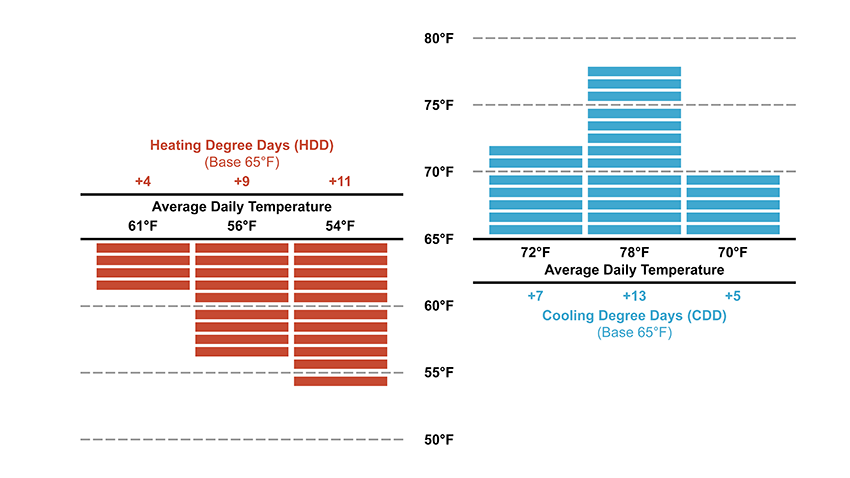
Consider the following example (Figure 1). If the base temperature is 65F and the average daily temperature is 61F, then 4 heating degree days would be recorded for that day. If the next day, the average temperature drops to 56F, then 9 heating degree days would be recorded. The total heating degree days for a given location is the summation of all heating degree days recorded over the course of a year.

Similarly, during the cooling season the average daily temperatures will be above the base temperature and thus cooling degree days would be recorded and the total cooling degree days may be determined.

Figure 1: Heating degree days (HDD) and cooling degree days (CDD) are determined daily based on the average ambient temperature relative to an established base temperature.
Illustration courtesy of Daniel Overbey.


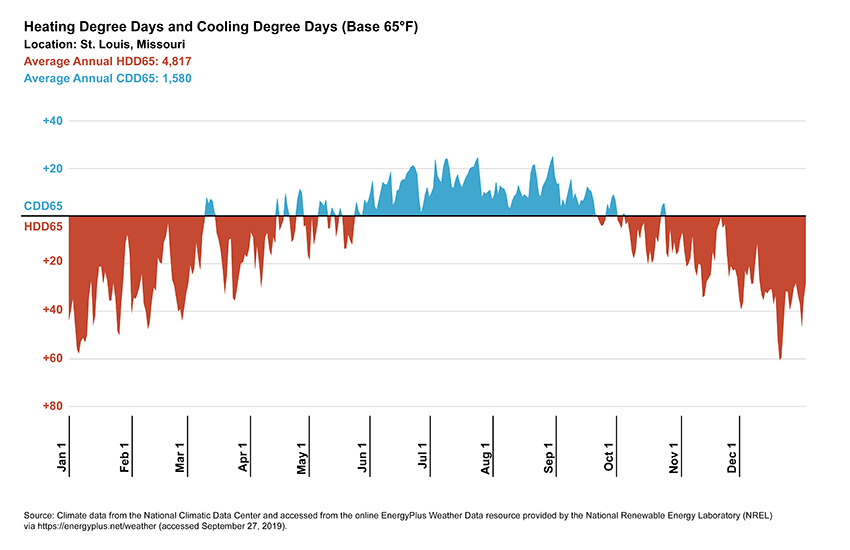
Over the course of a year, the totality of HDD and CDD provides a useful metric to gauge the heating and cooling energy demand for a given location. Consider the following example (Figure 2) in which the average ambient temperature of St. Louis, Mo., is measured against a consistent base temperature of 65F. The average annual HDD65 of 4,817 is much greater than the average annual CDD65 of 1,580 and puts into perspective the city's dominant heating requirement for buildings with such seasonal base temperatures.

Figure 2: Average heating degree days (HDD65) and cooling degree days (CDD65) for St. Louis, Mo.
Illustration courtesy of Daniel Overbey.

 
KEYWORDS: cooling HVAC

Share This Story

Overbey   head shot 2020 3

Daniel Overbey, AIA, NCARB, LEED Fellow (LEED AP BD+C, ID+C, O+M), WELL AP is an Assistant Professor of Architecture at Ball State University and the Director of Sustainability for Browning Day in Indianapolis, Ind. His work focuses on high-performance building design and construction, environmental systems research, green building certification services, energy/life-cycle assessment modeling, and resilient design. He can be reached at djoverbey@bsu.edu.

Recent Comments

These are actually very helpful tips. It is...

This is the most beneficial blog for all...

This blog is a great resource for anyone...

Thank you for sharing this important information. I...

This is a very interesting subject of the...

Manage My Account
  • Sign up for the Newsletter
  • Online Registration
  • Manage My Preferences
  • Registration Customer Service

More Videos

Sponsored Content

Sponsored Content is a special paid section where industry companies provide high quality, objective, non-commercial content around topics of interest to the Building Enclosure audience. All Sponsored Content is supplied by the advertising company and any opinions expressed in this article are those of the author and not necessarily reflect the views of Building Enclosure or its parent company, BNP Media. Interested in participating in our Sponsored Content section? Contact your local rep!

close
  • HITT Construction headquarters
    Sponsored byBuilding Composites® LLC

    Pushing the Envelope

  • 2 construction workers and a DEXcell panel
    Sponsored byDEXcell Roof Boards

    Designing Low-Slope Roofs for Resilience

  • Bell Bank headquarters in Fargo, North Dakota
    Sponsored bySto Corp.

    Drained and Back-Ventilated Rainscreens vs Pressurized-Equalized Rainscreens

Popular Stories

Open vs. closed cell foam in an attic

Open-Cell vs. Closed-Cell Spray Foam

graphic shows white arrows pointing to the right on a light green background

A Breakdown of Air Leakage Testing in LEED v5 BD+C

graphic shows a building destoryed by tornados with information on the amount of torandos in 2026 in the US

Record-Breaking Tornado Activity in Illinois Signals New Challenges for Architects

Building Enclosure Newsletter

BE Poll

Events

April 9, 2026

Strategies for High-Performance Below-Grade Waterproofing

Credits: 1 AIA LU/HSW ; 1 IIBEC CEH; 0.1 IACET CEU

On-Demand Designing a high-performance building enclosure requires more than just surface-level protection; it demands a rigorous, performance-based mastery of below-grade water and gas mitigation. This discussion will provide an expert-level analysis of below-grade waterproofing within the comprehensive framework of the high-performance building enclosure.

April 28, 2026

Roof Design Considerations That Prevent Installation Failures and Change Orders

Credit: 1 AIA LU/HSW; 1 IIBEC CEH; 0.1 ICC CEU

On-Demand This course provides visual examples of actual field conditions. Some good, some not so good; along with design suggestions that can cut installation costs and reduce construction change orders. Upon completion of this course, you will have a better understanding of the requirements the roofing contractor must meet to provide the specified roofing system warranty, and long-term value to the owner.

View All Submit An Event

Products

Plaster and Drywall Assemblies Manual

Plaster and Drywall Assemblies Manual

This is a comprehensive manual that goes beyond codes and standards, providing expert guidance in design, detailing, material selection and troubleshooting for plaster and drywall.

See More Products
×

Enhance your expertise with unparalleled insights.

Join thousands of building professionals today. Shouldn’t you know what they know?

SUBSCRIBE TODAY!
  • RESOURCES
    • Advertise
    • Contact Us
    • Store
    • Want More
  • SIGN UP TODAY
    • Create Account
    • Newsletter
    • Customer Service
    • Manage Preferences
  • SERVICES
    • Marketing Services
    • Reprints
    • Market Research
    • List Rental
    • Survey/Respondent Access
  • STAY CONNECTED
    • LinkedIn
    • Facebook
    • Instagram
    • YouTube
    • X
  • PRIVACY
    • PRIVACY POLICY
    • TERMS & CONDITIONS
    • DO NOT SELL MY PERSONAL INFORMATION
    • PRIVACY REQUEST
    • ACCESSIBILITY

Copyright ©2026. All Rights Reserved BNP Media, Inc. and BNP Media II, LLC.

Design, CMS, Hosting & Web Development :: ePublishing