Building Enclosure logo
search
cart
facebook twitter linkedin youtube instagram Spotify Podcasts Apple Podcasts Spotify Podcasts Apple Podcasts
  • Sign In
  • Create Account
  • Sign Out
  • My Account
Building Enclosure logo
  • NEWS
    • Breaking News
  • SECTIONS
    • Columns
    • Project Profiles
    • Trade Shows
    • Sponsor Insights
  • SYSTEM DESIGNS
    • Low-Slope Roofs
    • Pitched Roofs
    • Metal Roofing Materials
    • Waterproofing
    • Sustainability
    • Insulation
    • Exterior Claddings
    • Wall Systems
    • Building Envelope
  • BLOG
    • The BE Blog
  • MEDIA
    • Podcasts
    • Webinars
    • Quiz
    • Videos
    • Polls
    • Interactive Spotlights
    • Newsletter
    • Photo Galleries
  • DIRECTORIES
    • Directory: Blue Book
    • Directory: Roofing Resource
  • PRODUCTS
  • TECHNICAL
    • Codes
      • Waterproofing
      • Roofing
    • Details
      • Waterproofing
      • Roofing
  • CONTINUING ED
  • ABOUT
    • Advertise
      • Editorial Calendar
    • Contact
    • eMag Archive Issues
  • SIGN UP!

The Basic Forms of Heat Transfer
By Daniel Overbey
heat transfer
September 6, 2019

Heat always flows from substances of a warmer temperature to substances of a cooler temperature. Heat (thermal energy) will be exchanged in an environment until a common temperature (equilibrium) is achieved. This equalizing of temperature in an environment is caused by a combination of three basic types of heat transfer: conduction, radiation and convection.


Conduction

Conduction is the transfer of vibrating energy between adjacent molecule (Figure 1). The transfer is always from the warmer region (i.e., faster vibration) to the cooler region (i.e., slower vibration). Conductive heat transfer can happen in any direction and is independent of gravity.

If a person place the palm of a hand flatly upon a surface, that surface will feel relatively warmer or cooler. Such a sensation is indicative of conductive heat transfer. A familiar demonstration of conduction is holding a mug filled with hot coffee. The hot coffee causes the molecules of the mug to vibrate more rapidly. Heat, therefore, is transmitted and soon thereafter enters the hand holding the mug. The faster (warmer) molecules will continue to transfer heat to the mug and hand until equilibrium is achieved.

How readily a substance conducts heat depends on its molecular structure. Typically, denser materials (e.g., concrete or steel) will conduct heat more readily than less dense materials (e.g., wood or mineral wool). Keep in mind that conduction depends on the transfer of vibrating energy between adjacent molecules. No molecules, no conduction. This is precisely why a near-vacuum space (such as the air space in an insulated glass unit) is effective at reducing heat transfer.

Figure 1: Heat transfer by conduction.

Illustration courtesy of Daniel Overbey. Adapted from Moore, 1993.


Radiation

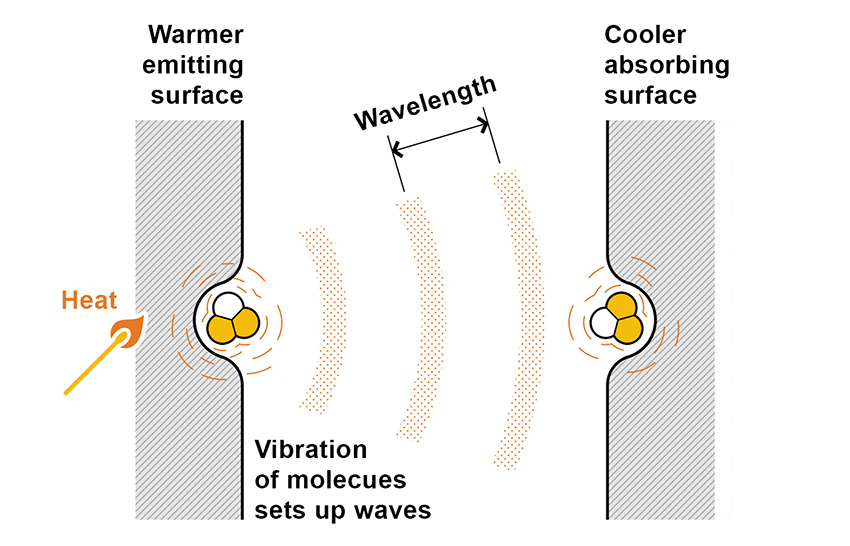
Radiation is the transfer of molecular vibrating energy (heat) by electromagnetic waves (Figure 2). As the molecules along the surface of a substance vibrate, electromagnetic waves (radiation) travel away from the surface at the speed of light. These waves travel until they strike a surface and are absorbed. The molecules on the receiving surface absorb some of the radiant energy and converts it into heat.

All substances radiate energy in all directions as a function of the absolute surface temperature. This means that even a cool surface will give off radiation at the same time that it is absorbing radiation. The net radiant energy transfer is from the warmer surface to the cooler surface.

Figure 2: Radiant energy transfer between two surface molecules.

Illustration courtesy of Daniel Overbey. Adapted from Moore, 1993.


Convection

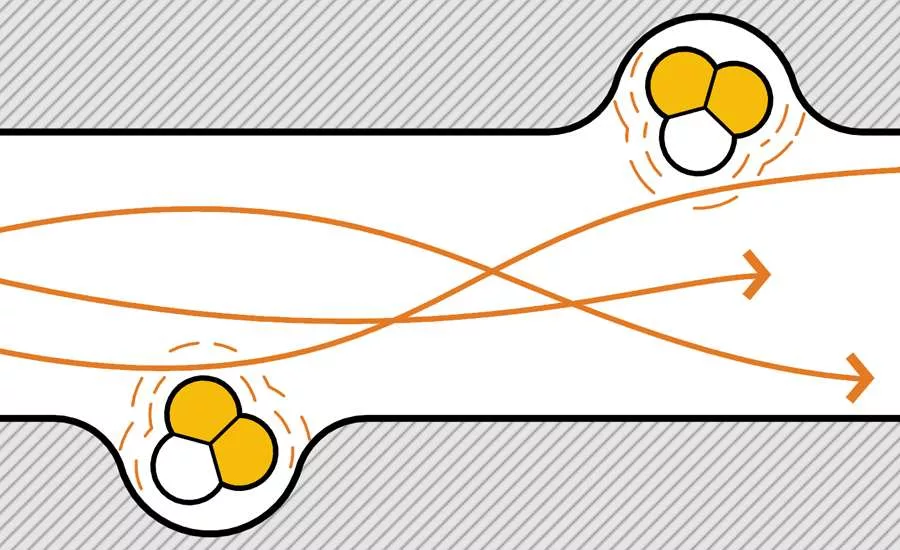
As a substance is heated, its molecules vibrate increasingly faster. Generally, in response to this increase in activity, the molecules separate themselves more and more. The additional space between the molecules results in an expansion of the substance. This in turn causes solids and liquids to increase in volume. It also causes fluids (liquids and gases) become less dense and, therefore, more buoyant than adjacent cooler fluids. Convection is the transfer of heat via a moving fluid medium (Figure 3).

Technically, convection is a form of both radiation and conduction in combination with the movement of the fluid as more dense (cooler) fluid is weighed down by gravity; but for purposes of understanding heat transfer as related to the built environment, it is useful to consider convection as a separate mode of heat transfer.

Side note: The phenomenon of warmer fluids being more buoyant explains how a hot air balloon works. However, it has also "given rise" (sorry) to the oversimplified assertion that heat rises. Technically, heat does not rise.

Figure 3: Heat transfer from location "A" to location "B" by convection.

Illustration courtesy of Daniel Overbey. Adapted from Moore, 1993.


But wait, there's more!

These is actually a fourth form of heat transfer: phase change. It takes energy to convert a solid into a liquid or a liquid into a gas. However, the energy inputs required for phase change to occur are not able to be perceived as a change in sensible heat (i.e., increasing/decreasing molecular vibration). Rather, this latent heat is embodied by the phase change itself.


Reference:

Moore, Fuller, 1993, Environmental Control Systems: Heating Cooling Lighting. McGraw-Hill, Inc., pp. 13-22.

KEYWORDS: energy efficiency heat mitigation

Share This Story

Overbey   head shot 2020 3

Daniel Overbey, AIA, NCARB, LEED Fellow (LEED AP BD+C, ID+C, O+M), WELL AP is an Assistant Professor of Architecture at Ball State University and the Director of Sustainability for Browning Day in Indianapolis, Ind. His work focuses on high-performance building design and construction, environmental systems research, green building certification services, energy/life-cycle assessment modeling, and resilient design. He can be reached at djoverbey@bsu.edu.

Recent Comments

These are actually very helpful tips. It is...

This is the most beneficial blog for all...

This blog is a great resource for anyone...

Thank you for sharing this important information. I...

This is a very interesting subject of the...

Manage My Account
  • Sign up for the Newsletter
  • Online Registration
  • Manage My Preferences
  • Registration Customer Service

More Videos

Sponsored Content

Sponsored Content is a special paid section where industry companies provide high quality, objective, non-commercial content around topics of interest to the Building Enclosure audience. All Sponsored Content is supplied by the advertising company and any opinions expressed in this article are those of the author and not necessarily reflect the views of Building Enclosure or its parent company, BNP Media. Interested in participating in our Sponsored Content section? Contact your local rep!

close
  • 2 construction workers and a DEXcell panel
    Sponsored byDEXcell Roof Boards

    Designing Low-Slope Roofs for Resilience

  • Bell Bank headquarters in Fargo, North Dakota
    Sponsored bySto Corp.

    Drained and Back-Ventilated Rainscreens vs Pressurized-Equalized Rainscreens

  • A construction worker using DEXcell roof boards
    Sponsored byDEXcell Roof Boards

    The Hidden Strength of Low-Slope Roof Systems: Why Roof Cover Boards Matter

Popular Stories

construction industry workers in hard hats stand around a city scape

Construction Industry Revolts Over New CSI Licensing Plan

Canalino Elementary School and Canalino Family School exterior

Daylighting Design to Support Rapidly Growing Trend in Modular Building Construction

construction workers on a roof, plane flies in background

Why Specifications Are Becoming the Next Critical Layer of Construction Compliance

Building Enclosure Newsletter

BE Poll

Events

June 17, 2025

Addressing Condensation in Low-Slope Roof Assemblies

Credits: 1 AIA LU/HSW; 0.1 ICC CEU; 1 IIBEC CEH; 0.1 IACET CEU

On Demand In modern roofing systems, vapor retarders and air barriers do more than just minimize air leakage—they’re essential to maximizing performance and longevity. This engaging course dives into the next generation of moisture control: permeable vapor retarders and air barriers. Discover how these cutting-edge technologies are transforming low-slope roofing assemblies by improving energy efficiency, managing moisture, and boosting wind uplift resistance.

April 9, 2026

Strategies for High-Performance Below-Grade Waterproofing

Credits: 1 AIA LU/HSW ; 1 IIBEC CEH; 0.1 IACET CEU

On-Demand Designing a high-performance building enclosure requires more than just surface-level protection; it demands a rigorous, performance-based mastery of below-grade water and gas mitigation. This discussion will provide an expert-level analysis of below-grade waterproofing within the comprehensive framework of the high-performance building enclosure.

View All Submit An Event

Products

Plaster and Drywall Assemblies Manual

Plaster and Drywall Assemblies Manual

This is a comprehensive manual that goes beyond codes and standards, providing expert guidance in design, detailing, material selection and troubleshooting for plaster and drywall.

See More Products
×

Enhance your expertise with unparalleled insights.

Join thousands of building professionals today. Shouldn’t you know what they know?

SUBSCRIBE TODAY!
  • RESOURCES
    • Advertise
    • Contact Us
    • Store
    • Want More
  • SIGN UP TODAY
    • Create Account
    • Newsletter
    • Customer Service
    • Manage Preferences
  • SERVICES
    • Marketing Services
    • Reprints
    • Market Research
    • List Rental
    • Survey/Respondent Access
  • STAY CONNECTED
    • LinkedIn
    • Facebook
    • Instagram
    • YouTube
    • X
  • PRIVACY
    • PRIVACY POLICY
    • TERMS & CONDITIONS
    • DO NOT SELL MY PERSONAL INFORMATION
    • PRIVACY REQUEST
    • ACCESSIBILITY

Copyright ©2026. All Rights Reserved BNP Media, Inc. and BNP Media II, LLC.

Design, CMS, Hosting & Web Development :: ePublishing