Building Enclosure logo
search
cart
facebook twitter linkedin youtube instagram Spotify Podcasts Apple Podcasts Spotify Podcasts Apple Podcasts
  • Sign In
  • Create Account
  • Sign Out
  • My Account
Building Enclosure logo
  • NEWS
    • Breaking News
  • SECTIONS
    • Columns
    • Project Profiles
    • Trade Shows
    • Sponsor Insights
  • SYSTEM DESIGNS
    • Low-Slope Roofs
    • Pitched Roofs
    • Metal Roofing Materials
    • Waterproofing
    • Sustainability
    • Insulation
    • Exterior Claddings
    • Wall Systems
    • Building Envelope
  • BLOG
    • The BE Blog
  • MEDIA
    • Podcasts
    • Webinars
    • Quiz
    • Videos
    • Polls
    • Interactive Spotlights
    • Newsletter
    • Photo Galleries
  • DIRECTORIES
    • Directory: Blue Book
    • Directory: Roofing Resource
  • PRODUCTS
  • TECHNICAL
    • Codes
      • Waterproofing
      • Roofing
    • Details
      • Waterproofing
      • Roofing
  • CONTINUING ED
  • ABOUT
    • Advertise
      • Editorial Calendar
    • Contact
    • eMag Archive Issues
  • SIGN UP!

New LEED v4 Requirements Shift Responsibility to End-User
By Javier Esteban
Student Housing Shifting Environmental
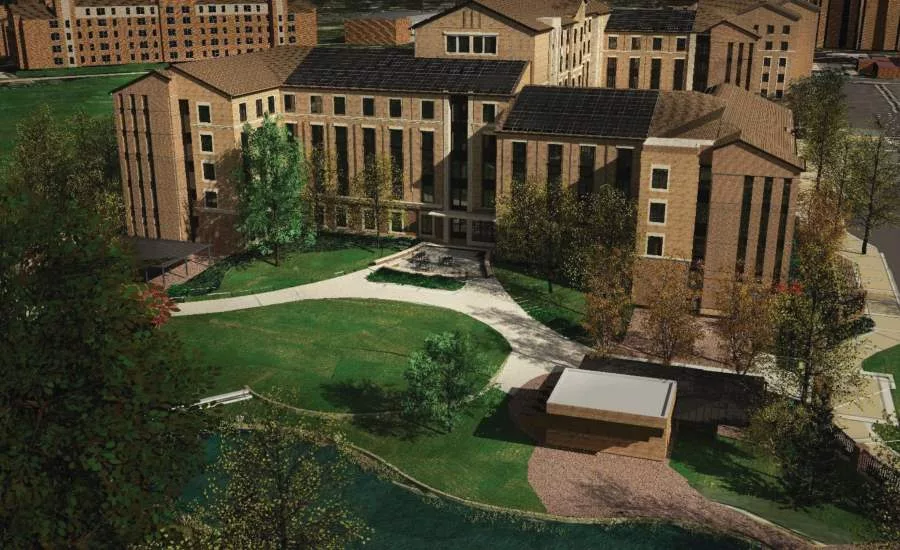
Rooftop solar panels will help increase energy efficiency at the University of Colorado Boulder’s newest residence hall, Williams Village East, designed by KWK Architects for LEED Platinum certification. Construction of Williams Village East is expected to be completed by fall 2019.
February 6, 2019

Many universities across the country are striving to design new residence halls based on the Leadership in Energy and Environmental Design (LEED) standards established by the U.S. Green Building Council (USGBC). The latest version of these standards, LEED version 4 (LEED v4), officially launched in November 2013, though projects were still able to seek certification under the previous version, LEED v2009, through October 2016.

Under the new LEED v4 requirements, some of the responsibility for achieving certification shifts from the design and construction process to the end-user and life cycle of the building. This change is requiring new training and a shift in the behaviors of students, residence life staff, maintenance, and housekeeping staff, according to the student housing design experts at KWK Architects.

This is a new challenge where everyday student behaviors can have a quantifiable impact on the immediate environment. LEED version 4 places a major emphasis on sustainability education and building usage for the next generation of residence halls.

There are four major areas where the new LEED v4 has made significant modifications:

  • Materials: The new requirements are designed to better understand the composition of the materials being used and their manufacturing and assembly process. Creating a ‘healthy’ building has become a major focus by awarding certification points for selecting materials that are sustainably sourced and focused on end-user/occupant health.
  • Performance: There is an increased focus on the performance of the building, operations and maintenance during the life cycle of the building, which requires an increase in metering and benchmarking.
  • Energy Consumption: The new version places a greater emphasis on smart grid usage and optimizing the energy consumption of the building during peak demand times to reduce usage spikes.
  • Water Consumption: LEED v4 takes a more comprehensive approach to better understanding overall water consumption of the building, not only from the design and construction point of view, but also from the operations stand point, with an emphasis on “efficiency first.”

Under LEED v4, the performance and energy and water consumption of a residence hall is directly tied to student behaviors. For example, encouraging students in Florida to set their room temperatures to 78 degrees and adding a fan will save up to 10 percent on cooling temperature and the air movement will alleviate the sense of heat. The moisture removed from the air in order to keep the proper relative humidity inside the building can be easily reused for irrigation, the cooling tower, or greywater usage.

Specific student behaviors related to sustainability can be altered through design or influenced by Resident Advisors (RA) and the university as a whole. The new LEED v4 regulations, according to Esteban, require the university’s full commitment to the LEED process.

At 201 Reserve at the University of Wisconsin Stevens Point, a central ‘recyclables only’ chute was included on every floor to encourage students to recycle. At other universities, RA communities may have a competition for a pizza night to see who can reduce their energy usage the most. 

Over the years, we have observed the trends of institutions and their full commitment to the LEED process, and the use of LEED as a guideline to set the tone for the general quality of the building. We have identified through our research which student behaviors are successful in reducing energy usage, and which ones fall flat. Listening to student input, encouraging behaviors that promote sustainability, and being committed to the entire LEED process will achieve the greatest results for universities under the LEED v4 guidelines.

KEYWORDS: environmental impacts LEED

Share This Story

Javier Esteban is a Principal at KWK Architects.

Recent Comments

These are actually very helpful tips. It is...

This is the most beneficial blog for all...

This blog is a great resource for anyone...

Thank you for sharing this important information. I...

This is a very interesting subject of the...

Manage My Account
  • Sign up for the Newsletter
  • Online Registration
  • Manage My Preferences
  • Registration Customer Service

More Videos

Sponsored Content

Sponsored Content is a special paid section where industry companies provide high quality, objective, non-commercial content around topics of interest to the Building Enclosure audience. All Sponsored Content is supplied by the advertising company and any opinions expressed in this article are those of the author and not necessarily reflect the views of Building Enclosure or its parent company, BNP Media. Interested in participating in our Sponsored Content section? Contact your local rep!

close
  • 2 construction workers and a DEXcell panel
    Sponsored byDEXcell Roof Boards

    Designing Low-Slope Roofs for Resilience

  • Bell Bank headquarters in Fargo, North Dakota
    Sponsored bySto Corp.

    Drained and Back-Ventilated Rainscreens vs Pressurized-Equalized Rainscreens

  • A construction worker using DEXcell roof boards
    Sponsored byDEXcell Roof Boards

    The Hidden Strength of Low-Slope Roof Systems: Why Roof Cover Boards Matter

Popular Stories

a man wearing a mask installs insulation into a wall system

Quiet Rooms and Healthier Air: A Second Look at What Goes Inside the Wall Cavity

Canalino Elementary School and Canalino Family School exterior

Daylighting Design to Support Rapidly Growing Trend in Modular Building Construction

construction workers on a roof, plane flies in background

Why Specifications Are Becoming the Next Critical Layer of Construction Compliance

Building Enclosure Newsletter

BE Poll

Events

June 17, 2025

Addressing Condensation in Low-Slope Roof Assemblies

Credits: 1 AIA LU/HSW; 0.1 ICC CEU; 1 IIBEC CEH; 0.1 IACET CEU

On Demand In modern roofing systems, vapor retarders and air barriers do more than just minimize air leakage—they’re essential to maximizing performance and longevity. This engaging course dives into the next generation of moisture control: permeable vapor retarders and air barriers. Discover how these cutting-edge technologies are transforming low-slope roofing assemblies by improving energy efficiency, managing moisture, and boosting wind uplift resistance.

April 9, 2026

Strategies for High-Performance Below-Grade Waterproofing

Credits: 1 AIA LU/HSW ; 1 IIBEC CEH; 0.1 IACET CEU

On-Demand Designing a high-performance building enclosure requires more than just surface-level protection; it demands a rigorous, performance-based mastery of below-grade water and gas mitigation. This discussion will provide an expert-level analysis of below-grade waterproofing within the comprehensive framework of the high-performance building enclosure.

View All Submit An Event

Products

Plaster and Drywall Assemblies Manual

Plaster and Drywall Assemblies Manual

This is a comprehensive manual that goes beyond codes and standards, providing expert guidance in design, detailing, material selection and troubleshooting for plaster and drywall.

See More Products
×

Enhance your expertise with unparalleled insights.

Join thousands of building professionals today. Shouldn’t you know what they know?

SUBSCRIBE TODAY!
  • RESOURCES
    • Advertise
    • Contact Us
    • Store
    • Want More
  • SIGN UP TODAY
    • Create Account
    • Newsletter
    • Customer Service
    • Manage Preferences
  • SERVICES
    • Marketing Services
    • Reprints
    • Market Research
    • List Rental
    • Survey/Respondent Access
  • STAY CONNECTED
    • LinkedIn
    • Facebook
    • Instagram
    • YouTube
    • X
  • PRIVACY
    • PRIVACY POLICY
    • TERMS & CONDITIONS
    • DO NOT SELL MY PERSONAL INFORMATION
    • PRIVACY REQUEST
    • ACCESSIBILITY

Copyright ©2026. All Rights Reserved BNP Media, Inc. and BNP Media II, LLC.

Design, CMS, Hosting & Web Development :: ePublishing