Building Enclosure logo
search
cart
facebook twitter linkedin youtube instagram Spotify Podcasts Apple Podcasts Spotify Podcasts Apple Podcasts
  • Sign In
  • Create Account
  • Sign Out
  • My Account
Building Enclosure logo
  • NEWS
    • Breaking News
  • SECTIONS
    • Columns
    • Project Profiles
    • Trade Shows
    • Sponsor Insights
  • SYSTEM DESIGNS
    • Low-Slope Roofs
    • Pitched Roofs
    • Metal Roofing Materials
    • Waterproofing
    • Sustainability
    • Insulation
    • Exterior Claddings
    • Wall Systems
    • Building Envelope
  • BLOG
    • The BE Blog
  • MEDIA
    • Podcasts
    • Webinars
    • Quiz
    • Videos
    • Polls
    • Interactive Spotlights
    • Newsletter
    • Photo Galleries
  • DIRECTORIES
    • Directory: Blue Book
    • Directory: Roofing Resource
  • PRODUCTS
  • TECHNICAL
    • Codes
      • Waterproofing
      • Roofing
    • Details
      • Waterproofing
      • Roofing
  • CONTINUING ED
  • ABOUT
    • Advertise
      • Editorial Calendar
    • Contact
    • eMag Archive Issues
  • SIGN UP!

Thermal Dynamics: Visualizing Sensible Versus Latent Heat
By Daniel Overbey
Latent Heat
March 12, 2018

It's the first law of thermodynamics. The Law of Conservation of Energy states that energy can neither be created nor destroyed; energy can only be transferred or changed from one form to another.

This is the foundation of phase change in the physical environment. Molecular activity requires energy. The activity does not just magically happen.


Phase Change

When a material changes its state or phase (e.g., going from a solid to a liquid or a liquid to a gas) a large amount of heat must be absorbed (or released) in order to make the transition. This is a type of heat transfer that is distinct from conduction, convection, and radiation.

The phase change of water is a common occurrence in the built environment. Therefore, it will be referenced here as an example. 


Dry-Bulb Temperature

If the air in a room were completely dry, devoid of any moisture whatsoever, then its thermal properties could be described using a conventional thermometer to measure the dry-bulb temperature.

However, the terrestrial environments, completely dry air conditions virtually never exist. There is always some amount of moisture present in the air in the form of water vapor. This vapor has a significant impact on thermal comfort. 


Sensible Heat vs Latent Heat

Sensible heat is the “dry” heat in the air and relates directly to the dry-bulb temperature. This is the heat that one can "sense" with a conventional thermometer, as the term suggests. For example, heat added to an air mass from the glowing coil of an electric cooking range is an example of sensible heat.

Latent heat is the “wet” heat captured in the air as water undergoes phase change from liquid to vapor via evaporation or boiling. For example, water vapor added to an air mass from a tea kettle boiling on the stove is an example of latent heat. The process is also reversible as latent heat is released when moisture is condensed out of the air mass.

Enthalpy is the sum of the sensible and latent heat in a given air-vapor mix. It is sometimes referred to as the total heat of the air. The units for sensible heat, latent heat, and enthalpy are the same:

BTU/lb of dry air.

Unlike sensible heat, latent heat is not directly "sensed" by a conventional thermometer with a dry-bulb. Latent heat can be borne out by comparing the dry-bulb temperature with the wet-bulb temperature.


Wet-Bulb Temperature 

One way to measure the effect of moisture present in an air-vapor mixture is via wet-bulb temperature. It is measured using a thermometer with a wetted bulb moving rapidly through the air in order to facilitate evaporation. If the air is relatively dry, then evaporation will occur rapidly, resulting in a cooling of the thermometer bulb. As a result of the evaporative cooling, the measured temperature will be substantially lower than the dry-bulb temperature.

The difference between the corresponding dry-bulb and wet-bulb temperatures is termed the wet-bulb depression. If the air is heavily moisture-laden, evaporation will be minimal and the wet-bulb depression will be small. In completely saturated air, the wet-bulb temperature will equal the dry-bulb temperature. 


Visualizing Sensible and Latent Heat

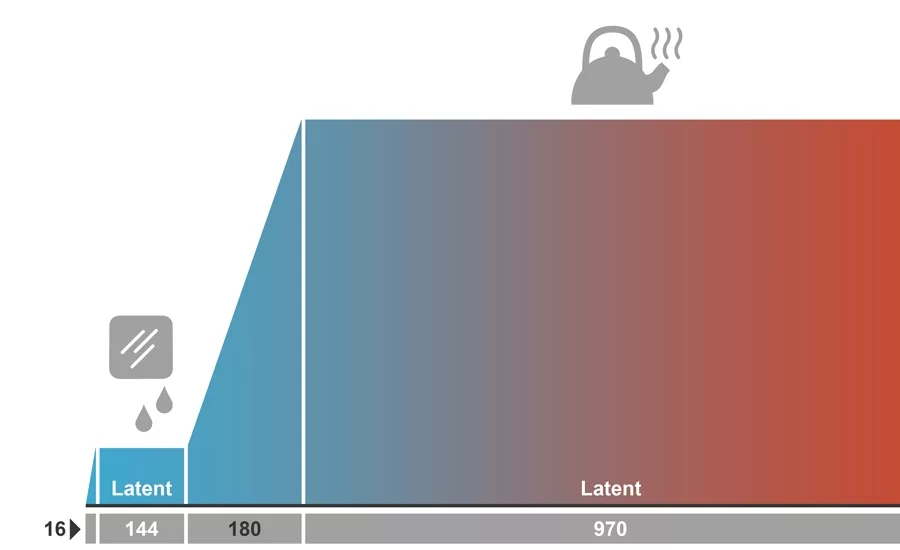
In order to visualize sensible and latent heat, let's consider the example of one pound of water (see figure below). First, let's cool it down to a 0 degrees Fahrenheit block of ice. The thermal energy required to heat the 0F block of ice up to 32F is 16 British Thermal Units (BTU; basically, the equivalent of one kitchen match of heat). This is sensible heat — the temperature of the ice was increased.

What happens to water at 32F? It achieves its melting point and will undergo a phase change from solid to liquid as additional thermal energy is provided. In order to fully change 32F ice to 32F water is 144 BTUs. The ice would take on all of that thermal energy and yet it would not increase in temperature one bit — that's latent heat.

In order to heat the pound of 32F water up to 212F, 180 BTUs will be required. But at 212F, we reach the boiling point of water and once again phase change will occur as additional thermal energy is taken on. However, converting water to vapor requires a tremendous amount of energy: 970 BTUs.

Once the water is completely evaporated, the vapor can take on additional energy inputs. Its sensible heat will continue to increase. The pressure of the water vapor will also increase as the additional thermal energy increases molecular activity.


Sensible and latent heat graphically depicted for a pound of water.

Illustration courtesy of Daniel Overbey. 

 
KEYWORDS: latent heat thermal barrier

Share This Story

Overbey   head shot 2020 3

Daniel Overbey, AIA, NCARB, LEED Fellow (LEED AP BD+C, ID+C, O+M), WELL AP is an Assistant Professor of Architecture at Ball State University and the Director of Sustainability for Browning Day in Indianapolis, Ind. His work focuses on high-performance building design and construction, environmental systems research, green building certification services, energy/life-cycle assessment modeling, and resilient design. He can be reached at djoverbey@bsu.edu.

Recent Comments

These are actually very helpful tips. It is...

This is the most beneficial blog for all...

This blog is a great resource for anyone...

Thank you for sharing this important information. I...

This is a very interesting subject of the...

Manage My Account
  • Sign up for the Newsletter
  • Online Registration
  • Manage My Preferences
  • Registration Customer Service

More Videos

Sponsored Content

Sponsored Content is a special paid section where industry companies provide high quality, objective, non-commercial content around topics of interest to the Building Enclosure audience. All Sponsored Content is supplied by the advertising company and any opinions expressed in this article are those of the author and not necessarily reflect the views of Building Enclosure or its parent company, BNP Media. Interested in participating in our Sponsored Content section? Contact your local rep!

close
  • HITT Construction headquarters
    Sponsored byBuilding Composites® LLC

    Pushing the Envelope

  • 2 construction workers and a DEXcell panel
    Sponsored byDEXcell Roof Boards

    Designing Low-Slope Roofs for Resilience

  • Bell Bank headquarters in Fargo, North Dakota
    Sponsored bySto Corp.

    Drained and Back-Ventilated Rainscreens vs Pressurized-Equalized Rainscreens

Popular Stories

graphic shows white arrows pointing to the right on a light green background

A Breakdown of Air Leakage Testing in LEED v5 BD+C

Open vs. closed cell foam in an attic

Open-Cell vs. Closed-Cell Spray Foam

skyscraper

NYC Tower Failure Offers Warning for Contractors

Building Enclosure Newsletter

BE Poll

Events

April 9, 2026

Strategies for High-Performance Below-Grade Waterproofing

Credits: 1 AIA LU/HSW ; 1 IIBEC CEH; 0.1 IACET CEU

On-Demand Designing a high-performance building enclosure requires more than just surface-level protection; it demands a rigorous, performance-based mastery of below-grade water and gas mitigation. This discussion will provide an expert-level analysis of below-grade waterproofing within the comprehensive framework of the high-performance building enclosure.

April 28, 2026

Roof Design Considerations That Prevent Installation Failures and Change Orders

Credit: 1 AIA LU/HSW; 1 IIBEC CEH; 0.1 ICC CEU

On-Demand This course provides visual examples of actual field conditions. Some good, some not so good; along with design suggestions that can cut installation costs and reduce construction change orders. Upon completion of this course, you will have a better understanding of the requirements the roofing contractor must meet to provide the specified roofing system warranty, and long-term value to the owner.

View All Submit An Event

Products

Plaster and Drywall Assemblies Manual

Plaster and Drywall Assemblies Manual

This is a comprehensive manual that goes beyond codes and standards, providing expert guidance in design, detailing, material selection and troubleshooting for plaster and drywall.

See More Products
×

Enhance your expertise with unparalleled insights.

Join thousands of building professionals today. Shouldn’t you know what they know?

SUBSCRIBE TODAY!
  • RESOURCES
    • Advertise
    • Contact Us
    • Store
    • Want More
  • SIGN UP TODAY
    • Create Account
    • Newsletter
    • Customer Service
    • Manage Preferences
  • SERVICES
    • Marketing Services
    • Reprints
    • Market Research
    • List Rental
    • Survey/Respondent Access
  • STAY CONNECTED
    • LinkedIn
    • Facebook
    • Instagram
    • YouTube
    • X
  • PRIVACY
    • PRIVACY POLICY
    • TERMS & CONDITIONS
    • DO NOT SELL MY PERSONAL INFORMATION
    • PRIVACY REQUEST
    • ACCESSIBILITY

Copyright ©2026. All Rights Reserved BNP Media, Inc. and BNP Media II, LLC.

Design, CMS, Hosting & Web Development :: ePublishing