Building Enclosure logo
search
cart
facebook twitter linkedin youtube instagram Spotify Podcasts Apple Podcasts Spotify Podcasts Apple Podcasts
  • Sign In
  • Create Account
  • Sign Out
  • My Account
Building Enclosure logo
  • NEWS
    • Breaking News
  • SECTIONS
    • Columns
    • Project Profiles
    • Trade Shows
    • Sponsor Insights
  • SYSTEM DESIGNS
    • Low-Slope Roofs
    • Pitched Roofs
    • Metal Roofing Materials
    • Waterproofing
    • Sustainability
    • Insulation
    • Exterior Claddings
    • Wall Systems
    • Building Envelope
  • BLOG
    • The BE Blog
  • MEDIA
    • Podcasts
    • Webinars
    • Quiz
    • Videos
    • Polls
    • Interactive Spotlights
    • Newsletter
    • Photo Galleries
  • DIRECTORIES
    • Directory: Blue Book
    • Directory: Roofing Resource
  • PRODUCTS
  • TECHNICAL
    • Codes
      • Waterproofing
      • Roofing
    • Details
      • Waterproofing
      • Roofing
  • CONTINUING ED
  • ABOUT
    • Advertise
      • Editorial Calendar
    • Contact
    • eMag Archive Issues
  • SIGN UP!

Leveraging Life Cycle Assessment in the Design Process
By Daniel Overbey
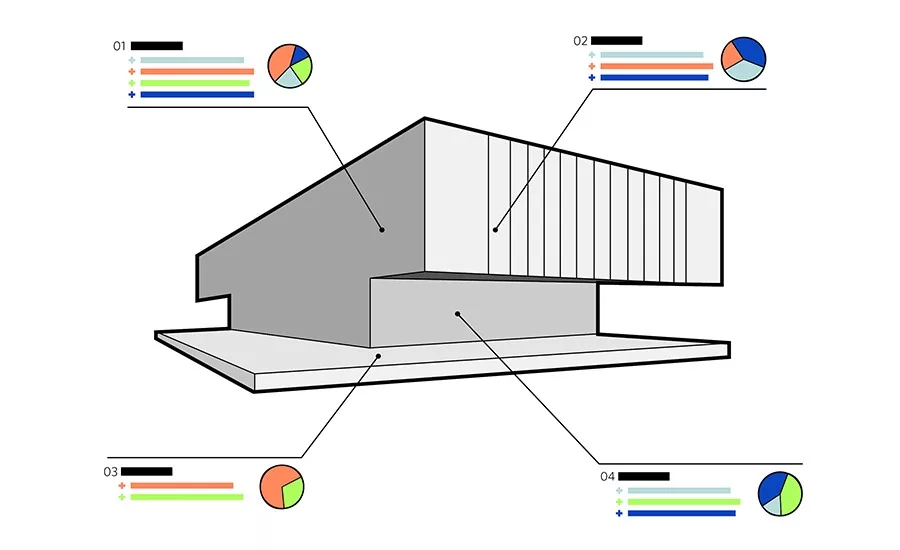
KT Innovations.
Illustration courtesy of KT Innovations.
October 11, 2017

While environmentally responsible design and sustainable building practices have become increasingly prevalent in the design and construction industry, decision-making for building products and materials have historically focused on single attributes such as regional manufacturing, recycled content, or consisting of renewable materials or certified wood.

It use to frustrate me that there was not an efficient way to make holistic decisions about building products and materials that incorporated a range of factors, much like we can do regarding building operational energy and water usage. Until relatively recently, the industry has lacked an easily-accessible platform for whole-building life cycle assessment (LCA) – a tool that could integrate into a design team’s workflow and not require esoteric knowledge.

This is starting to change. We are now at the cusp of being able to leverage design performance modeling to conduct environmental impact assessments on whole buildings, manufactured building products, and material assemblies. Thanks to an emerging marketplace of user-friendly analysis tools, architects, engineers, and contractors can now leverage in-depth LCA analyses to compare building materials that both minimize a project’s environmental impact and are more efficient, durable, and valuable to building design and construction. Additionally, because LCA can now be used to earn the LEEDv4 Building Life-Cycle Impact Reduction credit (via Option 4: Whole-Building Life-Cycle Assessment), it is increasingly being adopted and required by clients and project teams pursuing LEED certification.


There are a handful of platforms currently available. The two most popular are:

Tally 

A joint development project from KT Innovations, thinkstep, and Autodesk, Tally is the first LCA application that allows users to calculate the environmental impacts of a project's building material selections directly in an Autodesk Revit model. Because Tally is Revit-integrated, it integrates seamlessly into the workflow of a project team, making it uniquely positioned to generate data and provide feedback at every design phase.

Learn more at choosetally.com 


Athena Impact Estimator for Buildings

Developed by the Athena Sustainable Materials Institute, the Impact Estimator for Buildings allows users to quickly describe building assemblies through dialogue boxes that request simple information such as bay sizes and loads - then the software does the rest. It calculates a bill of materials and the associated environmental impacts. Users have flexibility to add materials as needed. Alternatively, users can import their own bill of materials from any CAD program.

Learn more at athenasmi.org


Both tools can be used to pursue the LEEDv4 Building Life-Cycle Impact Reduction credit.


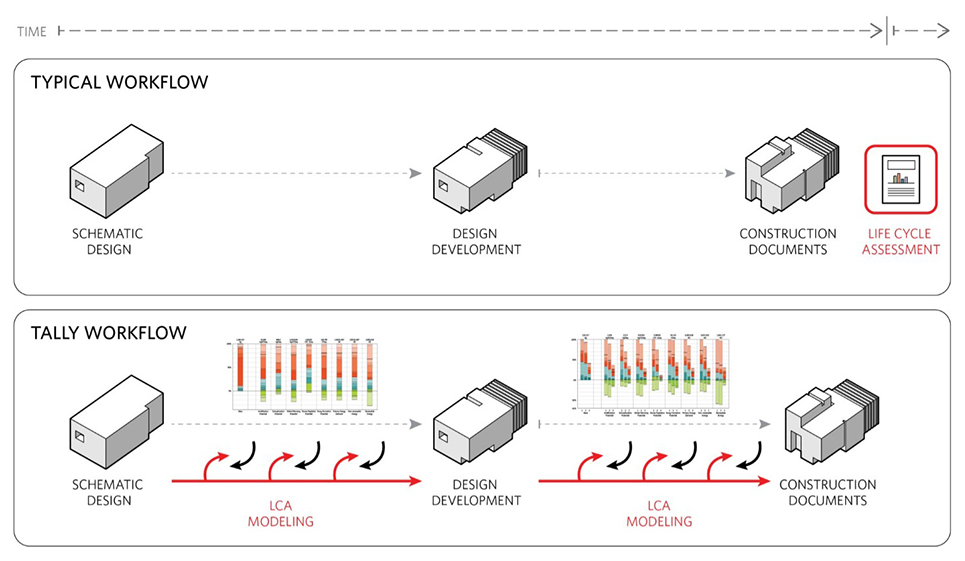
Using life cycle assessment (LCA) tools such as Tally, design teams can leverage iterative LCA modeling as decision-making tool throughout the design process.

Illustration courtesy of KT Innovations.


A New Kind of Design Performance Modeling

Like any design performance modeling tool, LCA analysis programs will require a learning curve – both in terms of software functionality as well as the technical content being utilized. Of course, these tools are only as reliable as their inputs. Ill-conceived inputs will yield unreliable results. The emerging whole-building LCA tools also support an integrative process, requiring input from multiple disciplines to ascertain specificity with regard to the nuance of the building structure and envelope.

In application, comparing design options in terms of environmental impacts may be a bit confounding. The units of measure may not be familiar to many designers. However, a deep level of understanding with regard to LCA is not essential. Relative comparisons of environmental impact categories from various design options will suffice for documenting improvements for, say, the aforementioned LEEDv4 credit.

This emerging marketplace of accessible LCA tools exemplify the next step in a more substantive dialog about whole-building life cycle impacts. It represents a real shift away from single attribute-based decision-making when it comes to environmentally responsible choices for building products and materials. These tools will only become more robust and they will eventually take on human health considerations and also account for additional impacts, such as on-site energy and water consumption directly attributed to construction.

Let’s boldly move forward to understand the life cycle impacts of our building projects and then improve them in a measurable way.


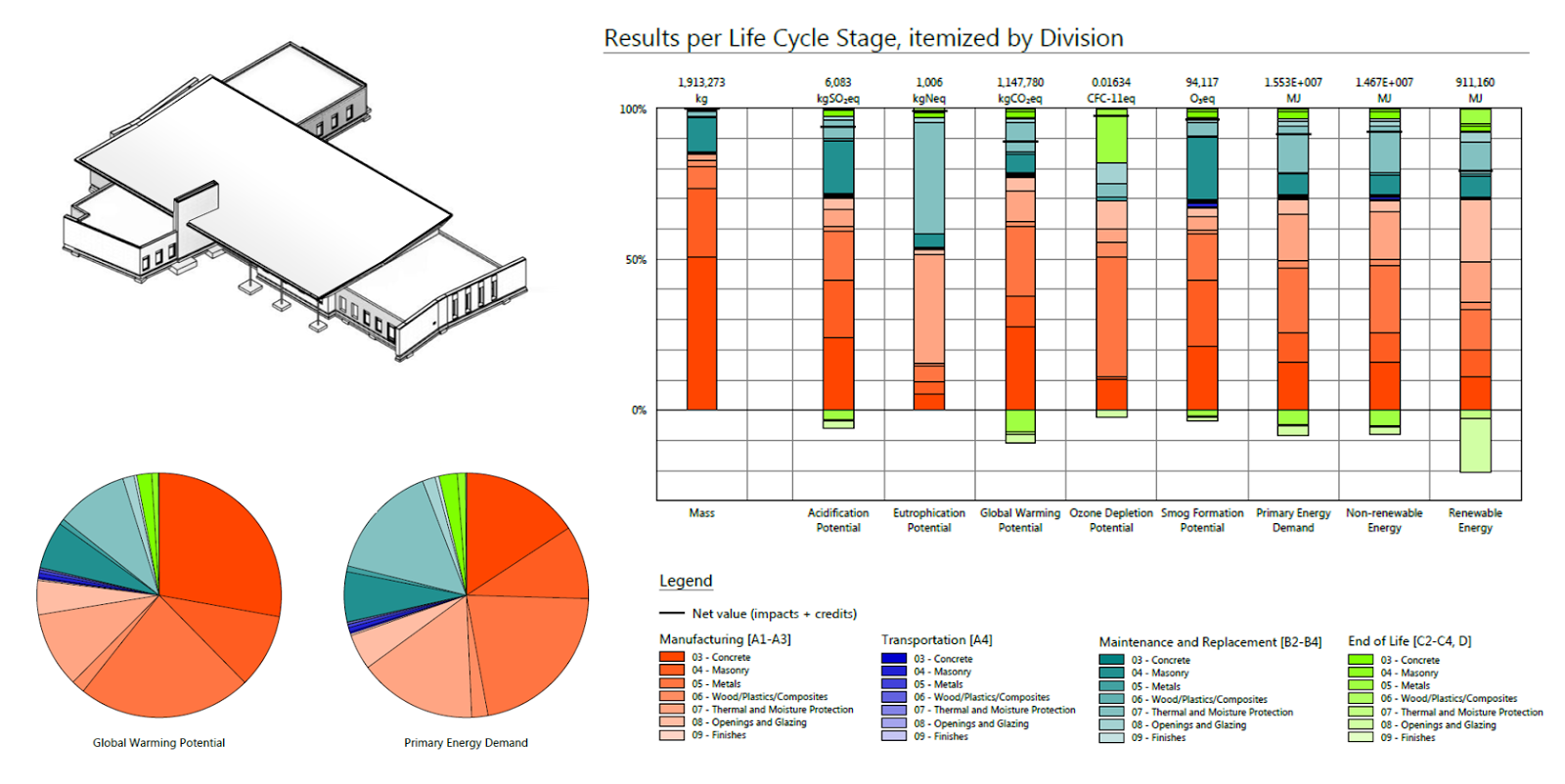
Excerpt from a whole-building life cycle assessment (LCA) study for a branch library in Indianapolis, Indiana, using the Tally plug-in for Revit developed by KT Innovations, thinkstep, and Autodesk.

Illustration provided by of Browning Day Mullins Dierdorf.

 
KEYWORDS: building design LEED life-cycle assessment

Share This Story

Overbey   head shot 2020 3

Daniel Overbey, AIA, NCARB, LEED Fellow (LEED AP BD+C, ID+C, O+M), WELL AP is an Assistant Professor of Architecture at Ball State University and the Director of Sustainability for Browning Day in Indianapolis, Ind. His work focuses on high-performance building design and construction, environmental systems research, green building certification services, energy/life-cycle assessment modeling, and resilient design. He can be reached at djoverbey@bsu.edu.

Recent Comments

These are actually very helpful tips. It is...

This is the most beneficial blog for all...

This blog is a great resource for anyone...

Thank you for sharing this important information. I...

This is a very interesting subject of the...

Manage My Account
  • Sign up for the Newsletter
  • Online Registration
  • Manage My Preferences
  • Registration Customer Service

More Videos

Sponsored Content

Sponsored Content is a special paid section where industry companies provide high quality, objective, non-commercial content around topics of interest to the Building Enclosure audience. All Sponsored Content is supplied by the advertising company and any opinions expressed in this article are those of the author and not necessarily reflect the views of Building Enclosure or its parent company, BNP Media. Interested in participating in our Sponsored Content section? Contact your local rep!

close
  • 2 construction workers and a DEXcell panel
    Sponsored byDEXcell Roof Boards

    Designing Low-Slope Roofs for Resilience

  • Bell Bank headquarters in Fargo, North Dakota
    Sponsored bySto Corp.

    Drained and Back-Ventilated Rainscreens vs Pressurized-Equalized Rainscreens

  • A construction worker using DEXcell roof boards
    Sponsored byDEXcell Roof Boards

    The Hidden Strength of Low-Slope Roof Systems: Why Roof Cover Boards Matter

Popular Stories

a man wearing a mask installs insulation into a wall system

Quiet Rooms and Healthier Air: A Second Look at What Goes Inside the Wall Cavity

Canalino Elementary School and Canalino Family School exterior

Daylighting Design to Support Rapidly Growing Trend in Modular Building Construction

construction workers on a roof, plane flies in background

Why Specifications Are Becoming the Next Critical Layer of Construction Compliance

Building Enclosure Newsletter

BE Poll

Events

June 17, 2025

Addressing Condensation in Low-Slope Roof Assemblies

Credits: 1 AIA LU/HSW; 0.1 ICC CEU; 1 IIBEC CEH; 0.1 IACET CEU

On Demand In modern roofing systems, vapor retarders and air barriers do more than just minimize air leakage—they’re essential to maximizing performance and longevity. This engaging course dives into the next generation of moisture control: permeable vapor retarders and air barriers. Discover how these cutting-edge technologies are transforming low-slope roofing assemblies by improving energy efficiency, managing moisture, and boosting wind uplift resistance.

April 9, 2026

Strategies for High-Performance Below-Grade Waterproofing

Credits: 1 AIA LU/HSW ; 1 IIBEC CEH; 0.1 IACET CEU

On-Demand Designing a high-performance building enclosure requires more than just surface-level protection; it demands a rigorous, performance-based mastery of below-grade water and gas mitigation. This discussion will provide an expert-level analysis of below-grade waterproofing within the comprehensive framework of the high-performance building enclosure.

View All Submit An Event

Products

Plaster and Drywall Assemblies Manual

Plaster and Drywall Assemblies Manual

This is a comprehensive manual that goes beyond codes and standards, providing expert guidance in design, detailing, material selection and troubleshooting for plaster and drywall.

See More Products
×

Enhance your expertise with unparalleled insights.

Join thousands of building professionals today. Shouldn’t you know what they know?

SUBSCRIBE TODAY!
  • RESOURCES
    • Advertise
    • Contact Us
    • Store
    • Want More
  • SIGN UP TODAY
    • Create Account
    • Newsletter
    • Customer Service
    • Manage Preferences
  • SERVICES
    • Marketing Services
    • Reprints
    • Market Research
    • List Rental
    • Survey/Respondent Access
  • STAY CONNECTED
    • LinkedIn
    • Facebook
    • Instagram
    • YouTube
    • X
  • PRIVACY
    • PRIVACY POLICY
    • TERMS & CONDITIONS
    • DO NOT SELL MY PERSONAL INFORMATION
    • PRIVACY REQUEST
    • ACCESSIBILITY

Copyright ©2026. All Rights Reserved BNP Media, Inc. and BNP Media II, LLC.

Design, CMS, Hosting & Web Development :: ePublishing