Building Enclosure logo
search
cart
facebook twitter linkedin youtube instagram Spotify Podcasts Apple Podcasts Spotify Podcasts Apple Podcasts
  • Sign In
  • Create Account
  • Sign Out
  • My Account
Building Enclosure logo
  • NEWS
    • Breaking News
  • SECTIONS
    • Columns
    • Project Profiles
    • Trade Shows
    • Sponsor Insights
  • SYSTEM DESIGNS
    • Low-Slope Roofs
    • Pitched Roofs
    • Metal Roofing Materials
    • Waterproofing
    • Sustainability
    • Insulation
    • Exterior Claddings
    • Wall Systems
    • Building Envelope
  • BLOG
    • The BE Blog
  • MEDIA
    • Podcasts
    • Webinars
    • Quiz
    • Videos
    • Polls
    • Interactive Spotlights
    • Newsletter
    • Photo Galleries
  • DIRECTORIES
    • Directory: Blue Book
    • Directory: Roofing Resource
  • PRODUCTS
  • TECHNICAL
    • Codes
      • Waterproofing
      • Roofing
    • Details
      • Waterproofing
      • Roofing
  • CONTINUING ED
  • ABOUT
    • Advertise
      • Editorial Calendar
    • Contact
    • eMag Archive Issues
  • SIGN UP!

Taking the Guess Work Out of Envelope Design

By Stacy Fitzgerald-Redd
Insulation Institute
August 24, 2017

Wall system design is increasingly challenging for builders and architects, as modern building practices have changed and codes have become much more stringent to meet energy efficiency requirements. Uncertainty about moisture risk associated with innovative envelope approaches can hinder adoption of new approaches and technologies.

A new beta version of a web-based tool, the Building Science Advisor (BSA), developed jointly by the U.S. Department of Energy (DOE) Energy Efficiency and Renewable Energy Office and officials at the Oak Ridge National Laboratory (ORNL), can provide guidance to building professionals on how to minimize moisture risks in low energy, high performance homes.

Developed with Builder Concerns in Mind

In developing the BSA tool, officials at DOE and ORNL were guided by research conducted from Home Innovation Research Labs on the top challenges builders expressed about energy efficient construction:

  • Moisture performance of energy efficient walls
  • Moisture performance of energy efficient attics
  • Understanding the impact of new code requirements on long-term performance
  • Proven durability of new products and materials

DOE and ORNL worked for about 2 years in consultation with experts in building science and researchers to develop the BSA – viewed as a scalable solution to get expert knowledge into the hands of all industry professionals. “The tool is designed to be a moisture management reference and learning tool for builders, architects, contractors and others in the build environment,” according to Simon Pallin, Ph.D, Research and Development Associate at ORNL.  “We know that new materials and new types of assemblies are increasingly used in residential building and that there’s a potential risk for moisture accumulation that can cause problems in the building envelope,” said Pallin. This new tool will allow building professionals to plug in a summary of the system design, such as sheathing, water/air barrier, air tightness level, etc. to predict the moisture durability performance of a wall system.

ORNL says this is the first application of an expert system for moisture management in buildings. “The Building Science Advisor is needed because building professionals don’t always have access to building scientists who can readily answer their questions about wall system design,” Pallin notes. Based on the input and knowledge of the researchers and building scientists who contributed to its development, the BSA will enable users to make informed decisions to minimize risks and confidently build homes that can reduce the energy use of a home by at least 60 percent.1 
Informing Envelope Best Practices

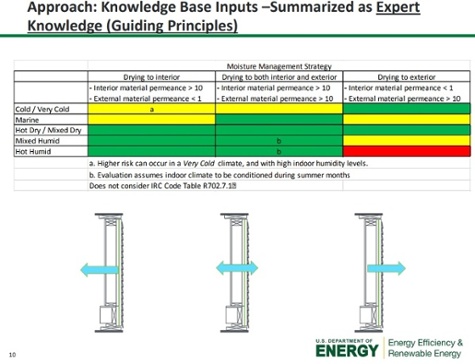
The BSA was developed with the guiding principles of optimum moisture management practices, which vary by climate zone (see chart at right). Hygrothermal simulation are used to identify the conditions under which assemblies would be most susceptible to moisture-related problems based on the materials used and the predicated moisture durability performance is assessed. Once the components of the assembly are entered into the tool, it produces guidance that addresses how to achieve the best moisture durability.

Pallin notes that the tool will be modified and enhanced as it’s used by building professionals. “The feedback from stakeholders who’ve tried the tool thus far has been positive it will continue to evolve and get better and better,” says Pallin. “This is an opportunity for builders to get expert judgement in order to have a level of confidence in the practicality and durability of wall system design.”


1. U.S. Department of Energy, Office of Energy Efficiency and Renewables, ORNL Presentation. https://energy.gov/sites/prod/files/2017/04/f34/2_1112_Jackson_031417-1400.pdf


For more on this and other great blog posts, visit The Insulation Institute's website.

KEYWORDS: building envelope design moisture

Share This Story

Stacy is the Director Marketing & Communications for North American Insulation Manufacturers Association (NAIMA).

Recent Comments

These are actually very helpful tips. It is...

This is the most beneficial blog for all...

This blog is a great resource for anyone...

Thank you for sharing this important information. I...

This is a very interesting subject of the...

Manage My Account
  • Sign up for the Newsletter
  • Online Registration
  • Manage My Preferences
  • Registration Customer Service

More Videos

Sponsored Content

Sponsored Content is a special paid section where industry companies provide high quality, objective, non-commercial content around topics of interest to the Building Enclosure audience. All Sponsored Content is supplied by the advertising company and any opinions expressed in this article are those of the author and not necessarily reflect the views of Building Enclosure or its parent company, BNP Media. Interested in participating in our Sponsored Content section? Contact your local rep!

close
  • 2 construction workers and a DEXcell panel
    Sponsored byDEXcell Roof Boards

    Designing Low-Slope Roofs for Resilience

  • Bell Bank headquarters in Fargo, North Dakota
    Sponsored bySto Corp.

    Drained and Back-Ventilated Rainscreens vs Pressurized-Equalized Rainscreens

  • A construction worker using DEXcell roof boards
    Sponsored byDEXcell Roof Boards

    The Hidden Strength of Low-Slope Roof Systems: Why Roof Cover Boards Matter

Popular Stories

construction industry workers in hard hats stand around a city scape

Construction Industry Revolts Over New CSI Licensing Plan

a man wearing a mask installs insulation into a wall system

Quiet Rooms and Healthier Air: A Second Look at What Goes Inside the Wall Cavity

Canalino Elementary School and Canalino Family School exterior

Daylighting Design to Support Rapidly Growing Trend in Modular Building Construction

Building Enclosure Newsletter

BE Poll

Events

June 17, 2025

Addressing Condensation in Low-Slope Roof Assemblies

Credits: 1 AIA LU/HSW; 0.1 ICC CEU; 1 IIBEC CEH; 0.1 IACET CEU

On Demand In modern roofing systems, vapor retarders and air barriers do more than just minimize air leakage—they’re essential to maximizing performance and longevity. This engaging course dives into the next generation of moisture control: permeable vapor retarders and air barriers. Discover how these cutting-edge technologies are transforming low-slope roofing assemblies by improving energy efficiency, managing moisture, and boosting wind uplift resistance.

April 9, 2026

Strategies for High-Performance Below-Grade Waterproofing

Credits: 1 AIA LU/HSW ; 1 IIBEC CEH; 0.1 IACET CEU

On-Demand Designing a high-performance building enclosure requires more than just surface-level protection; it demands a rigorous, performance-based mastery of below-grade water and gas mitigation. This discussion will provide an expert-level analysis of below-grade waterproofing within the comprehensive framework of the high-performance building enclosure.

View All Submit An Event

Products

Plaster and Drywall Assemblies Manual

Plaster and Drywall Assemblies Manual

This is a comprehensive manual that goes beyond codes and standards, providing expert guidance in design, detailing, material selection and troubleshooting for plaster and drywall.

See More Products
×

Enhance your expertise with unparalleled insights.

Join thousands of building professionals today. Shouldn’t you know what they know?

SUBSCRIBE TODAY!
  • RESOURCES
    • Advertise
    • Contact Us
    • Store
    • Want More
  • SIGN UP TODAY
    • Create Account
    • Newsletter
    • Customer Service
    • Manage Preferences
  • SERVICES
    • Marketing Services
    • Reprints
    • Market Research
    • List Rental
    • Survey/Respondent Access
  • STAY CONNECTED
    • LinkedIn
    • Facebook
    • Instagram
    • YouTube
    • X
  • PRIVACY
    • PRIVACY POLICY
    • TERMS & CONDITIONS
    • DO NOT SELL MY PERSONAL INFORMATION
    • PRIVACY REQUEST
    • ACCESSIBILITY

Copyright ©2026. All Rights Reserved BNP Media, Inc. and BNP Media II, LLC.

Design, CMS, Hosting & Web Development :: ePublishing