Building Enclosure logo
search
cart
facebook twitter linkedin youtube instagram Spotify Podcasts Apple Podcasts Spotify Podcasts Apple Podcasts
  • Sign In
  • Create Account
  • Sign Out
  • My Account
Building Enclosure logo
  • NEWS
    • Breaking News
  • SECTIONS
    • Columns
    • Project Profiles
    • Trade Shows
    • Sponsor Insights
  • SYSTEM DESIGNS
    • Low-Slope Roofs
    • Pitched Roofs
    • Metal Roofing Materials
    • Waterproofing
    • Sustainability
    • Insulation
    • Exterior Claddings
    • Wall Systems
    • Building Envelope
  • BLOG
    • The BE Blog
  • MEDIA
    • Podcasts
    • Webinars
    • Quiz
    • Videos
    • Polls
    • Interactive Spotlights
    • Newsletter
    • Photo Galleries
  • DIRECTORIES
    • Directory: Blue Book
    • Directory: Roofing Resource
  • PRODUCTS
  • TECHNICAL
    • Codes
      • Waterproofing
      • Roofing
    • Details
      • Waterproofing
      • Roofing
  • CONTINUING ED
  • ABOUT
    • Advertise
      • Editorial Calendar
    • Contact
    • eMag Archive Issues
  • SIGN UP!
Insulation

High-Performance Vented Attics with Buried Ducts
12-15-16 Insulation Institute
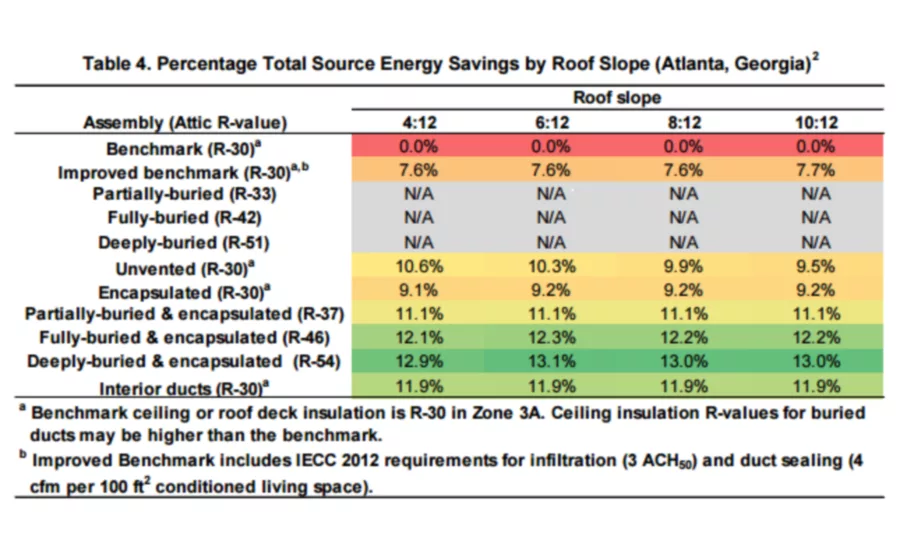
NREL Report for DOE entitled "Measure Guideline: Buried and/or Encapsulated Ducts." Graph courtesy of the Insulation Institute.
December 19, 2016

When a new version of the International Energy Conservation Code (IECC) is completed there can be a good deal of lag time between publication and market impact. This is because states need to adopt the new code, a process which is measured in years, not weeks or months. However, there can be exceptions to this general rule. The 2018 IECC laid out a prescriptive path for the use of buried ducts with fibrous insulation in vented attics, for all climate zones. This new path was approved because it will allow builders to get much of the energy efficiency benefits of an unvented attic with closed cell spray foam by instead doing a traditional vented attic with the ducts buried in fibrous insulation.

Data from DOE’s Building America program shows buried ducts can save more energy than a home with vented attics and ccSPF below the roof. In fact, the data from the DOE report excerpted below shows deeply buried ducts are 20-30 percent more efficient than an unvented attic system.1 This code change lowers the cost of designing and building higher performance homes, but if it’s in the 2018 IECC, how can it have an impact now?

Construction practices not limited to code

Many builders are aware that while the IECC does contain many prescriptive requirements, it does not preclude use of products and practices which aren’t specifically referenced in the code. The mechanism by which the IRC allows this is Section 104.1 “Alternative material, design and methods of construction and equipment”. This section lays out how a builder can get approval for an approach that the code itself may be silent on. Previous versions of the IECC did not disallow use of buried ducts in any climates; they were just silent on the subject. Because of this, builders operating under any version of the IECC are free to use the 2018 IECC prescriptive approach to buried ducts by taking the language to their code official and, under IRC 104.1, getting approval for the design.

“This is huge folks. Huge”

This practice is not new in many parts of the country; however, concerns over condensation prevented it from taking off in the hot/humid climates, namely 1A, 2A and 3A. Years of research by Building America, Home Innovation Research Labs, California Air Resources Board (CARB) and others focused on understanding what was needed to prevent condensation in hot and humid attics. What was most critical was finding out what level of duct insulation was necessary to prevent condensation. After years of research in the field, these “magic R-values” (to quote Dr. Joe) were found to be R-13 in hot/humid zones and R-8 everywhere else. This was the “huge” discovery that now allows builders anywhere to utilize this practice with confidence. However, managing condensation, and getting the maximum level of energy savings from this design approach, requires more than just the right duct insulation levels. This approach also requires (among other things):

  •     Proper HVAC system design. The duct system must be designed such that it can be sufficiently buried in insulation.
  •     Tight duct systems. This has two components. To undertake this approach at all, you must be at or below the current code allowed leakage of 4 percent. However, the 2018 code will only allow builders to claim the ducts as being in “conditioned space” if the leakage rate is 1.5 percent or lower. This is really an energy modeling “sweetener”, it is not a requirement for the practice.
  •     Duct vapor retarders. Much of the literature on buried ducts speaks to “encapsulated” ducts, meaning encapsulated with 1.5 inches of ccSPF. This was done both for vapor retarding capability AND to get above the R-13 duct insulation requirement. However, R-13 fiberglass duct wrap with an integrated, properly sealed FSK jacket would also work and comply with code (for your hot/humid zones), and standard R-8 fiberglass duct insulation with the FSK jacket would comply elsewhere.
    • Note: some might think encapsulation would help with duct tightness too. However, in this DOE report prepared by HIRL they relayed the example of a test house in New Jersey in which they got the duct to 1 CFM25/100SFcfa before encapsulation with ccSPF. The sealing approach relied on conventional mastic.
  •     Proper attic insulation levels. The 2018 code spells out what these levels are and how to calculate the duct insulation’s contribution to the overall level (the BSC blog has a good graphic on this).

This is not a full breakdown of every element of the code change. In the coming months, Insulation Institute will be offering more material on this practice, including a Tech Spec from Home Innovation Research Labs which will provide clear guidance on how to design, install and get code approval for this approach. We think this practice has the potential to offer builders a high performance alternative to more costly unvented attic designs. Stay tuned for more.


For more on this and other great blog posts, visit The Insulation Institute's website.

1. This range is derived by comparing the two partially and fully buried energy savings figures (12.1-13.1 percent) with the energy savings of an unvented attic (9.5-10.3 percent).

KEYWORDS: attics IECC (International Energy Conservation Code)

Share This Story

Recent Comments

These are actually very helpful tips. It is...

This is the most beneficial blog for all...

This blog is a great resource for anyone...

Thank you for sharing this important information. I...

This is a very interesting subject of the...

Manage My Account
  • Sign up for the Newsletter
  • Online Registration
  • Manage My Preferences
  • Registration Customer Service

More Videos

Sponsored Content

Sponsored Content is a special paid section where industry companies provide high quality, objective, non-commercial content around topics of interest to the Building Enclosure audience. All Sponsored Content is supplied by the advertising company and any opinions expressed in this article are those of the author and not necessarily reflect the views of Building Enclosure or its parent company, BNP Media. Interested in participating in our Sponsored Content section? Contact your local rep!

close
  • 2 construction workers and a DEXcell panel
    Sponsored byDEXcell Roof Boards

    Designing Low-Slope Roofs for Resilience

  • Bell Bank headquarters in Fargo, North Dakota
    Sponsored bySto Corp.

    Drained and Back-Ventilated Rainscreens vs Pressurized-Equalized Rainscreens

  • A construction worker using DEXcell roof boards
    Sponsored byDEXcell Roof Boards

    The Hidden Strength of Low-Slope Roof Systems: Why Roof Cover Boards Matter

Popular Stories

construction industry workers in hard hats stand around a city scape

Construction Industry Revolts Over New CSI Licensing Plan

a man wearing a mask installs insulation into a wall system

Quiet Rooms and Healthier Air: A Second Look at What Goes Inside the Wall Cavity

Canalino Elementary School and Canalino Family School exterior

Daylighting Design to Support Rapidly Growing Trend in Modular Building Construction

Building Enclosure Newsletter

BE Poll

Events

June 17, 2025

Addressing Condensation in Low-Slope Roof Assemblies

Credits: 1 AIA LU/HSW; 0.1 ICC CEU; 1 IIBEC CEH; 0.1 IACET CEU

On Demand In modern roofing systems, vapor retarders and air barriers do more than just minimize air leakage—they’re essential to maximizing performance and longevity. This engaging course dives into the next generation of moisture control: permeable vapor retarders and air barriers. Discover how these cutting-edge technologies are transforming low-slope roofing assemblies by improving energy efficiency, managing moisture, and boosting wind uplift resistance.

April 9, 2026

Strategies for High-Performance Below-Grade Waterproofing

Credits: 1 AIA LU/HSW ; 1 IIBEC CEH; 0.1 IACET CEU

On-Demand Designing a high-performance building enclosure requires more than just surface-level protection; it demands a rigorous, performance-based mastery of below-grade water and gas mitigation. This discussion will provide an expert-level analysis of below-grade waterproofing within the comprehensive framework of the high-performance building enclosure.

View All Submit An Event

Products

Plaster and Drywall Assemblies Manual

Plaster and Drywall Assemblies Manual

This is a comprehensive manual that goes beyond codes and standards, providing expert guidance in design, detailing, material selection and troubleshooting for plaster and drywall.

See More Products
×

Enhance your expertise with unparalleled insights.

Join thousands of building professionals today. Shouldn’t you know what they know?

SUBSCRIBE TODAY!
  • RESOURCES
    • Advertise
    • Contact Us
    • Store
    • Want More
  • SIGN UP TODAY
    • Create Account
    • Newsletter
    • Customer Service
    • Manage Preferences
  • SERVICES
    • Marketing Services
    • Reprints
    • Market Research
    • List Rental
    • Survey/Respondent Access
  • STAY CONNECTED
    • LinkedIn
    • Facebook
    • Instagram
    • YouTube
    • X
  • PRIVACY
    • PRIVACY POLICY
    • TERMS & CONDITIONS
    • DO NOT SELL MY PERSONAL INFORMATION
    • PRIVACY REQUEST
    • ACCESSIBILITY

Copyright ©2026. All Rights Reserved BNP Media, Inc. and BNP Media II, LLC.

Design, CMS, Hosting & Web Development :: ePublishing