Building Enclosure logo
search
cart
facebook twitter linkedin youtube instagram Spotify Podcasts Apple Podcasts Spotify Podcasts Apple Podcasts
  • Sign In
  • Create Account
  • Sign Out
  • My Account
Building Enclosure logo
  • NEWS
    • Breaking News
  • SECTIONS
    • Columns
    • Project Profiles
    • Trade Shows
    • Sponsor Insights
  • SYSTEM DESIGNS
    • Low-Slope Roofs
    • Pitched Roofs
    • Metal Roofing Materials
    • Waterproofing
    • Sustainability
    • Insulation
    • Exterior Claddings
    • Wall Systems
    • Building Envelope
  • BLOG
    • The BE Blog
  • MEDIA
    • Podcasts
    • Webinars
    • Quiz
    • Videos
    • Polls
    • Interactive Spotlights
    • Newsletter
    • Photo Galleries
  • DIRECTORIES
    • Directory: Blue Book
    • Directory: Roofing Resource
  • PRODUCTS
  • TECHNICAL
    • Codes
      • Waterproofing
      • Roofing
    • Details
      • Waterproofing
      • Roofing
  • CONTINUING ED
  • ABOUT
    • Advertise
      • Editorial Calendar
    • Contact
    • eMag Archive Issues
  • SIGN UP!
Insulation

Lab Test vs. Eye Test: Slumping and Settling

By Jordan Doria
Insulation Institute
August 25, 2016

Over the years, there has been significant discussion about batt insulation slumping and loose fill insulation settling. Manufacturers often discount these claims as inaccurate or the result of rumors spread by competitors. They do this because they have test data they believe proves these defects are not real issues. But the perspective of builders, HERS raters, insulation contractors and other boots on the ground is driven by what they see in the field, and that includes settled loose fill and slumped batts. How do we reconcile the lab test with the eye test?

Latest on Slumping and Settling

In late 2015, Home Innovation Research Labs (HIRL) concluded testing to examine whether fiber glass friction fit batts, loose fill fiberglass and rock wool friction fit batts would slump or settle over time.  Specifically, the testing examined whether vibrations associated with door closing, even door slamming, would over time cause slumping of batts or settling of loose fill in wall cavities.

The test wall contained a standard metal clad, exterior, residential door which was opened and closed 65,700 times using an automated system to open and close the door. The 65,700 cycles were intended to approximate the number of times a "typical" door would be closed over a time period of 60 years. The testing at HIRL revealed that none of the three types tested exhibited any signs of slumping or settling.  The results here conform to previous research examining settling of loose fill fiberglass in attic.1  On the basis of these findings we feel confident in saying that “fiber glass and mineral wool, both batts and loose fill, do not slump or settle over time in either attics or in walls.”

What Is Missing Here?

Most readers could probably guess what the text above is missing, and that is one critical qualifier: “…when properly installed.” We hear builders say “how can you say batts don’t slump, I’ve seen them do it!” We have too. It is important to understand what this claim means and what it doesn’t. It doesn’t mean that a batt cannot, under any circumstances, slump, or that loosefill can never settle. If a batt is not cut properly for the cavity, or is not in contact on all six sides, it could slump. If loosefill fiberglass is overblown it can settle. Improper installation can defeat even well designed products.

The Truth Is in the Middle

Manufacturers saying “our products don’t do this” falls on deaf ears for those who have seen defects in the field with their own two eyes. Likewise, when those in the field say to manufacturers “your products slump/settle” this is met with frustration at the perceived inaccuracy of the statement. The reality is in between. The products in question do not lose some property over time that causes slumping or settling; if they did, it would be on manufacturers to correct this. The truth is that improper installation can result in conditions which, over time, can allow slumping or settling. In some ways, it is more accurate to say the installation slumps or settles, not the product itself. Improper installation can sabotage the performance of any insulation product. The Building Science Corporation (BSC) Thermal Metric testing found, even in controlled lab conditions, spray foam had installation failures that could compromise thermal performance; they are just not readily visible. Humidity, temperature, substrate moisture content, product mixing, storage and shelf life can all impact spray foam installation quality.
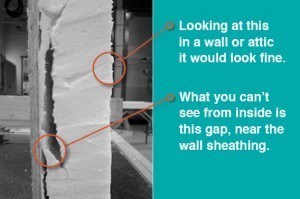
 TM_Report_SPF_separation.jpg

This image from, the BSC report, showed large gaps that ran the length of the bay where the foam separated from the sheathing.

Performance Depends on Proper Installation

It is not helpful for building industry professionals to conflate product attributes with installation variables. Likewise, it is unhelpful for building product manufacturers to pretend that proper installation should be a given in the field. A comparison of competing products should consider both their inherent attributes as well as the installation challenges associated with each, without confusing one with the other. Ultimately, getting the performance outcomes you want is not just about specifying a given product, it is about specifying products that work together to deliver system performance, installing them properly and then ensuring all of this was actually done right.


For more on this and other great blog posts, visit The Insulation Institute's website.


1. NAHB Research Center, Inc., NAIMA Loose-Fill Settling Study, Study of the Thickness Settling of Dry-Applied Attic Open Blow Mineral Fiber Loose-Fill Insulations in Site-Built Test Home Attics, Fourth Year Report, August 2008

KEYWORDS: fiberglass

Share This Story

Recent Comments

These are actually very helpful tips. It is...

This is the most beneficial blog for all...

This blog is a great resource for anyone...

Thank you for sharing this important information. I...

This is a very interesting subject of the...

Manage My Account
  • Sign up for the Newsletter
  • Online Registration
  • Manage My Preferences
  • Registration Customer Service

More Videos

Sponsored Content

Sponsored Content is a special paid section where industry companies provide high quality, objective, non-commercial content around topics of interest to the Building Enclosure audience. All Sponsored Content is supplied by the advertising company and any opinions expressed in this article are those of the author and not necessarily reflect the views of Building Enclosure or its parent company, BNP Media. Interested in participating in our Sponsored Content section? Contact your local rep!

close
  • 2 construction workers and a DEXcell panel
    Sponsored byDEXcell Roof Boards

    Designing Low-Slope Roofs for Resilience

  • Bell Bank headquarters in Fargo, North Dakota
    Sponsored bySto Corp.

    Drained and Back-Ventilated Rainscreens vs Pressurized-Equalized Rainscreens

  • A construction worker using DEXcell roof boards
    Sponsored byDEXcell Roof Boards

    The Hidden Strength of Low-Slope Roof Systems: Why Roof Cover Boards Matter

Popular Stories

a man wearing a mask installs insulation into a wall system

Quiet Rooms and Healthier Air: A Second Look at What Goes Inside the Wall Cavity

Canalino Elementary School and Canalino Family School exterior

Daylighting Design to Support Rapidly Growing Trend in Modular Building Construction

construction workers on a roof, plane flies in background

Why Specifications Are Becoming the Next Critical Layer of Construction Compliance

Building Enclosure Newsletter

BE Poll

Events

June 17, 2025

Addressing Condensation in Low-Slope Roof Assemblies

Credits: 1 AIA LU/HSW; 0.1 ICC CEU; 1 IIBEC CEH; 0.1 IACET CEU

On Demand In modern roofing systems, vapor retarders and air barriers do more than just minimize air leakage—they’re essential to maximizing performance and longevity. This engaging course dives into the next generation of moisture control: permeable vapor retarders and air barriers. Discover how these cutting-edge technologies are transforming low-slope roofing assemblies by improving energy efficiency, managing moisture, and boosting wind uplift resistance.

April 9, 2026

Strategies for High-Performance Below-Grade Waterproofing

Credits: 1 AIA LU/HSW ; 1 IIBEC CEH; 0.1 IACET CEU

On-Demand Designing a high-performance building enclosure requires more than just surface-level protection; it demands a rigorous, performance-based mastery of below-grade water and gas mitigation. This discussion will provide an expert-level analysis of below-grade waterproofing within the comprehensive framework of the high-performance building enclosure.

View All Submit An Event

Products

Plaster and Drywall Assemblies Manual

Plaster and Drywall Assemblies Manual

This is a comprehensive manual that goes beyond codes and standards, providing expert guidance in design, detailing, material selection and troubleshooting for plaster and drywall.

See More Products
×

Enhance your expertise with unparalleled insights.

Join thousands of building professionals today. Shouldn’t you know what they know?

SUBSCRIBE TODAY!
  • RESOURCES
    • Advertise
    • Contact Us
    • Store
    • Want More
  • SIGN UP TODAY
    • Create Account
    • Newsletter
    • Customer Service
    • Manage Preferences
  • SERVICES
    • Marketing Services
    • Reprints
    • Market Research
    • List Rental
    • Survey/Respondent Access
  • STAY CONNECTED
    • LinkedIn
    • Facebook
    • Instagram
    • YouTube
    • X
  • PRIVACY
    • PRIVACY POLICY
    • TERMS & CONDITIONS
    • DO NOT SELL MY PERSONAL INFORMATION
    • PRIVACY REQUEST
    • ACCESSIBILITY

Copyright ©2026. All Rights Reserved BNP Media, Inc. and BNP Media II, LLC.

Design, CMS, Hosting & Web Development :: ePublishing