Building Enclosure logo
search
cart
facebook twitter linkedin youtube instagram Spotify Podcasts Apple Podcasts Spotify Podcasts Apple Podcasts
  • Sign In
  • Create Account
  • Sign Out
  • My Account
Building Enclosure logo
  • NEWS
    • Breaking News
  • SECTIONS
    • Columns
    • Project Profiles
    • Trade Shows
    • Sponsor Insights
  • SYSTEM DESIGNS
    • Low-Slope Roofs
    • Pitched Roofs
    • Metal Roofing Materials
    • Waterproofing
    • Sustainability
    • Insulation
    • Exterior Claddings
    • Wall Systems
    • Building Envelope
  • BLOG
    • The BE Blog
  • MEDIA
    • Podcasts
    • Webinars
    • Quiz
    • Videos
    • Polls
    • Interactive Spotlights
    • Newsletter
    • Photo Galleries
  • DIRECTORIES
    • Directory: Blue Book
    • Directory: Roofing Resource
  • PRODUCTS
  • TECHNICAL
    • Codes
      • Waterproofing
      • Roofing
    • Details
      • Waterproofing
      • Roofing
  • CONTINUING ED
  • ABOUT
    • Advertise
      • Editorial Calendar
    • Contact
    • eMag Archive Issues
  • SIGN UP!
Insulation

Are Insulation R-Values a Good Measure of Performance?

Insulation Institute
May 25, 2016

Yes. The answer is simple, so this could be the shortest blog ever. However, given the misinformation that is out there it is worth explaining why R-value is in fact a good measure of thermal performance and dispelling some common misconceptions about it.


What R-value considers and what it doesn’t

We know that R-value measures resistance to heat flow, and there are three kinds of heat transfer to consider: conduction, convection and radiation. The FTC Rule on “Labeling and Advertising of Home Insulation” requires the R-values of typical insulation materials be based on measurements taken using one of four approved ASTM test standards[1].  These ASTM standards measure heat flux - which includes all three modes of heat transfer:  conduction, convection and radiation.   Despite this, there are claims in the market that R-value only considers one type of heat flow, namely conduction. Martin Holladay, writing for Green Building Advisor back in 2009, recognized and sought to dispel this misinformation in a very thoughtful article on this subject. Fast forward to today, May of 2016, and this same misinformation is being propagated, this time in Spray Foam Magazine’s May-June edition, which contains an article again claiming R-value only considers conduction and not convection or radiation. Same claim, still false.


Why the misinformation?

Why would certain parties choose to misrepresent R-value and try to diminish its significance? Simply put, to make their insulation products appear better. The FTC regulates insulation labeling and how to determine its R-value because it recognizes the need for consumers to have a clear way to compare insulation performance across product types. The FTC declined to incorporate air infiltration or air leakage into the R-value Rule because air leakage could not be uniformly measured in a reliable and consistent manner so as to make it a reliable tool for consumers. The FTC says that if you describe insulation’s thermal performance you must do so using R-value. However, the FTC cannot currently preclude parties from seeking to cast doubt about the reliability of R-value as a measure of insulation’s thermal performance. As a result, manufacturers and others can make misleading or even totally false claims relating to insulation R-values as a measurement, despite the FTC’s rule.


So is R-value the be-all, end all? What about proper installation? What about air sealing?

Of course insulation’s stated R-value is one of several factors that affect its performance. We know the R-value of a wall assembly differs from insulation’s labeled R-value.  The R-value also varies based on where you measure it - in the center of a wall cavity where there aren’t any studs causing thermal bridging versus measuring a larger area including studs and the thermal bridging they cause (for more on this check out a recent Energy Vanguard blog on the “4 types of R-value”). Air leakage absolutely impacts the thermal performance of a home.  Also, improper installation can significantly reduce home performance. Yet despite this, last year Building Sciences Corporation released its final Thermal Metric Report which stated (page iii) that “when walls are constructed with the same installed R-value in the stud space, and air sealed both inside and outside (i.e. there is effectively zero air leakage through the assembly), they exhibit essentially the same thermal performance regardless of the type of insulation material used.” This conclusion reinforces that R-value is indeed a good measure of thermal performance and that R-value is different than air leakage and must be addressed separately, regardless of the type of insulation used.
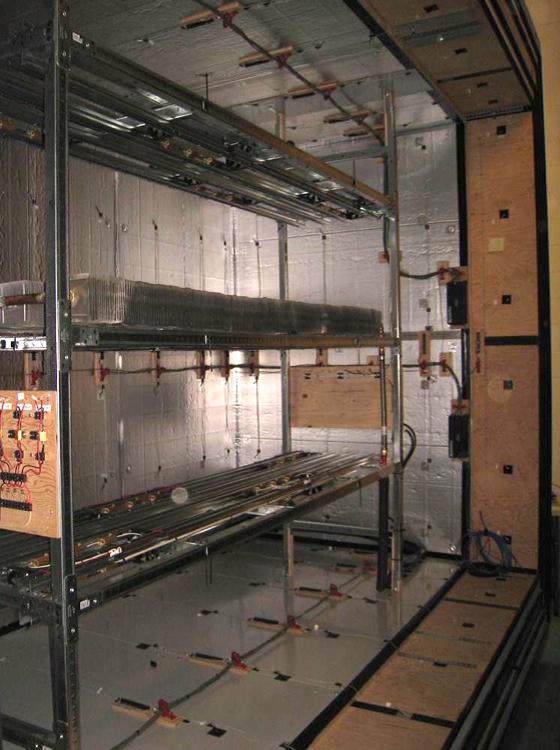
 Thermal_Metric_hotbox.png

Metering side of the hotbox apparatus used by Building Sciences Corporation in their insulation performance testing (2015 Thermal Metric Summary Report)


As manufactured vs. as installed

Insulation R-values are a good measure of its thermal performance; they are both accurate and comprehensive. However, what we ultimately care about is a home’s thermal performance, not the performance of the insulation alone. This is determined by, among other things, a combination of assembly R-value, proper whole-home air sealing and correct installation. These final two are field-dependent variables that are critically important. No insulation product is immune to improper installation, and no insulation product alone is an effective whole-home air sealing solution. But when it comes to R-value, you can be confident that it is the measure of insulation’s thermal performance you should use to compare insulation types, and if anyone tries to tell you otherwise, buyer beware.

Can't get enough building science knowledge? Download our Building Science 101 guide to get even smarter.


[1] The standards are spelled out in 26 C.F.R. 460.5(a)


For more on this and other great blog posts, visit The Insulation Institute's website.

KEYWORDS: air barriers building performance R-value spray foam insulation

Share This Story

Recent Comments

These are actually very helpful tips. It is...

This is the most beneficial blog for all...

This blog is a great resource for anyone...

Thank you for sharing this important information. I...

This is a very interesting subject of the...

Manage My Account
  • Sign up for the Newsletter
  • Online Registration
  • Manage My Preferences
  • Registration Customer Service

More Videos

Sponsored Content

Sponsored Content is a special paid section where industry companies provide high quality, objective, non-commercial content around topics of interest to the Building Enclosure audience. All Sponsored Content is supplied by the advertising company and any opinions expressed in this article are those of the author and not necessarily reflect the views of Building Enclosure or its parent company, BNP Media. Interested in participating in our Sponsored Content section? Contact your local rep!

close
  • 2 construction workers and a DEXcell panel
    Sponsored byDEXcell Roof Boards

    Designing Low-Slope Roofs for Resilience

  • Bell Bank headquarters in Fargo, North Dakota
    Sponsored bySto Corp.

    Drained and Back-Ventilated Rainscreens vs Pressurized-Equalized Rainscreens

  • A construction worker using DEXcell roof boards
    Sponsored byDEXcell Roof Boards

    The Hidden Strength of Low-Slope Roof Systems: Why Roof Cover Boards Matter

Popular Stories

construction industry workers in hard hats stand around a city scape

Construction Industry Revolts Over New CSI Licensing Plan

a man wearing a mask installs insulation into a wall system

Quiet Rooms and Healthier Air: A Second Look at What Goes Inside the Wall Cavity

Canalino Elementary School and Canalino Family School exterior

Daylighting Design to Support Rapidly Growing Trend in Modular Building Construction

Building Enclosure Newsletter

BE Poll

Events

June 17, 2025

Addressing Condensation in Low-Slope Roof Assemblies

Credits: 1 AIA LU/HSW; 0.1 ICC CEU; 1 IIBEC CEH; 0.1 IACET CEU

On Demand In modern roofing systems, vapor retarders and air barriers do more than just minimize air leakage—they’re essential to maximizing performance and longevity. This engaging course dives into the next generation of moisture control: permeable vapor retarders and air barriers. Discover how these cutting-edge technologies are transforming low-slope roofing assemblies by improving energy efficiency, managing moisture, and boosting wind uplift resistance.

April 9, 2026

Strategies for High-Performance Below-Grade Waterproofing

Credits: 1 AIA LU/HSW ; 1 IIBEC CEH; 0.1 IACET CEU

On-Demand Designing a high-performance building enclosure requires more than just surface-level protection; it demands a rigorous, performance-based mastery of below-grade water and gas mitigation. This discussion will provide an expert-level analysis of below-grade waterproofing within the comprehensive framework of the high-performance building enclosure.

View All Submit An Event

Products

Plaster and Drywall Assemblies Manual

Plaster and Drywall Assemblies Manual

This is a comprehensive manual that goes beyond codes and standards, providing expert guidance in design, detailing, material selection and troubleshooting for plaster and drywall.

See More Products
×

Enhance your expertise with unparalleled insights.

Join thousands of building professionals today. Shouldn’t you know what they know?

SUBSCRIBE TODAY!
  • RESOURCES
    • Advertise
    • Contact Us
    • Store
    • Want More
  • SIGN UP TODAY
    • Create Account
    • Newsletter
    • Customer Service
    • Manage Preferences
  • SERVICES
    • Marketing Services
    • Reprints
    • Market Research
    • List Rental
    • Survey/Respondent Access
  • STAY CONNECTED
    • LinkedIn
    • Facebook
    • Instagram
    • YouTube
    • X
  • PRIVACY
    • PRIVACY POLICY
    • TERMS & CONDITIONS
    • DO NOT SELL MY PERSONAL INFORMATION
    • PRIVACY REQUEST
    • ACCESSIBILITY

Copyright ©2026. All Rights Reserved BNP Media, Inc. and BNP Media II, LLC.

Design, CMS, Hosting & Web Development :: ePublishing