Building Enclosure logo
search
cart
facebook twitter linkedin youtube instagram Spotify Podcasts Apple Podcasts Spotify Podcasts Apple Podcasts
  • Sign In
  • Create Account
  • Sign Out
  • My Account
Building Enclosure logo
  • NEWS
    • Breaking News
  • SECTIONS
    • Columns
    • Project Profiles
    • Trade Shows
    • Sponsor Insights
  • SYSTEM DESIGNS
    • Low-Slope Roofs
    • Pitched Roofs
    • Metal Roofing Materials
    • Waterproofing
    • Sustainability
    • Insulation
    • Exterior Claddings
    • Wall Systems
    • Building Envelope
  • BLOG
    • The BE Blog
  • MEDIA
    • Podcasts
    • Webinars
    • Quiz
    • Videos
    • Polls
    • Interactive Spotlights
    • Newsletter
    • Photo Galleries
  • DIRECTORIES
    • Directory: Blue Book
    • Directory: Roofing Resource
  • PRODUCTS
  • TECHNICAL
    • Codes
      • Waterproofing
      • Roofing
    • Details
      • Waterproofing
      • Roofing
  • CONTINUING ED
  • ABOUT
    • Advertise
      • Editorial Calendar
    • Contact
    • eMag Archive Issues
  • SIGN UP!

When the ‘Prevailing’ Wind Direction is Anything But

By Daniel Overbey
June 5, 2015

The wind rose is a conventional diagram for characterizing both the direction and frequency of wind around a project site. This graphic is commonly included in a climate data analysis.

Some software platforms such as Climate Consultant, one of several free energy analysis tools developed and released through the University of California, Los Angeles Department of Architecture & Urban Design, can generate wind roses for any specific range of time based on the climate data file loaded into the program (the U.S. Department of Energy manages an international database of climate data files through their Office of Energy Efficiency & Renewable Energy).
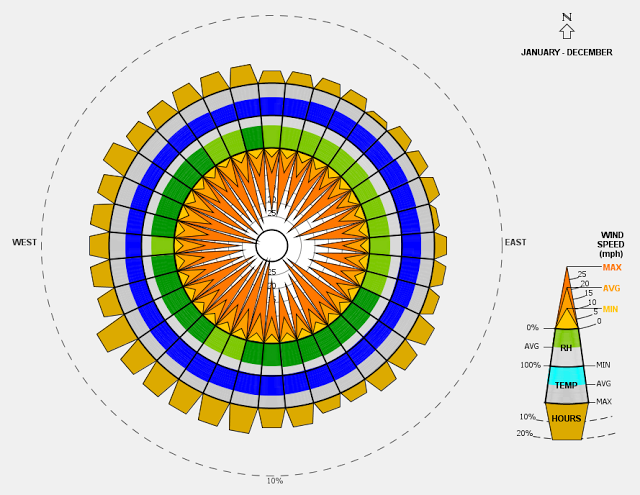


Annual wind rose for Indianapolis, Indiana, USA, generated by Climate Consultant 6.0 Beta.
Climate Consultant is available through the Department of Architecture and Urban Design at the University of California, Los Angeles
.


Through its graphic clarity, the wind rose allows individuals to quickly determine the relative direction and frequency of winds at a weather station from which the data was recorded.

However, there are two common caveats with using wind roses for a project’s site analysis of energy flows.

First, if climate normals are used to generate the wind roses, then keep in mind that this macroclimate data was collected from a remote location and likely does not accurately represent the microclimate conditions at the project site. Any number of built and/or natural features in and around a site will alter the local climate data presented by the wind rose.
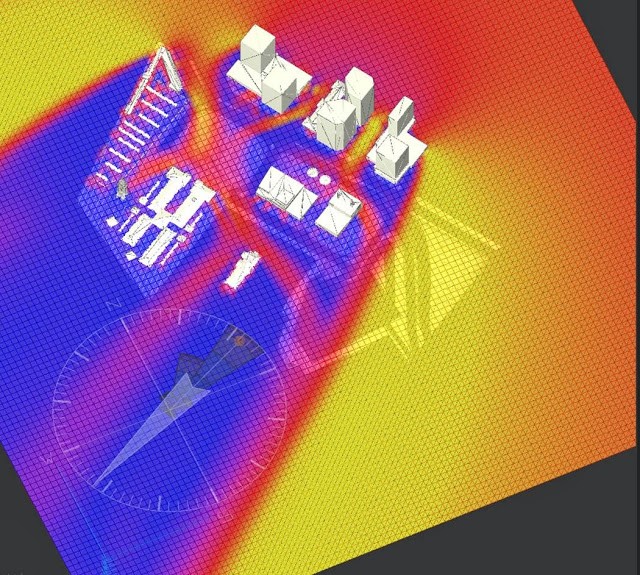


Prevailing wind directions can be altered around a site due to the natural and built context.
Image property of Browning Day Mullins Dierdorf.


Secondly, be careful about leaning too heavily on ‘prevailing’ wind directions for natural ventilation strategies.

By way of example, consider the wind roses below for Indianapolis, Indiana. Both the January and July wind roses indicate prevailing winds directions. In the winter, winds from the westerly directions (i.e., SW through WNW) will be a liability but for much of the year. Yet in the summer, prevailing southwesterly winds could be considered an asset. Buildings in this locale should consider operable windows on the southwest to catch these prevailing winds and corresponding outlets on the northeast. Stack ventilation outlets should not face the southwesterly direction.


January and July wind roses for Indianapolis, Indiana, USA.
Adapted from Climate Context: Information for Architectural Design by Mark DeKay and David C. Meyers.

However, upon further examination, it becomes apparent that natural ventilation strategies for this locale should not respond only to the prevailing southwestern direction. While July winds blow from the southwest more often than from any other direction, in aggregate the wind blows from a direction other than the prevailing direction over 80 percent of the time. Design teams would be wise to provide natural ventilation strategies that can function with a variety of wind directions in order to provide effective passive cooling for the greatest amount of time.

KEYWORDS: climate change reports and studies ventilation wind resistance

Share This Story

Overbey   head shot 2020 3

Daniel Overbey, AIA, NCARB, LEED Fellow (LEED AP BD+C, ID+C, O+M), WELL AP is an Assistant Professor of Architecture at Ball State University and the Director of Sustainability for Browning Day in Indianapolis, Ind. His work focuses on high-performance building design and construction, environmental systems research, green building certification services, energy/life-cycle assessment modeling, and resilient design. He can be reached at djoverbey@bsu.edu.

Recent Comments

These are actually very helpful tips. It is...

This is the most beneficial blog for all...

This blog is a great resource for anyone...

Thank you for sharing this important information. I...

This is a very interesting subject of the...

Manage My Account
  • Sign up for the Newsletter
  • Online Registration
  • Manage My Preferences
  • Registration Customer Service

More Videos

Sponsored Content

Sponsored Content is a special paid section where industry companies provide high quality, objective, non-commercial content around topics of interest to the Building Enclosure audience. All Sponsored Content is supplied by the advertising company and any opinions expressed in this article are those of the author and not necessarily reflect the views of Building Enclosure or its parent company, BNP Media. Interested in participating in our Sponsored Content section? Contact your local rep!

close
  • HITT Construction headquarters
    Sponsored byBuilding Composites® LLC

    Pushing the Envelope

  • 2 construction workers and a DEXcell panel
    Sponsored byDEXcell Roof Boards

    Designing Low-Slope Roofs for Resilience

  • Bell Bank headquarters in Fargo, North Dakota
    Sponsored bySto Corp.

    Drained and Back-Ventilated Rainscreens vs Pressurized-Equalized Rainscreens

Popular Stories

graphic shows white arrows pointing to the right on a light green background

A Breakdown of Air Leakage Testing in LEED v5 BD+C

graphic shows a building destoryed by tornados with information on the amount of torandos in 2026 in the US

Record-Breaking Tornado Activity in Illinois Signals New Challenges for Architects

Patient room doors with flexible privacy features widens possible uses within these spaces and improves patient comfort

Acoustics and Aesthetics: The Value of Integrated Opening Systems

Building Enclosure Newsletter

BE Poll

Events

April 9, 2026

Strategies for High-Performance Below-Grade Waterproofing

Credits: 1 AIA LU/HSW ; 1 IIBEC CEH; 0.1 IACET CEU

On-Demand Designing a high-performance building enclosure requires more than just surface-level protection; it demands a rigorous, performance-based mastery of below-grade water and gas mitigation. This discussion will provide an expert-level analysis of below-grade waterproofing within the comprehensive framework of the high-performance building enclosure.

April 28, 2026

Roof Design Considerations That Prevent Installation Failures and Change Orders

Credit: 1 AIA LU/HSW; 1 IIBEC CEH; 0.1 ICC CEU

On-Demand This course provides visual examples of actual field conditions. Some good, some not so good; along with design suggestions that can cut installation costs and reduce construction change orders. Upon completion of this course, you will have a better understanding of the requirements the roofing contractor must meet to provide the specified roofing system warranty, and long-term value to the owner.

View All Submit An Event

Products

Plaster and Drywall Assemblies Manual

Plaster and Drywall Assemblies Manual

This is a comprehensive manual that goes beyond codes and standards, providing expert guidance in design, detailing, material selection and troubleshooting for plaster and drywall.

See More Products
×

Enhance your expertise with unparalleled insights.

Join thousands of building professionals today. Shouldn’t you know what they know?

SUBSCRIBE TODAY!
  • RESOURCES
    • Advertise
    • Contact Us
    • Store
    • Want More
  • SIGN UP TODAY
    • Create Account
    • Newsletter
    • Customer Service
    • Manage Preferences
  • SERVICES
    • Marketing Services
    • Reprints
    • Market Research
    • List Rental
    • Survey/Respondent Access
  • STAY CONNECTED
    • LinkedIn
    • Facebook
    • Instagram
    • YouTube
    • X
  • PRIVACY
    • PRIVACY POLICY
    • TERMS & CONDITIONS
    • DO NOT SELL MY PERSONAL INFORMATION
    • PRIVACY REQUEST
    • ACCESSIBILITY

Copyright ©2026. All Rights Reserved BNP Media, Inc. and BNP Media II, LLC.

Design, CMS, Hosting & Web Development :: ePublishing