Does Your Roof System Outperform Expectations?
Beyond Code Compliance
.webp?t=1781013933)
Key Takeaways
- Building codes establish minimum roofing performance standards, but compliance alone does not ensure long-term durability.
- Membrane chemistry and material quality significantly influence resistance to UV exposure, weathering, and aging.
- Proper installation and high-performance materials are essential for maximizing roof lifespan and protecting critical assets.
Commercial and industrial buildings contain billions of dollars in critical infrastructure and equipment that businesses rely on to function reliably and profitably. Protecting that infrastructure is largely the job of a sound and durable building envelope.
Commercial roofs are, in some respects, the most important part of that building envelope. They shield interior operations from the outdoor elements and help prevent costly leaks and other failures that can disrupt operations, create safety issues, and drive-up expenses for building owners and operators.
That’s why commercial roof assemblies are subject to a range of building codes and performance standards designed to establish a reliable baseline for safety and durability. However, code compliance alone does not guarantee long-term performance. Even roof systems that meet the same testing requirements can react very differently over time under real-world environmental and operational conditions. In this article, we’ll explore some of the most important codes and standards governing commercial roofing systems and explore how material and system differences can influence long-term performance in the field.
An Overview of Relevant Code Concerns
First, it’s worth a brief overview of the common codes, standards, and testing methods that provide a baseline of performance for commercial roof systems across several key areas.
ASTM E108 and UL790 for Fire Performance. These are the two most widely recognized classifications for commercial roofing, indicating that a roofing assembly has passed the required testing for flame spread. Class A is the highest fire-resistance rating and is often an architectural requirement for buildings that may be more at risk for fires or for local building codes in areas prone to high wildfire risk.
ASCE 7 and FM Global 190 Wind Testing. These are the primary U.S. engineering standards used to determine minimum design loads for buildings, including wind loads on commercial and industrial roof systems. They are commonly referenced in architectural specifications and guidelines, and in many local codes, including the Florida Building Code. Because of the state’s exposure to hurricanes and tropical storms, the Florida Building Code is often considered one of the most stringent U.S. codes for wind performance.
International Energy Conservation Code (IECC). The IECC sets standards to help improve the energy efficiency of buildings. For commercial roof systems, IECC establishes prescribed R-values (which measure a material’s resistance to heat flow) in accordance with designated climate zones throughout the United States. Colder northern climates generally require higher R-values and thicker insulation to maintain thermal performance, while warmer southern climates often require lower overall insulation levels to appropriately manage interior dew point conditions.
FM Global Very Severe Hail. In certain regions within the U.S., FM Global has determined minimum performance requirements for FM-insured commercial roofing systems to be classified as very severe hail (VSH) rated. VSH is classified as hailstones that are greater than 2 inches in diameter (roughly the size of a billiard ball) and most commonly occur in the Great Plains states.
While not a comprehensive list of commercial roofing standards, these four provide a clear picture of some of the most significant risks roof systems are designed to face. Wind, hail, fire resistance, and thermal performance are all critical functions of a commercial roof. Together, they also help illustrate how certain roofing materials and systems may outperform others under real-world conditions.
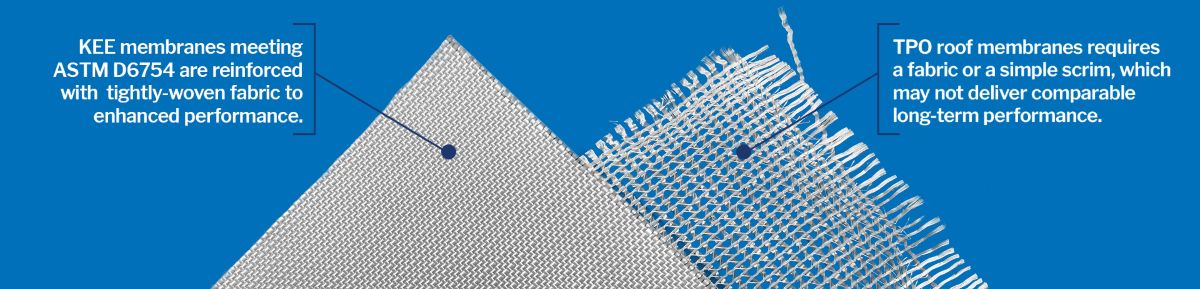
Image courtesy of FiberTite
Code Compliance vs. Real-World Performance
When considering code compliance and testing limits, it’s important to remember that these standards represent only a snapshot of anticipated performance. They document how a system functions under defined testing conditions in a controlled environment. The true test of a commercial roof system’s performance is how well it withstands real-world conditions over the course of its service life.
ASTM E108 and UL790 fire performance ratings provide a good example of this distinction. The testing protocols use several fire exposure methods to simulate different conditions, including intermittent flame exposure, flame spread, and a roof assembly’s ability to resist ignition. A Class A rating indicates that a system is expected to withstand fire exposure while providing a high degree of protection to the roof deck.
However, a Class A rating does not distinguish between the varying chemistries used in today’s most common commercial roof membranes. For example, roofing assemblies incorporating builder-grade thermoplastic polyolefin (TPO) membranes are capable of achieving a Class A fire rating, yet TPO formulations may vary between manufacturers and even between production batches. Over time, continuous UV exposure, freeze/thaw cycles, and potential chemical exposure can cause TPO membranes to lose dimensional stability and become brittle, potentially compromising long-term fire performance.
ASCE 7 and FM 1-90 wind performance testing come with similar limitations. These test protocols rely on specific substrates and fastening patterns that may not model exactly what will take place during roof assembly. The tests cannot fully account for the effects of aging and degradation on adhesive bond strength over time. UV exposure, freeze/thaw cycles, seismic activity, and environmental stressors can all affect fastening integrity throughout a roof’s lifespan. Ultimately, the strength of these attachment systems plays a critical role in determining how well a roof performs during extreme wind events.
One way to ensure that a commercial roof system delivers anticipated long-term performance is to select higher-performing membrane materials. Compared to builder-grade TPO options, alternatives such as ketone ethylene ester-based (KEE-based) membranes can deliver superior UV, chemical, and fire resistance. This helps prevent premature embrittlement or other forms of degradation that may interfere with long-term performance.
Specifically, KEE-based membranes that meet the ASTM D6754 standard can be relied upon for enhanced performance. ASTM D6754 covers flexible sheet made from ketone ethylene ester (KEE) as the primary polymer intended for use in single-ply roofing membrane exposed to the weather. It also specifies that the sheet must be reinforced with tightly-woven fabric to form a monolithic bond that contributes to enhanced performance. The result is a membrane material that will remain flexible for decades, better resist punctures and tears, and withstand severe weather exposure over the course of several decades. Comparatively, the ASTM D6878 standard for TPO roof membranes requires a fabric or a simple scrim, which can vary by manufacturer and may not deliver comparable long-term performance.
It is also important to recognize that even the highest-performing roofing systems can only deliver anticipated results when installed properly. Regardless of the testing standards a roof assembly meets, installation quality remains a critical factor in long-term reliability. For that reason, building owners should work with trained and certified contractors.
Ultimately, code compliance is not necessarily a guarantee of anticipated performance throughout a commercial roof system’s service life. Such a rating confirms that an assembly has been tested once under controlled conditions and is not always a reliable predictor of performance in real-world situations. For this reason, building owners, consultants, architects, and other stakeholders should carefully consider their options before selecting and specifying high-performance materials for critical buildings. It can significantly impact your installation outcomes and operations.
Looking for a reprint of this article?
From high-res PDFs to custom plaques, order your copy today!
-(002).webp?height=96&t=1760069432&width=96)
.webp?height=740&t=1767036885&width=auto "Header - BE 1170x658 (002).png")

.webp?height=740&t=1755781744&width=auto "KEE(2).png")
.webp?height=200&t=1760020883&width=200 "FiberTite(1).png")