Quiet Rooms and Healthier Air: A Second Look at What Goes Inside the Wall Cavity
Why insulation conversations should include what occupants breathe, not only what they hear
.webp?t=1778247230)
Key Takeaways
- Better wall design improves acoustics without overpaying for unnecessary high-density insulation.
- Insulation choices can directly impact indoor air quality, respiratory health, and occupant comfort.
- Third-party certified materials help create healthier, high-performance buildings for occupants and construction workers alike.
When builders, specifiers, and architects talk about insulation, the conversation usually starts with thermal or acoustic performance. Indoor air quality, if it comes up at all, tends to follow later. That is understandable. Insulation sits behind finishes, out of sight and out of mind, and decisions are often guided by a small number of familiar assumptions. One of these, in particular, is worth revisiting.
The Density Assumption
There is a widely held belief that heavier insulation produces quieter rooms. It sounds logical: denser materials should absorb more sound, so higher density must mean better acoustic performance. The data tell a different story.
Sound Transmission Class (STC), measured under ASTM E90, reflects the performance of the full wall assembly, not just the insulation. Gypsum boards, stud type and spacing, resilient channels, sealing details, and the cavity insulation all contribute. Within that system, increasing insulation density at the same thickness does not deliver the improvement many expect.
A study by the National Research Council of Canada compared fiberglass and rock mineral wool (at roughly three times the density) across 21 otherwise identical wall assemblies. These included variations in stud type, spacing, and wall configuration. Across all assemblies, fiberglass averaged an STC of 50, while rock mineral wool averaged 48.6. Statistical analysis showed no statistically significant difference at 99 percent confidence. If anything, the marginal numerical advantage was with the lighter material.
From a physics perspective, this makes sense. Mass is important for sound control, but it is most effective at the wall surfaces (for example, gypsum layers), not within the cavity. Increasing insulation density within the cavity does not significantly improve sound blocking and, in some configurations, can increase stiffness and allow vibrations to transmit more readily. The same principle explains why studs spaced at 24 inches generally outperform studs at 16 inches, a detail that still surprises people. The key point is that acoustic performance is determined by the wall as a system, not by insulation density alone.
What Gets Missed About Indoor Air
People spend close to 90 percent of their time indoors. Over the course of a day, an adult inhales a significant volume of air containing particles such as pollen, pet dander, dust mite allergen, and chemical residues from building materials and household products.
A 2016 meta-analysis of U.S. indoor dust studies (Mitro et al., Environmental Science & Technology) reported that ten consumer-product chemicals, including specific phthalates and flame retardants, were detected in 90 percent or more of household dust samples. For people with asthma or allergies, and for the very young or very old, these exposures are not background noise. They influence sleep, asthma and allergy symptoms, medication use, and day-to-day quality of life in very real ways.
Insulation, while hidden, can influence several of these factors. It may contribute to volatile organic compound (VOC) emissions after installation. It can release fibers and dust during cutting, installation, or later disturbance. Historically, some insulation products have also used chemicals that may be of concern for people with sensitive airways.
The Tight-Envelope
One reason this matters more now than it did a generation ago is that buildings have changed. Energy codes have driven envelopes to be tighter and better sealed, which is the right direction for thermal performance and carbon reduction. This has changed how pollutants behave indoors.
In a leakier building, emissions from materials and furnishings disperse more quickly through uncontrolled air exchange. In a tightly sealed, high-performance envelope, those emissions have fewer routes out. Unless mechanical ventilation is specified carefully and commissioned well, the same amount of off-gassing from finishes, furniture, adhesives, and insulation can produce higher measured concentrations of VOCs and fine particulates in the breathing zone. The people most affected are the vulnerable: young children, older adults, and anyone with asthma, allergies, or other respiratory conditions.
This is why material selection inside a high-performance wall carries more significance than it used to. Insulation that meets tight thermal and air-barrier requirements is a given. What varies is what else that material contributes to the cavity over time: emissions, fibers, dust, and the conditions that allow or resist mold. A product that performs well thermally but introduces avoidable pollutants into a sealed envelope is working against the health outcomes the same envelope is supposed to support.
It is also worth noting that the highest exposure to insulation materials often occurs during installation and renovation, affecting installers and other construction workers directly. Most direct contact with insulation happens at this stage rather than during normal occupancy. A product specified for lower dust and fiber release, and for lower VOC emissions, benefits the tradespeople handling it on site as much as the families or staff who will eventually occupy the finished building. That is an important part of the specification conversation and one that tends to be underweighted.
What Certification Evaluates
This is where independent, protocol-driven testing becomes important. The Asthma & Allergy Friendly® Certification Program, a collaborative initiative between Allergy Standards Limited and the Asthma and Allergy Foundation of America (AAFA), evaluates fiberglass insulation against defined scientific criteria under the ASP:19-01/101 standard. Certification is based on multiple performance areas.
A full constituent review assesses the chemical composition of the product, ensuring that substances of concern for sensitive individuals are either absent or present only at very low levels. Formaldehyde-based binders are not permitted under the standard.
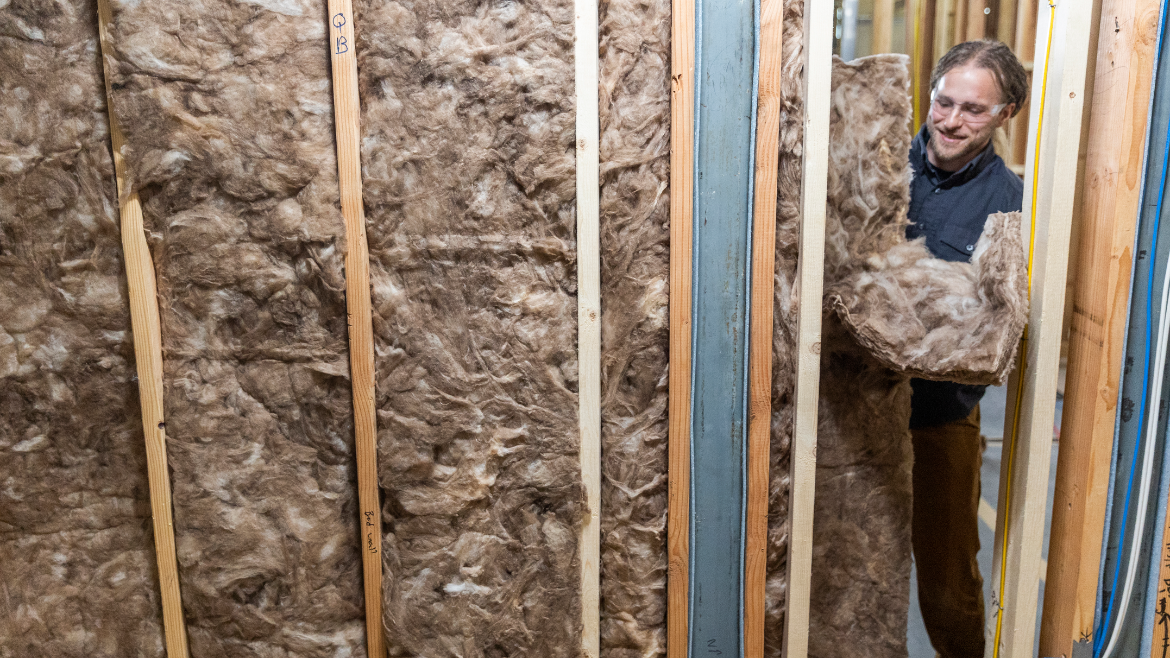
 Independent certification under the Asthma & Allergy Friendly® Certification Program evaluates fiberglass insulation against defined criteria. Photo credit: Knauf Insulation.
Airborne particle and fiber release is evaluated under simulated installation and disturbance conditions in a controlled environmental chamber, reflecting real-world handling.
Fungal growth resistance is assessed to confirm that the product does not readily support mold growth under test conditions.
VOC emissions are measured at defined time points, including 24 hours and 14 days after installation, with limits applied to total VOCs and specific compounds such as formaldehyde and acetaldehyde.
Testing is conducted in independent laboratories using established protocols, and certified products are traceable through unique certification identifiers. For specifiers, this provides a way to move beyond general product claims and rely on defined, test-based criteria when evaluating materials for use in occupied spaces.
Where the Two Conversations Meet
Taken together, this changes how insulation is considered. If acoustic performance is not determined by insulation density alone, specifying higher-density products for that reason may not deliver the intended outcome. At the same time, insulation choices can influence indoor environmental conditions, both during installation and throughout the lifetime of the building.
A more balanced approach is to select insulation that performs as required thermally and from a fire perspective, fits the cavity appropriately, and has been independently evaluated against indoor air quality criteria. Acoustic performance can then be addressed through assembly design, including appropriate wall construction, spacing, etc.
In practice, this means moving focus away from individual material attributes and toward overall wall design. Specifiers can achieve better acoustic outcomes by prioritizing assembly configuration, including appropriate stud spacing, sealing, and surface mass, while selecting insulation that meets both performance and indoor air quality criteria. This approach avoids over-specifying density where it does not provide actual benefit.
Points to Keep in Mind
A few practical points are worth highlighting.
- Density alone does not determine STC performance. Laboratory data show that overall assembly design plays the dominant role.
- Indoor air quality claims should be verifiable. Terms such as “low emission” can vary in meaning, while third-party certification based on a published standard provides greater clarity.
- The wall cavity serves multiple functions. It contributes to thermal, acoustic, and indoor environmental performance at the same time.
- A balanced specification delivers better outcomes. Considering these factors together typically results in more robust, better-performing wall assemblies.
Closing Thought
Walls influence more than structure and sound. They quietly shape how a building feels to the people who use it: how it sounds, how the air smells, how a child with asthma sleeps at night, how a worker feels finishing the day. Insulation is part of that story, even if nobody sees it once the drywall is up.
The evidence on acoustic performance and the evidence on indoor air quality do not pull in different directions. They line right up. With the correct approach, both can be addressed within the same specification.
The author acknowledges the technical input provided by Scott Stillabower, Product Technical Support Manager at Knauf Insulation North America.
Looking for a reprint of this article?
From high-res PDFs to custom plaques, order your copy today!
.webp?height=740&t=1767036885&width=auto "Header - BE 1170x658 (002).png")

.webp?height=740&t=1755781744&width=auto "KEE(2).png")

.webp?height=200&t=1766503602&width=200 "HVAC(1).png")