A Contemporary Home for Care in Newfoundland and Labrador
Rebuking historic approaches to mental health and addictions care, the Mental Health and Addictions Centre in St. John’s, NL prioritizes dignity, accessibility, and community
Key Takeaways
- Reduces stigma and improves outcomes by making mental health care welcoming, accessible, and community-integrated
- Patient-centered design (nature, daylight, amenities) enhances recovery, satisfaction, and long-term wellbeing
- Efficient, sustainable facility lowers operational costs while expanding critical mental health services capacity
The recently completed Mental Health and Addictions Centre (MHAC), located in St. John’s, is a new six-storey, 102-bed hub for mental health and addictions care in the Province of Newfoundland and Labrador, along with a 60-room hostel. The facility was designed and developed for the Province and local health authority, NL Health Services, by the Avalon Healthcare Partnership: a Public Private Partnership composed of Plenary Americas, Marco/Cahill Mental Health Partnership (B+H served as prime consultant) and Cahill FM.
Receiving mental health and addictions care has historically been stigmatized. MHAC, however, realizes the Province’s vision for a contemporary care facility. With exterior and interior architecture by B+H in partnership with John Hearn Architects, MHAC is designed to reduce stigma, centre the patient experience, improve access to services, and integrate patient families and communities into care.
The new 240,000 sq.-ft. facility—an addition to the Health Sciences Centre (HSC) campus in St. John’s—represents a major expansion of the province’s mental health and addictions services. The program includes two adult acute-care units, a forensic care unit, a geriatric unit, a short-stay unit, and a dedicated inpatient eating-disorders program.
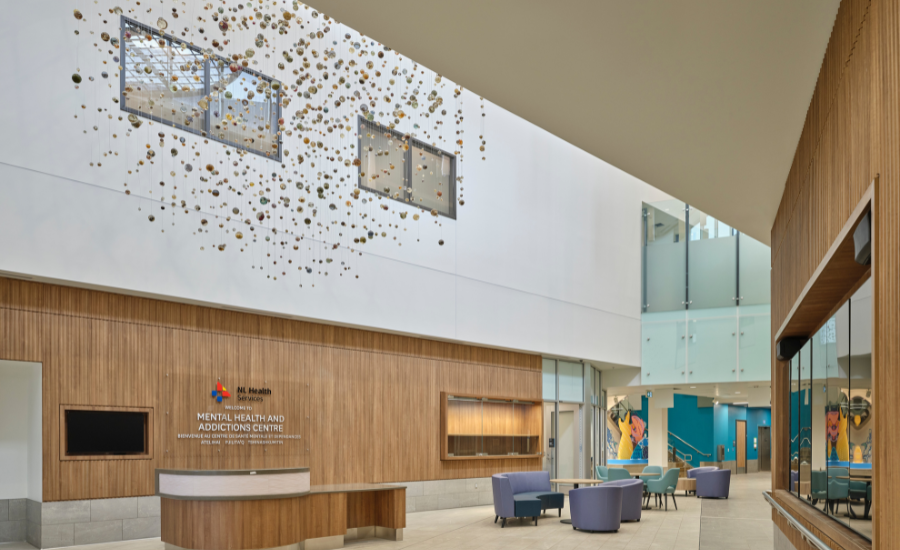
Patient-focused amenities are organized around a “therapeutic mall,” offering services such as physiotherapy, a fitness studio, art and music therapy, a horticultural suite, a hair salon, a clothing boutique, and a library, along with indoor and outdoor contemplation spaces. The facility also includes a full range of clinical areas to support both inpatient and outpatient care.
Reducing stigma
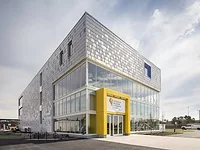
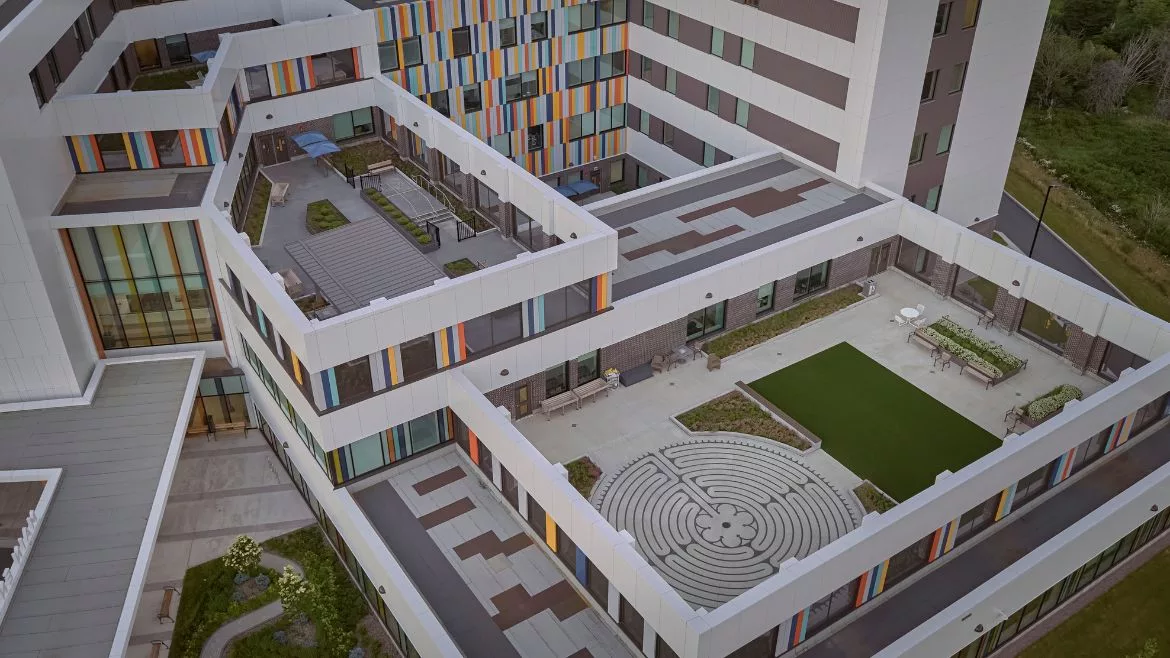
Rather than being a place of isolation or shame, MHAC is designed to be a welcoming, dignified care facility that prioritizes and centres the patient experience. While this is most apparent in interior spaces, it is further reflected in the building’s plan and form. MHACconsists of dual wings, composed in a C-shape, with a series of tiered terraces cascading toward the building’s entrance near a major arterial road. By reducing the scale of the building near its entrance, MHAC consciously considers a patient’s arrival sequence with a form that is welcoming, rather than intimidating.
The recurring use of colour further communicates optimism, warmth, and approachability. Most notable are bands of colourful vertical stripes adorning the building’s metal façade. (MHAC’s exterior is primarily constructed of aluminum and steel panelling, wrapped on the lower level with durable masonry). Inside, colours serve important wayfinding functions while also underlining the building’s connection to the local context by referencing the province’s brightly coloured Saltbox houses.
 Julian Parkinson
Accessible client-centred patient care & community integration
Rather than isolating patients from their families and communities, MHACenables their integration into the patient care and recovery process. A 60-room on-site hostel can accommodate families for overnight and extended visits, while communal spaces designed for gathering are integrated throughout. Patient rooms can even temporarily accommodate family members in critical situations.
Outpatient treatment services are designed to improve accessibility for patients and families. These include consultation and exam spaces, dentistry facilities, as well as ECT and TMS treatment spaces, among others.
Access to the outdoors
Adhering to evidence-based design, MHAC prioritizes access to nature and the outdoors as pillars of care. Patient terraces are found on the building’s upper levels, while courtyards are located at the ground level. These spaces include therapy gardens. Snowmelt systems improve year-round access to these exterior terraces. Terraces and courtyards feature a mix of hard and soft landscaping elements. Enclosure walls, consistent with the building's architectural style, create a secure, comfortable, and destigmatized patient environment.
The building’s architecture embraces and adapts to its site, enhancing public spaces and surrounding landscapes. The site plan, which connects MHAC to an existing campus spine and amenity space, improves campus access to the neighbouring wetlands. Staff, families, and select patients can now conveniently access nearby forested walking paths.
The design and development process carefully considered and mitigated MHAC’s impact on the wetlands while undertaking measures to mitigate and prevent flooding. The building's massing towards Warners Road minimizes its footprint on the wetlands, creating a green buffer between the facility and the natural area. A comprehensive stormwater management system ensures that MHAC is not susceptible to flooding.
Interior spaces also prioritize a connection to the outdoors. Upper-level terraces offer expansive views of the surroundings, while the building's angled and tiered form ensures ample daylighting in patient rooms. The use of natural materials, such as wood, aligns with biophilic design principles to enhance the overall patient experience.
Efficient Programming
MHAC’s facility planning aims to optimize operational efficiency by minimizing staff travel, enhancing energy efficiency through detailed technical specifications, and standardizing complex programmatic requirements for future adaptability.
Sustainable performance
MHAC is LEED Gold certified, standing out for its high-performance building envelope designed for energy efficiency, incorporating features such as:
- Terraces with integrated snow melt systems
- Seasonally optimized design for ease of maintenance
- A robust snow management plan
Other sustainability features include:
- All plant species used in landscaping are drought-resistant and native to the area.
Lighting design maximizes natural lighting to improve both energy performance and occupant comfort through daylighting sensors.
Looking for a reprint of this article?
From high-res PDFs to custom plaques, order your copy today!
.webp?height=740&t=1767036885&width=auto "Header - BE 1170x658 (002).png")

.webp?height=740&t=1755781744&width=auto "KEE(2).png")