Building Enclosure logo
search
cart
facebook twitter linkedin youtube instagram Spotify Podcasts Apple Podcasts Spotify Podcasts Apple Podcasts
  • Sign In
  • Create Account
  • Sign Out
  • My Account
Building Enclosure logo
  • NEWS
    • Breaking News
  • SECTIONS
    • Columns
    • Project Profiles
    • Trade Shows
    • Sponsor Insights
  • SYSTEM DESIGNS
    • Low-Slope Roofs
    • Pitched Roofs
    • Metal Roofing Materials
    • Waterproofing
    • Sustainability
    • Insulation
    • Exterior Claddings
    • Wall Systems
    • Building Envelope
  • BLOG
    • The BE Blog
  • MEDIA
    • Podcasts
    • Webinars
    • Quiz
    • Videos
    • Polls
    • Interactive Spotlights
    • Newsletter
    • Photo Galleries
  • DIRECTORIES
    • Directory: Blue Book
    • Directory: Roofing Resource
  • PRODUCTS
  • TECHNICAL
    • Codes
      • Waterproofing
      • Roofing
    • Details
      • Waterproofing
      • Roofing
  • CONTINUING ED
  • ABOUT
    • Advertise
      • Editorial Calendar
    • Contact
    • eMag Archive Issues
  • SIGN UP!
Breaking News

USGBC California Releases Building Performance Standards Policy Guidance for Local Jurisdictions

The guidance follows the launch of the California Building Performance Hub digital platform
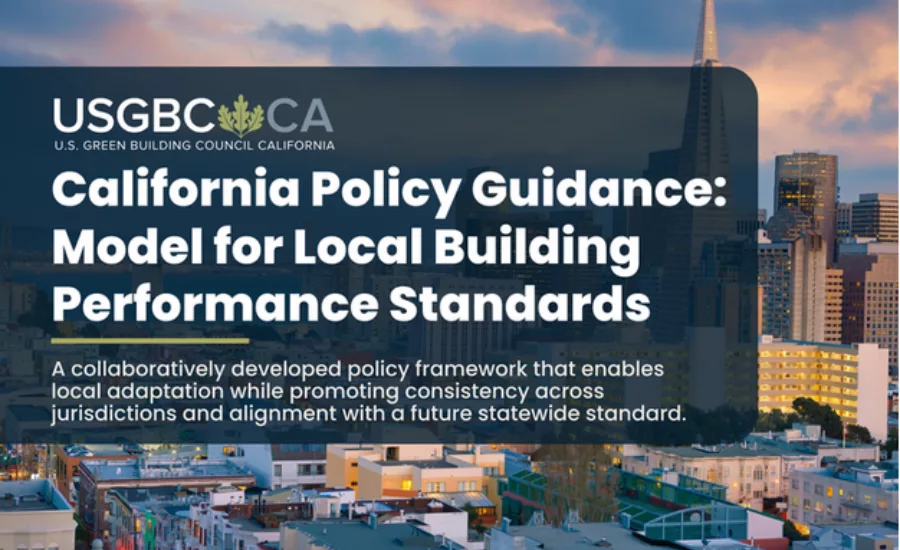
graphic shows USGBC-CA Releases Building Performance Standards Policy Guidance for Local CA Jurisdictions
USGBC CA
February 24, 2026

USGBC California (USGBC-CA) announces the launch of a building performance standard (BPS) model policy to help cities and counties across California reduce pollution from buildings, improve energy efficiency, and reach their climate goals. BPS are policies that regulate the annual greenhouse gas emissions and/or energy use of existing large buildings – typically residential, commercial, and government buildings with floor area above 20,000 ft2 or more.
 
The goal of this policy guidance is to give local jurisdictions a head start on developing local BPS policies while encouraging consistency across California jurisdictions – a key need identified by property owners and the community of professionals that benchmark, audit, and retrofit covered buildings. In developing the guidance, USGBC California prioritized simplicity, practical feasibility, and equity.
 
This follows USGBC California's October launch of the California Building Performance Hub, a comprehensive resource designed to guide thousands of buildings in accelerating retrofits, supporting California’s urgent need for equitable and affordable building decarbonization.
 
“California’s climate goals depend on the performance of the buildings we already have. This guidance is designed to help cities and counties move from conversation to action—providing a practical, consistent framework that supports implementation while allowing flexibility for local needs,” states Ben Stapleton, CEO, USGBC California. “Through the California Building Performance Hub and our Peer Learning Collaborative, USGBC California is committed to helping jurisdictions turn policy into real-world results for communities across the state.”
 
The model policy was developed by USGBC California with input from the California BPS Peer Learning Collaborative (CalBPS PLC), a program of USGBC California that brings together staff from 50 local governments, the California Energy Commission, and a number of other organizations to collaborate on development of BPS policies. The policy guidance adapts best practices from the Institute for Market Transformation (IMT) and adopted BPS ordinances around the U.S. into a shared policy framework for California cities and counties, with the intent that this framework will provide general consistency across jurisdictions and, to the extent possible, with a future statewide BPS.
 
California Energy Commission (CEC) Commissioner Andrew McAllister noted, “By serving as a template for BPS, USGBC California's model policy encourages alignment across adopting jurisdictions. A consistent policy framework and a solid implementation toolkit are critical for accelerating investment in buildings across the state. Getting things right from the outset helps to ensure that each project realizes the expected energy efficiency and pollution reduction outcomes, both in the near term and over the life of the building.”

The policy is designed to encourage efficient electrification through two metrics: requiring properties to eliminate greenhouse gas emissions produced on the property and to achieve a reasonable level of energy efficiency.
 
Most properties 20,000 square feet and larger are covered, with flexibility for jurisdictions to set their own limits.
 
BPS policies provide property owners clear, long-term performance targets to allow them to incorporate compliance into their capital planning process, while also requiring annual reporting (“benchmarking”) and compliance with interim performance targets that demonstrate progress toward the final targets. The first interim targets are meant to be relatively easy to achieve, and increase in stringency over time on a five year cycle toward the final targets.
 
BPS policies also include alternative compliance options to provide flexibility for property owners.
 
Because circumstances may make the standard compliance pathway a bad fit for certain properties, and in order to reward property owners who make a good faith effort to meet the requirements of this policy, a number of temporary exemptions, time extensions, and target modification options are available. These include special options for affordable housing and a portfolio option for large building owners.
 
The full policy guidance can be found here. USGBC California plans to release model ordinance text to complement the policy guidance in the spring.
 
 Buildings represent the second-largest source of greenhouse gas emissions in California after transportation, making building decarbonization critical to achieving the state's climate goals. USGBC California has taken the initiative to create a model policy and backed that up with the CA Building Performance Hub that offers sophisticated resources, tools, and expert guidance for building owners and managers, local governments, contractors, tenants, and community advocates as they navigate this growing and complex landscape around BPS policies statewide.
 
Read the complete Hub announcement here.
 

KEYWORDS: California climate change energy efficiency green building greenhouse gas USGBC (US Green Building Council)

Share This Story

Looking for a reprint of this article?
From high-res PDFs to custom plaques, order your copy today!


Recommended Content

JOIN TODAY
to unlock your recommendations.

Already have an account? Sign In

  • bar graph shows LEED v4/LEED v5/LEED v6 in various colors

    When Will LEED v4 / v4.1 and LEED v5 Expire?

    The latest version of the LEED rating system, LEED v5, is...
    Sustainability
    By: Daniel Overbey
  • Celebrating Women In AEC-2026

    Celebrating Women in The AEC Industry Part 1

    A round-up of women in the design, engineering and...
    Sustainability
    By: Lindsay Lewis
  • KEE membrane application on a roof

    A Beginner’s Guide to Single-Ply Roofing Membranes

    While PVC and TPO appear extremely similar, the chemistry...
    Low-Slope Roofs
    By: Peter Gross
Manage My Account
  • Sign up for the Newsletter
  • Online Registration
  • Manage My Preferences
  • Registration Customer Service

More Videos

Sponsored Content

Sponsored Content is a special paid section where industry companies provide high quality, objective, non-commercial content around topics of interest to the Building Enclosure audience. All Sponsored Content is supplied by the advertising company and any opinions expressed in this article are those of the author and not necessarily reflect the views of Building Enclosure or its parent company, BNP Media. Interested in participating in our Sponsored Content section? Contact your local rep!

close
  • 2 construction workers and a DEXcell panel
    Sponsored byDEXcell Roof Boards

    Designing Low-Slope Roofs for Resilience

  • Bell Bank headquarters in Fargo, North Dakota
    Sponsored bySto Corp.

    Drained and Back-Ventilated Rainscreens vs Pressurized-Equalized Rainscreens

  • A construction worker using DEXcell roof boards
    Sponsored byDEXcell Roof Boards

    The Hidden Strength of Low-Slope Roof Systems: Why Roof Cover Boards Matter

Popular Stories

a man wearing a mask installs insulation into a wall system

Quiet Rooms and Healthier Air: A Second Look at What Goes Inside the Wall Cavity

Canalino Elementary School and Canalino Family School exterior

Daylighting Design to Support Rapidly Growing Trend in Modular Building Construction

construction workers on a roof, plane flies in background

Why Specifications Are Becoming the Next Critical Layer of Construction Compliance

Building Enclosure Newsletter

BE Poll

Events

June 17, 2025

Addressing Condensation in Low-Slope Roof Assemblies

Credits: 1 AIA LU/HSW; 0.1 ICC CEU; 1 IIBEC CEH; 0.1 IACET CEU

On Demand In modern roofing systems, vapor retarders and air barriers do more than just minimize air leakage—they’re essential to maximizing performance and longevity. This engaging course dives into the next generation of moisture control: permeable vapor retarders and air barriers. Discover how these cutting-edge technologies are transforming low-slope roofing assemblies by improving energy efficiency, managing moisture, and boosting wind uplift resistance.

April 9, 2026

Strategies for High-Performance Below-Grade Waterproofing

Credits: 1 AIA LU/HSW ; 1 IIBEC CEH; 0.1 IACET CEU

On-Demand Designing a high-performance building enclosure requires more than just surface-level protection; it demands a rigorous, performance-based mastery of below-grade water and gas mitigation. This discussion will provide an expert-level analysis of below-grade waterproofing within the comprehensive framework of the high-performance building enclosure.

View All Submit An Event

Products

Plaster and Drywall Assemblies Manual

Plaster and Drywall Assemblies Manual

This is a comprehensive manual that goes beyond codes and standards, providing expert guidance in design, detailing, material selection and troubleshooting for plaster and drywall.

See More Products

Related Articles

  • Header - BE 1170x658 Dec.jpg

    How Building Performance Standards Can Advance Energy Codes

    See More
  • USGBC-CA logo

    USGBC California Brings 25th Annual CALIFORNIA GREEN BUILDING CONFERENCE to UC Berkeley

    See More
  • USGBC-CA logo

    USGBC-CA Launches Comprehensive Building Performance Hub to Help Accelerate Retrofits

    See More

Related Products

See More Products
  • studentguidebook.jpg

    Integrating Building Performance with Design: An Architecture Student’s Guidebook

  • 1118458605.jpg

    Sustainable Facades: Design Methods for High-Performance Building Envelopes

  • 111890950X.jpg

    Architectural Graphic Standards, 12th Edition

See More Products

Events

View AllSubmit An Event
  • May 13, 2025

    Unlock Enhanced Building Performance: Improved Durability and Efficiency Using Air Barriers and Vapor Retarders

    Credits: 1 AIA LU/HSW; 0.1 ICC CEU; 1 IIBEC CEH; 0.1 IACET CEUOn-Demand This presentation will uncover the differences between air barriers and vapor retarders and the benefits of each to improving the durability and efficiency of your building enclosure. Additionally, it will discuss critical installation details as it relates to the roof and roof/wall interface. 
View AllSubmit An Event
×

Enhance your expertise with unparalleled insights.

Join thousands of building professionals today. Shouldn’t you know what they know?

SUBSCRIBE TODAY!
  • RESOURCES
    • Advertise
    • Contact Us
    • Store
    • Want More
  • SIGN UP TODAY
    • Create Account
    • Newsletter
    • Customer Service
    • Manage Preferences
  • SERVICES
    • Marketing Services
    • Reprints
    • Market Research
    • List Rental
    • Survey/Respondent Access
  • STAY CONNECTED
    • LinkedIn
    • Facebook
    • Instagram
    • YouTube
    • X
  • PRIVACY
    • PRIVACY POLICY
    • TERMS & CONDITIONS
    • DO NOT SELL MY PERSONAL INFORMATION
    • PRIVACY REQUEST
    • ACCESSIBILITY

Copyright ©2026. All Rights Reserved BNP Media, Inc. and BNP Media II, LLC.

Design, CMS, Hosting & Web Development :: ePublishing