Project Preserves Memory While Building Seattle’s Future
State Street Apartments explores how new construction can positively contribute to an evolving neighborhood
Seattle’s Rainier Valley is one of the most racially and culturally diverse neighborhoods in the United States. Historically known as the Atlantic neighborhood, upper Rainier Valley was home to culturally rich communities of immigrants and marginalized populations, including Italian Americans in the early part of the 20th century, Japanese Americans prior to 1942, and African Americans whose housing options were limited by discriminatory policies. The once cohesive neighborhood was irreparably bifurcated by the construction of I-90 in 1940. Today, the upper Rainier Valley is rapidly transforming in response to a new Light Rail Station and major zoning changes intended to address housing affordability.
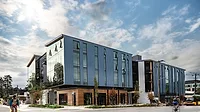
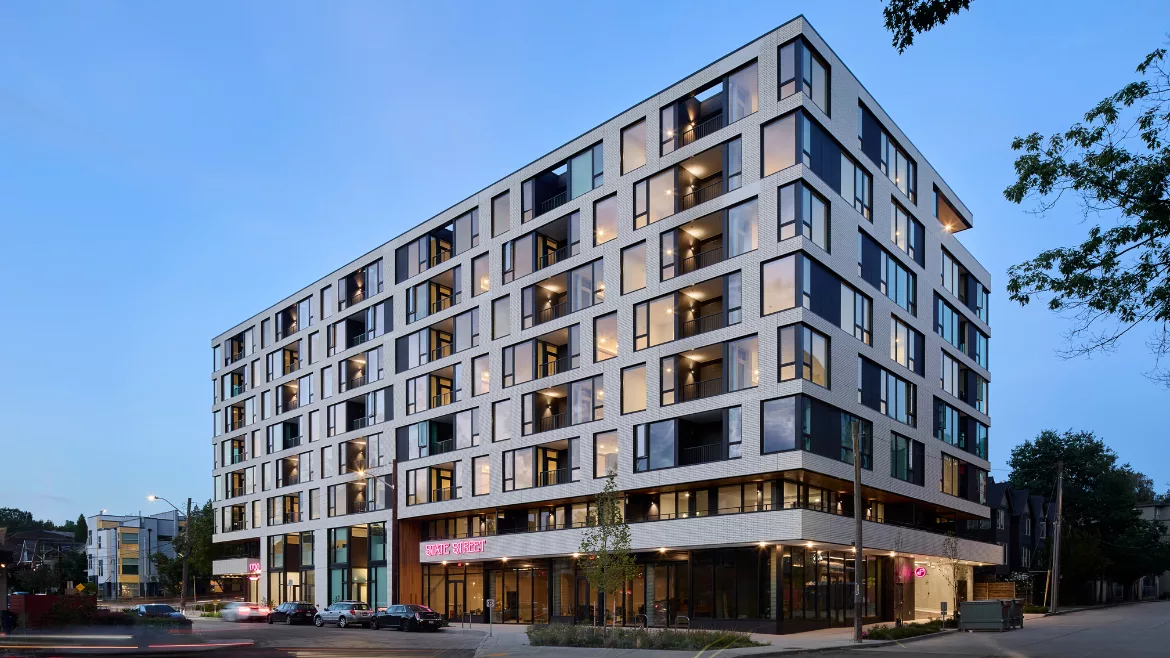
State Street Apartments explores how new construction can positively contribute to an evolving neighborhood. Located at a prominent intersection, the eight-story building serves as a new gateway to the neighborhood. 158 apartment units float above a glassy, pedestrian-oriented base that contains commercial spaces and a residential lobby. Two levels of parking accommodate 66 vehicles and 150 bikes.
A subtractive approach to managing the building’s mass allowed the design team to address differing contextual conditions around the site. Along the primary street, the first two levels are recessed, creating a lofty, sheltered pedestrian zone that heightens the presence of the commercial spaces. This move also distinguishes the concrete construction of the lower levels from the wood-framed stories above. Along the east side, two large courtyards are carved into the mass, responding to the smaller scale neighboring townhouses. These outdoor spaces are positioned to maximize light and privacy for both residents and neighbors. A top-floor setback further softens the building’s transition to the townhouses and provides space for communal rooftop terraces.
The building presents a cohesive, singular image with brick wrapping all three street-facing sides and secondary materials kept to a minimum. A layered façade strategy with integrated balconies adds porosity and depth while also expressing the rhythm of apartment units within. Residential windows are arranged in a dynamic, but systematic manner that creates an even perforation across the brick exterior.
At street level, the building’s northwest and southwest corners serve as welcoming entry points for visitors and residents alike. A generous residential lobby occupies the north corner, encouraging interaction among residents and serving as a “lantern on the corner” after dark. The south corner contains a commercial space, likely a restaurant, that will animate the streetscape with oversized glass sliders connecting the interior to sidewalk activity. Between the lobby and commercial space, four high-functioning live work lofts exploit the double-height base, each with clearly articulated first-floor work areas and stairs leading to upper-level studio apartments.
A “memory walk” along the north side of the lobby pays homage to the history of the Atlantic neighborhood. Designed by a local artist Kenzan Tsutakawa-Chinn from Studio 1-Thousand, the installation features hexagonal reflectors that envelop the space, enticing passersby to wander in and contemplate the forces that have shaped this evolving neighborhood.
Looking for a reprint of this article?
From high-res PDFs to custom plaques, order your copy today!
.webp?height=740&t=1767036885&width=auto "Header - BE 1170x658 (002).png")

.webp?height=740&t=1755781744&width=auto "KEE(2).png")