Designing for What’s Next: Adaptive Reuse of an Industrial Landmark
Reimagining Industry: The Turn & Grind Shop in Lehigh Valley, PA
.webp?t=1758545255)
Lehigh Valley, Pennsylvania, once the epicenter of American industrial strength, is a region once shaped by steel and now by what comes after. In Bethlehem, one of the region’s three cities, the towering blast furnaces of the former Bethlehem Steel still dominate the skyline even as land around it is reimagined, one structure at a time, into a space where creativity and community take center stage.
The latest chapter in that transformation is the Lehigh Valley Health Network part of Jefferson Health Turn & Grind Shop, a former steelmaking facility now undergoing a complete adaptive reuse to become an integral part of ArtsQuest’s arts and culture campus. This project, developed by ArtsQuest and designed by MKSD architects, reflects both a respect for the past and a vision for the future; a future where arts, education and architecture intersect in meaningful ways.
Industrial Bones, Cultural Rebirth
The Turn & Grind Shop originally served as a vital space for Bethlehem Steel’s finishing work, where precision parts were shaped and polished. With steel production ceasing in 1995 and the final plant closure in 2003, the building sat dormant for years as part of a larger industrial landscape in transition.
When ArtsQuest began exploring ways to expand its programming footprint on the SteelStacks campus, the Turn & Grind Shop emerged as a candidate for adaptive reuse. Its industrial character, proximity to existing festival infrastructure and flexible open-span interior made it a compelling opportunity to support the organization’s growing demand for arts programming, festivals, exhibitions and private events.
Adaptive Reuse Strategy
The project prioritizes architectural integrity, sustainability and flexibility. Retaining the original steel framing and masonry exterior shell allows the building to maintain its historical identity while introducing modern systems to improve energy efficiency, accessibility and climate control.
The exterior is being carefully restored and enhanced using materials that complement the original structure but provide improved performance. While MKSD architects will provide more detail on the materials and building technology, the design embraces contrast: preserving rusted beams and patinated surfaces alongside new mechanical systems and high-performance glazing.
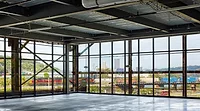
Rather than erase the building’s industrial past, the adaptive reuse design highlights it, bringing forward architectural details like gantry beams, overhead track systems, and steel trusses as visual storytelling tools. Where possible, original elements are being salvaged and integrated into public areas of the building.
Community, Flexibility and Use
Once complete, the 12,000-square-foot LVHN part of Jefferson Health Turn & Grind Shop will serve multiple functions for ArtsQuest and the greater Lehigh Valley community. It will be a key venue during large festivals like Musikfest, Christkindlmarkt and Oktoberfest, offering flexible space for everything from vendor markets and art installations to food and beverage experiences.
Outside of peak festival season, the facility will house rotating art and scientific exhibitions and private rentals including weddings, corporate events and additional celebratory events in a uniquely industrial setting. The adaptable open floor plan was a driving force in the building’s reactivation strategy, ensuring that it could support a wide variety of uses without requiring future structural rework.
In addition, the project integrates access to digital infrastructure, A/V systems and gallery-ready lighting to support a range of artistic disciplines, from traditional visual art to immersive media.
Sustainable Urban Renewal
From a city planning perspective, the reuse of the Turn & Grind Shop aligns with broader goals to reinvigorate underutilized industrial sites while preserving the unique character of Bethlehem’s built environment. As an anchor institution in the Lehigh Valley, ArtsQuest has invested in revitalizing South Bethlehem through cultural activation rather than demolition and reconstruction.
By repurposing the Turn & Grind Shop, the project reduces construction waste, conserves embodied carbon and preserves an important piece of regional identity. As with other SteelStacks structures, it represents a balance between preservation and innovation, making it possible for new stories to unfold within old walls.
A Model for Industrial Reuse
MKSD architects is leading the transformative adaptive reuse of the Turn and Grind Building at the former Bethlehem Steel campus, honoring its industrial legacy while preparing the structure to meet modern performance standards. MKSD’s design focuses on integrating a high-performance building enclosure that augments, rather than replaces, the structure’s historic fabric. The strategy preserves key architectural elements, including the original clerestory windows, which continue to provide natural daylighting, while introducing new materials and systems that meet today’s standards for energy efficiency, durability and occupant comfort.
Central to MKSD’s approach was a comprehensive cost modeling exercise that informed the development of the roof assembly, one of the most critical components of the building enclosure. The model evaluated multiple design options to identify a solution that achieved optimal thermal performance, water tightness, structural integrity and construction efficiency without compromising the building’s character. The resulting assembly balances performance and cost, allowing the project team to maximize value while minimizing disruption to the building’s historic elements.
As part of MKSD’s enclosure strategy, existing masonry walls that contribute to the building’s architectural character are being preserved and left exposed to highlight their historic texture and craftsmanship. In contrast, masonry walls that are not considered significant to the building’s visual identity are being insulated from the interior to improve thermal performance. This selective approach allows the project to honor the building’s industrial heritage while meeting modern energy efficiency standards.
MKSD architects’ design approach thoughtfully juxtaposes new architectural elements with the existing industrial fabric of the Turn and Grind Building, creating a dialogue between past and present. Contemporary materials and detailing-such as exposed concrete flooring, warm wood tones, glass and clean, minimalist forms-are introduced in ways that reference the building’s original function and character without mimicking it. These new insertions are deliberately expressed as distinct yet complementary, allowing the building’s historic masonry, steel and clerestory windows to remain visually prominent. The result is a layered architectural experience that honors the building’s industrial heritage while clearly marking its evolution into a modern, high-performing space.
The adaptive reuse effort not only preserves a key piece of Bethlehem’s industrial past but also demonstrates how legacy buildings can meet modern performance goals through intelligent design and strategic investment. Through their work on the Turn and Grind Building, MKSD architects illustrates how thoughtful integration of new systems within a historic shell can support sustainable development and set a precedent for future reuse efforts on the former steel campus and beyond.
The project has drawn interest from other communities exploring similar strategies to revive post-industrial landscapes. Through public-private collaboration and thoughtful architectural design, the LVHN part of Jefferson Health Turn & Grind Shop demonstrates what’s possible when creative placemaking meets intentional building reuse.
It also speaks to the broader trend of reclaiming industrial structures not simply for nostalgia, but for their structural potential, adaptability and place-based meaning.
Conclusion
The adaptive reuse of the LVHN part of Jefferson Health Turn & Grind Shop is not just about saving a building, it’s about restoring a sense of purpose to a place once defined by labor, scale and precision. In doing so, ArtsQuest and MKSD architects are creating a new kind of workspace: one where creativity replaces industry, and where community, culture and architecture work hand in hand.
As the Lehigh Valley continues to evolve as a hub for innovation and the arts, projects like this one help bridge the past and future, by showing that even the most utilitarian spaces can be transformed into centers of inspiration.
Looking for a reprint of this article?
From high-res PDFs to custom plaques, order your copy today!
.webp?height=740&t=1767036885&width=auto "Header - BE 1170x658 (002).png")

.webp?height=740&t=1755781744&width=auto "KEE(2).png")


.webp?height=200&t=1758808841&width=200 "Miller Hull(3).png")


