News Analysis
Court Strikes Down Trump’s ‘Liberation Day’ Tariffs
While suppliers had stockpiled materials, and metal tariffs remain in place, the economy may have dodged a bullet
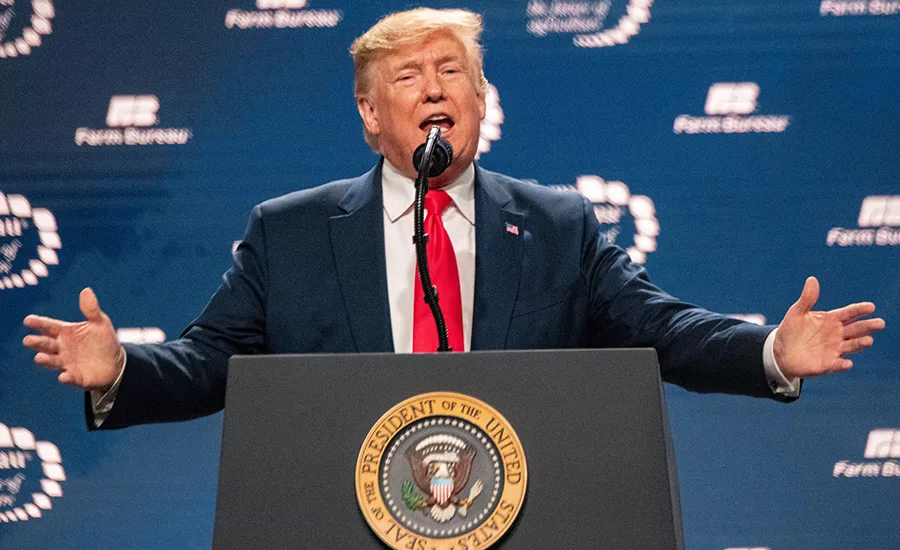
A federal court has struck down former President Donald Trump’s “Liberation Day” tariffs, ruling they exceeded constitutional limits. The decision halts sweeping import duties imposed under emergency powers and reaffirms that only Congress can enact broad trade measures.
— Image courtesy of Adobe Stock
A three‑judge panel of the U.S. Court of International Trade delivered a stinging rebuke to President Donald Trump’s use of emergency powers on May 28, ruling that his “Liberation Day” tariffs exceeded constitutional and statutory limits.
In its decision, the court held that Executive Order 14257 — under which Trump imposed a 10% baseline levy on most imports and higher, up to 50%, country‑specific duties — could not be justified under the International Emergency Economic Powers Act of 1977.
The decision permanently enjoined enforcement of those tariffs, finding that only Congress may legislate broad‑based import duties.
The ruling vacates virtually all of the IEEPA‑rooted tariffs Trump announced on April 2, including reciprocal measures targeting nations with which the United States runs a trade deficit, and those justified by national‑security arguments framed as emergencies.
“The court does not pass upon the wisdom or likely effectiveness of the President’s use of tariffs as leverage,” the panel wrote, “but that use is impermissible…because [federal law] does not allow it,” as first reported by Reuters.
At the same time, industry‑specific duties on steel, aluminum and automobiles — imposed under Section 232 of the Trade Expansion Act of 1962 following Commerce Department investigations — remain untouched by the decision.
QUICK READ: WHAT THIS MEANS FOR THE BUILDING INDUSTRY
- Broad Tariffs Struck Down: The court invalidated Trump’s “Liberation Day” tariffs, ruling they exceeded presidential authority. This eliminates many import duties that drove up material costs.
- Material Prices May Stabilize—Slowly: While some relief is expected, core tariffs on steel and aluminum, critical to roofing, remain in place. Price pressures will likely continue in the near term.
- Supply Chain Uncertainty Persists: Remain cautious. The ruling clarifies part of the trade policy chaos, but new tariff tools may still emerge, potentially affecting long-term procurement plans.
- Roofers Already Felt the Pain: An RC poll this month showed nearly one-third of roofers said tariffs were hurting business. Material costs are up 46% since 2020, straining project budgets and timelines.
- Policy Shift Reasserts Congressional Control: This decision reaffirms that only Congress can impose broad tariffs—limiting sudden shifts in trade rules. It’s a win for predictability, but political gridlock could still stall meaningful reform.
Legal Basis and Scope of the Ruling
The court’s unanimous per curiam order emphasized that the Constitution vests the power to regulate international commerce exclusively in Congress, a principle that cannot be overridden by executive fiat under the IEEPA.
In legal terms, the decision rested on two pillars: the nondelegation doctrine, which prohibits Congress from passing its legislative responsibilities to the president without an “intelligible principle,” and the “major questions” doctrine, requiring a clear statutory grant for decisions of vast economic and political significance.
Judge Gary S. Katzmann, speaking for the panel alongside Judges Timothy M. Reif and Jane A. Restani, insisted that trade imbalances, which have persisted for decades, do not constitute the “unusual and extraordinary threat” IEEPA demands before unleashing sweeping tariffs.
“That’s not how our constitutional republic works,” said Jeffrey M. Schwab, senior counsel at the Liberty Justice Center, one of the plaintiffs’ attorneys, as the lawsuits combined challenges by small businesses and 12 states.
Economic Impact on Industry
Financial markets greeted the court’s decision with relief. U.S. stock futures rose sharply on Thursday morning ahead of the market open, while the U.S. dollar strengthened against the euro, yen, and Swiss franc. Analysts attributed the rally to eased fears of a protracted trade war and robust corporate earnings.
For the building envelope's supply chain, however, the ruling offers only partial relief. The construction industry had already been roiled by uncertainty created by Trump’s on‑again, off‑again tariff threats.
Thomas Hasler, chief executive of Swiss chemicals maker Sika — a key supplier of materials used to strengthen and waterproof walls, floors and roofs — said uncertainty over trade policy prompted U.S. construction firms to delay projects.
“Everything started to slow down,” Hasler told Reuters. “Some of the projects that were indicated to launch soon have been put on the backburner.” He added that while the infrastructure sector remained “very resilient,” many companies were awaiting clearer guidance before adjusting their supply chains.
Roofing contractors reported acute strains. According to a poll by Roofing Contractor magazine, 32 percent of roofers said “tariffs are hurting business,” and nearly half of those surveyed cited rising material costs — already up 46 percent since 2020, per the National Roofing Contractors Association — as a top concern.
Trade Relations and Remaining Tariffs
The court’s decision wipes out the president’s IEEPA‑based tariffs on Canada, Mexico and China, which had included a 25 percent levy on certain Canadian and Mexican goods and a 10 percent surcharge on Chinese imports (later adjusted during a 90‑day pause.
Yet sector‑specific duties on steel and aluminum — vital inputs for machinery, vehicles and building materials — remain in force.
Canada, which supplies roughly 79 percent of U.S. primary aluminum, and major steel exporters like Brazil and South Korea, continue to face these trade barriers, maintaining pressure on domestic costs.
Looking Ahead
The injunction took effect immediately; the court ordered the Trump administration to issue conforming orders within 10 days and legal experts doubt the tariffs will be reinstated swiftly.
“The ruling makes it clear that the broad tariffs imposed unilaterally by Trump represent an overreach of executive power,” said Eswar Prasad, professor of trade policy at Cornell University.
Wendy Cutler, vice president at the Asia Society Policy Institute and a former U.S. trade official, warned that negotiating partners may stall trade talks until clarity emerges. “It throws the president’s trade policy into turmoil,” she told the Associated Press.
With his IEEPA-based toolkit effectively neutered, the administration is reportedly exploring alternative statutes, including Section 301 of the Trade Act of 1974 and the shorter-term authorities of Section 122 and Section 338, to impose targeted tariffs following investigations into unfair practices.
Whether such measures will replicate the broad leverage Mr. Trump sought remains uncertain and they lack the sweeping scope of the vacated “Liberation Day” tariffs.
For now, U.S. businesses and global markets will closely monitor the appeal. If upheld, the ruling reasserts congressional primacy in trade policy despite the majority party in Congress refusing to curb the executive ambitions, underscoring the constitutional balance of powers at the heart of America’s tariff regime.
Looking for a reprint of this article?
From high-res PDFs to custom plaques, order your copy today!
.webp?height=740&t=1767036885&width=auto "Header - BE 1170x658 (002).png")

.webp?height=740&t=1755781744&width=auto "KEE(2).png")
.webp?height=200&t=1755538489&width=200 "Tariffs(3).png")

.webp?height=200&t=1775190767&width=200 "AIA")