Building Enclosure logo
search
cart
facebook twitter linkedin youtube instagram Spotify Podcasts Apple Podcasts Spotify Podcasts Apple Podcasts
  • Sign In
  • Create Account
  • Sign Out
  • My Account
Building Enclosure logo
  • NEWS
    • Breaking News
  • SECTIONS
    • Columns
    • Project Profiles
    • Trade Shows
    • Sponsor Insights
  • SYSTEM DESIGNS
    • Low-Slope Roofs
    • Pitched Roofs
    • Metal Roofing Materials
    • Waterproofing
    • Sustainability
    • Insulation
    • Exterior Claddings
    • Wall Systems
    • Building Envelope
  • BLOG
    • The BE Blog
  • MEDIA
    • Podcasts
    • Webinars
    • Quiz
    • Videos
    • Polls
    • Interactive Spotlights
    • Newsletter
    • Photo Galleries
  • DIRECTORIES
    • Directory: Blue Book
    • Directory: Roofing Resource
  • PRODUCTS
  • TECHNICAL
    • Codes
      • Waterproofing
      • Roofing
    • Details
      • Waterproofing
      • Roofing
  • CONTINUING ED
  • ABOUT
    • Advertise
      • Editorial Calendar
    • Contact
    • eMag Archive Issues
  • SIGN UP!
Breaking News

ABC: Construction Industry Must Attract 439,000 Workers in 2025
ABC.png

Image courtesy of ABC.

January 27, 2025

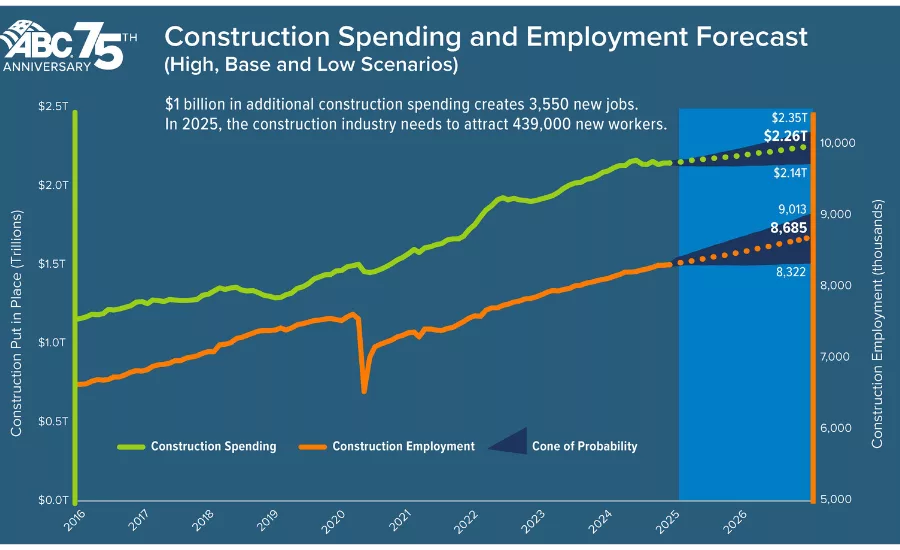
The construction industry will need to attract an estimated 439,000 net new workers in 2025 to meet anticipated demand for construction services, according to a proprietary model developed and released today by Associated Builders and Contractors. In 2026, the industry will need to bring in 499,000 new workers as spending picks up in response to presumed lower interest rates.

“While the construction workforce has become younger and more plentiful in recent years, the industry still must attract 439,000 new workers in 2025 to balance supply and demand,” said ABC Chief Economist Anirban Basu. “If it fails to do so, industrywide labor cost escalation will accelerate, exacerbating already high construction costs and reducing the volume of work that is financially feasible. Average hourly earnings throughout the industry are up 4.4% over the past 12 months, significantly outpacing earnings growth across all industries.”

ABC’s proprietary model uses the historical relationship between inflation-adjusted construction spending growth, sourced from the U.S. Census Bureau’s Construction Put in Place Survey, and payroll construction employment, sourced from the U.S. Bureau of Labor Statistics, to convert anticipated increases in construction outlays into demand for construction workers at a rate of approximately 3,550 jobs per billion dollars of additional spending. This model also incorporates the current level of job openings, unemployment and projected industry retirements and exits into its computations.

“This represents improved labor availability relative to recent years,” said Basu. “The improvement can be traced to two primary factors. First, construction spending is expected to grow at its slowest pace in years throughout 2025, especially in interest rate-sensitive segments like homebuilding. Interest rates will remain elevated in 2025 before likely beginning to dip next year. Second, the industrywide workforce has become significantly younger over the past several quarters, with the median construction worker now younger than 42 for the first time since 2011. As a result, the pace of retirements is expected to slow this year.

“Despite that improvement, contractors will struggle to fill open positions,” said Basu. “This will be especially true in areas where manufacturing and data center megaprojects are underway. More than $1 in every $5 spent on nonresidential construction currently goes toward manufacturing projects, and those projects are absorbing a significant share of the labor force in their respective regions.”

“The U.S. construction industry’s efforts to hire more workers to replace retirees and meet the demand for new construction projects gained momentum in 2024,” said Michael Bellaman, ABC president and CEO. “That is fantastic news, but we still have a long way to go to shore up the talent pipeline. The data on the number of young people choosing a career in construction suggests that employing practical technology and innovation in educational programs and on jobsites helps maximize the productivity and efficiency of the construction workforce. ABC’s all-of-the-above workforce development strategy is working to draw new entrants into the industry through hundreds of entry points and upskill them through both industry-driven and government-registered apprenticeship programs.”

“There are also factors that could render this model overly conservative, meaning worker shortages could be more severe than predicted in 2025,” said Basu. “While the consensus forecast has construction spending increasing by less than 3% in 2025, that same forecast has underestimated growth by a significant margin during each of the past three years. If inflation dissipates in coming months, borrowing costs will subside and construction volumes will increase. Faster-than-expected immigration over the past few years has also bolstered labor supply, and potential changes to immigration policy will likely constrain worker availability.”

“Another solution to addressing the shortage is a merit-based, market-based visa system,” said Bellaman. “ABC’s goal is to work with the Trump administration and Congress to create a visa system that allows people who want to contribute to society and work legally in the construction industry to do so.

“President Trump and the 119th Congress have a significant opportunity to advance policies and regulations that protect free enterprise, reduce regulatory burdens, expand workforce development and create a fair and level playing field for all construction workers, regardless of their labor affiliation,” said Bellaman. “Legislation like the Tax Cuts and Jobs Act, the Employee Rights Act, the Fair and Open Competition Act and permitting reform can create the conditions for the construction workforce to rebuild America’s infrastructure. The construction industry thrives when all 8.3 million workers are given the opportunity to build America with fewer obstacles.”

KEYWORDS: construction labor shortage taxes US government

Share This Story

Looking for a reprint of this article?
From high-res PDFs to custom plaques, order your copy today!


Recommended Content

JOIN TODAY
to unlock your recommendations.

Already have an account? Sign In

  • bar graph shows LEED v4/LEED v5/LEED v6 in various colors

    When Will LEED v4 / v4.1 and LEED v5 Expire?

    The latest version of the LEED rating system, LEED v5, is...
    Sustainability
    By: Daniel Overbey
  • Celebrating Women In AEC-2026

    Celebrating Women in The AEC Industry Part 1

    A round-up of women in the design, engineering and...
    Building Envelope
    By: Lindsay Lewis
  • KEE membrane application on a roof

    A Beginner’s Guide to Single-Ply Roofing Membranes

    While PVC and TPO appear extremely similar, the chemistry...
    Low-Slope Roofs
    By: Peter Gross
Manage My Account
  • Sign up for the Newsletter
  • Online Registration
  • Manage My Preferences
  • Registration Customer Service

More Videos

Sponsored Content

Sponsored Content is a special paid section where industry companies provide high quality, objective, non-commercial content around topics of interest to the Building Enclosure audience. All Sponsored Content is supplied by the advertising company and any opinions expressed in this article are those of the author and not necessarily reflect the views of Building Enclosure or its parent company, BNP Media. Interested in participating in our Sponsored Content section? Contact your local rep!

close
  • 2 construction workers and a DEXcell panel
    Sponsored byDEXcell Roof Boards

    Designing Low-Slope Roofs for Resilience

  • Bell Bank headquarters in Fargo, North Dakota
    Sponsored bySto Corp.

    Drained and Back-Ventilated Rainscreens vs Pressurized-Equalized Rainscreens

  • A construction worker using DEXcell roof boards
    Sponsored byDEXcell Roof Boards

    The Hidden Strength of Low-Slope Roof Systems: Why Roof Cover Boards Matter

Popular Stories

construction industry workers in hard hats stand around a city scape

Construction Industry Revolts Over New CSI Licensing Plan

a man wearing a mask installs insulation into a wall system

Quiet Rooms and Healthier Air: A Second Look at What Goes Inside the Wall Cavity

Canalino Elementary School and Canalino Family School exterior

Daylighting Design to Support Rapidly Growing Trend in Modular Building Construction

Building Enclosure Newsletter

BE Poll

Events

June 17, 2025

Addressing Condensation in Low-Slope Roof Assemblies

Credits: 1 AIA LU/HSW; 0.1 ICC CEU; 1 IIBEC CEH; 0.1 IACET CEU

On Demand In modern roofing systems, vapor retarders and air barriers do more than just minimize air leakage—they’re essential to maximizing performance and longevity. This engaging course dives into the next generation of moisture control: permeable vapor retarders and air barriers. Discover how these cutting-edge technologies are transforming low-slope roofing assemblies by improving energy efficiency, managing moisture, and boosting wind uplift resistance.

April 9, 2026

Strategies for High-Performance Below-Grade Waterproofing

Credits: 1 AIA LU/HSW ; 1 IIBEC CEH; 0.1 IACET CEU

On-Demand Designing a high-performance building enclosure requires more than just surface-level protection; it demands a rigorous, performance-based mastery of below-grade water and gas mitigation. This discussion will provide an expert-level analysis of below-grade waterproofing within the comprehensive framework of the high-performance building enclosure.

View All Submit An Event

Products

Plaster and Drywall Assemblies Manual

Plaster and Drywall Assemblies Manual

This is a comprehensive manual that goes beyond codes and standards, providing expert guidance in design, detailing, material selection and troubleshooting for plaster and drywall.

See More Products

Related Articles

  • ABC: Construction Materials Prices Jump 0.4% in July

    ABC: Construction Materials Prices Jump 0.4% in July

    See More
  • Producer Price Index Percent Change Inputs to Construction Industries graph

    ABC: Construction Materials Prices Soar in April, Up 6.2% Since January

    See More
  • Vectorworks(4).png

    Vectorworks Reveals the Technologies Transforming the AEC Industry in 2025 and Beyond

    See More

Related Products

See More Products
  • 9780128207918.jpg

    Eco-efficient Materials for Reducing Cooling Needs in Buildings and Construction 1st Edition

See More Products
×

Enhance your expertise with unparalleled insights.

Join thousands of building professionals today. Shouldn’t you know what they know?

SUBSCRIBE TODAY!
  • RESOURCES
    • Advertise
    • Contact Us
    • Store
    • Want More
  • SIGN UP TODAY
    • Create Account
    • Newsletter
    • Customer Service
    • Manage Preferences
  • SERVICES
    • Marketing Services
    • Reprints
    • Market Research
    • List Rental
    • Survey/Respondent Access
  • STAY CONNECTED
    • LinkedIn
    • Facebook
    • Instagram
    • YouTube
    • X
  • PRIVACY
    • PRIVACY POLICY
    • TERMS & CONDITIONS
    • DO NOT SELL MY PERSONAL INFORMATION
    • PRIVACY REQUEST
    • ACCESSIBILITY

Copyright ©2026. All Rights Reserved BNP Media, Inc. and BNP Media II, LLC.

Design, CMS, Hosting & Web Development :: ePublishing