Enhancing Roof Coatings with Liquid Applied Membranes
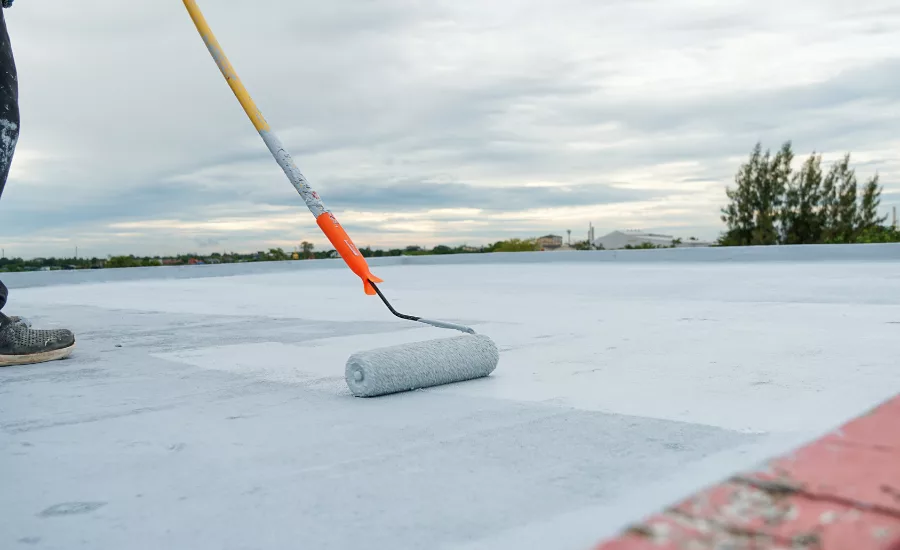
Photo courtesy of Trinseo.
With the global liquid roofing market projected to reach a staggering $16.61 billion by 20311, the use of latex-containing liquid applied membranes (LAMs) for exterior applications, including roof coatings, is rapidly rising in the dynamic building and construction industry.
LAMs are water-based latex dispersions offering high-performance roof coating formulations that excel in performance, such as ultra-violet resistance and cooling capabilities. They can be used in both new construction and roof rehabilitation. Moreover, LAMs allow for a simple application process as they are applied on substrates like metal, concrete, and bituminous material and only require commonly available coating devices, such as spray or roll.
Latex binders are central to the effectiveness of LAMs for roof coatings, which can be formulated to enhance performance and allow for improved sustainability. Customers can partner with a materials supplier to identify or even design the desired dispersion for the targeted application to achieve the right combination of performance properties. This way, they can offer full benefits to the end users, who will enjoy peace of mind regarding the roof’s functionality. In turn, industry players can enhance the longevity and performance of their roofing applications.
The Role of Latex Binders in Roof Coatings
Professional applications typically use pre- and top-coat layers. For maximum performance, the formulations can be differentiated. The objective is to have well-formed membranes with maximum waterproofing, weathering, and flexibility to withstand mechanical roofing movements for superior longevity. The proper latex formulation is essential to deliver the right property profile; close collaboration with the raw material supplier for formulation design can extract the most out of the chemistry applied.
Acrylic dispersions are predominantly used for their robust performance. However, it is also possible to turn to styrene butadiene (SB) emulsions for pre-coats. SB chemistry can provide stronger adhesion and lower water uptake than its acrylic counterparts and benefit from lower CO2 emissions at a competitive cost.
For top-coat applications, acrylic dispersions are the top choice for excellent weathering, UV resistance, and high mechanical flexibility. Acrylics are highly compatible with pigments, enabling excellent light reflection for cool roofing capabilities. Furthermore, they allow the right balance between waterproofing and moisture permeability, critically blocking water while maintaining breathability and allowing water vapor to escape. Formulators will also use special additives for low dirt pick-up during the coating phase.
By choosing the right chemistry, those in the building and construction industry can design a latex binder that meets their unique performance needs.
Improving Application
The role of latex binders goes beyond simply offering improved performance properties. These emulsions can further enhance the application process for roof coatings. The selection of the right latex allows for an optimal on-site application and the previously described roofing performance.
LAM membranes are developed and designed to withstand a broad range of operational temperatures, from freezing winters to hot summers. The latex polymer structure is designed to be tough and compensate for possible crack formation and substrate movement underneath.
Another benefit of using LAMs is that they can be applied over a longer time frame, potentially from early March to late November in some regions. Additionally, with the right latex binder, roof coatings can dry quickly in various demanding weather conditions, such as low temperatures or high humidity. The selection of the proper formulation can allow for faster setting, which typically allows for fast application and quicker waterproofing protection.
LAMs utilizing latex binders are significantly easier to apply than bituminous sheets for roof coatings. Bituminous sheets often require the use of open flames, which can be dangerous. Physical sheets also require glue to connect the roofing system, creating a greater risk of leaks if not installed correctly. The sheets must also be cut precisely to account for piping and other physical interruptions on the rooftop’s surface, resulting in more room for error and adding extra steps in the application process.
LAMs allow for ease of application, as they can be painted on and around piping. Furthermore, LAMs enable quick rehabilitation of roofing systems as they can easily be applied over an existing roof system. The binders within the LAMs also prevent asphalt from bleeding through, thereby allowing for the quick replacement of the previous system with updated technology, such as a cool roofing system.
Meeting Sustainability Requirements
In the coming years, the building and construction industry must meet both sustainability and performance requirements as environmental regulations evolve. Latex binders, with their unique properties, can play a vital role in supporting industry players in meeting new stringent guidelines. By formulating latex binders to be more sustainably advantaged without compromising performance, manufacturers can demonstrate their commitment to sustainability.
Working with their materials partner, manufacturers should look to formulate latex binders with low volatile organic compounds (VOCs) as more sustainability regulations surrounding emissions emerge. This collaborative approach ensures that the industry is at the forefront of sustainability efforts, creating a win-win situation for all stakeholders.
One way to do so is to create ammonia-free binders to reduce odor during application. Additionally, manufacturers can look to water-based binders as these chemistries do not include a solvent and further reduce VOCs.
To further their sustainability efforts, manufacturers should explore using latex binders in their roof coatings, which are produced using the International Sustainability and Carbon Certification’s mass balance approach. This chain of custody model makes it possible to track and validate the amount of sustainable materials within a final product as they move throughout the supply chain. Using this method, the industry can confirm the amount of sustainable or fossil-based materials in their roof coatings.
Manufacturers can also turn to latex binders that contain recycled content. Currently, latex binders are not inherently circular, but recycled feedstocks can reduce their reliance on raw materials. Post-consumer plastics can be broken down through chemical recycling technologies and repurposed into a high-quality monomer for use in the production of latex binders. By reimagining the composition of latex binders, the building and construction industry can be prepared to meet incoming sustainability regulations and adapt to the world around them.
The right latex binder formula enables the building and construction industry to enhance their roofing applications, allowing them to create a binder tailored to their specific performance requirements. Choosing the proper emulsion can also improve the application process for roof coatings, making them an attractive option compared to traditional coating sheets. Moreover, manufacturers can prepare themselves for evolving sustainability regulations by collaborating with their material partners to develop sustainably advantaged binder solutions for roof coatings.
Resources
1 Research, S. (2023, March 10). Liquid roofing market size, share, and future outlook to 2031. Straits Research.
Looking for a reprint of this article?
From high-res PDFs to custom plaques, order your copy today!
.webp?height=740&t=1767036885&width=auto "Header - BE 1170x658 (002).png")

.webp?height=740&t=1755781744&width=auto "KEE(2).png")