The Science of Sheen
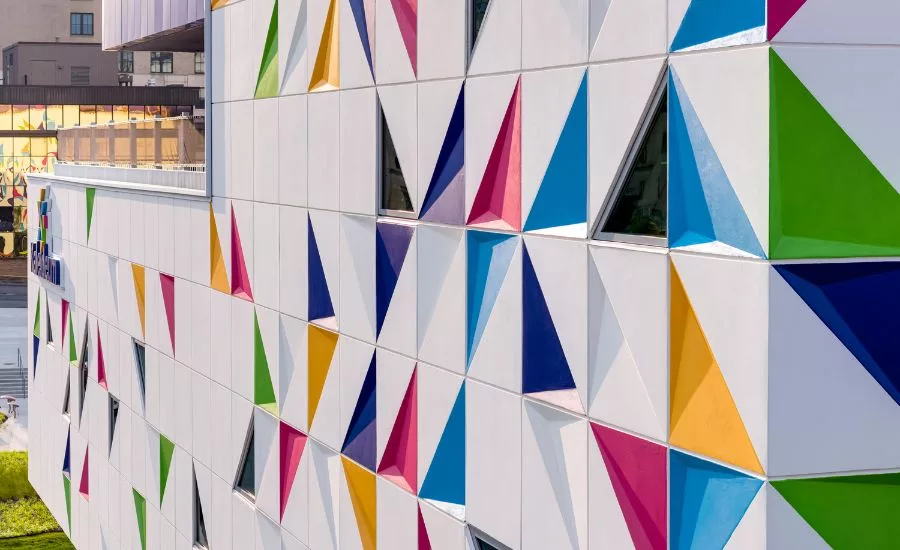
The Kaleideum Museum showcases vibrant, creative shapes finished with StoColor® Acryl Plus in an eggshell sheen. This exterior insulation and finish system (EIFS) not only enhances the bold, eye-catching appearance but also ensures long-lasting color retention and minimal maintenance to the facade.
By definition, sheen refers to the shiny or reflective quality of a surface, determined by the amount of light it reflects, and is most commonly related to paints or coatings. Glossy finishes have a higher sheen and, therefore, reflect more light, while flat or matte finishes have virtually no sheen at all and reflect less light. The higher the sheen, the more protective the finish. Or so we’ve been told. Innovation is challenging these simplistic definitions. New coatings and sheens don’t always live and perform by the old rules. What is driving this innovation, and what are some examples of these new rule-breaking coatings? We’ll get to that. But first, let’s talk about the origin of coatings and sheens.
A Brief History of Coatings and Sheen
Since the dawn of man, humans have expressed themselves through art and painting. The earliest evidence of paint-making is from South Africa and dates back over 100,000 years. The paint was made from red iron oxide and charcoal, and bone marrow was used as a binder, providing the sheen. From there, our desire for more pigments and different sheens drove innovation. Ancient Greeks, Egyptians, and Romans made coatings by mixing lead with wine and vinegar. Beeswax, egg yolk, and milk were used as binders. (Egyptians loved the high gloss.) In the late 19th century, enamel wall paint was introduced to European and American homes and was considered the ultimate in high gloss. As the science of coatings evolved, linseed oil became the go-to for creating a glossy finish. The more linseed oil used, the higher the gloss. But there was no gloss meter; painters determined the gloss level with the naked eye and achieved the sheen they were after by trial and error.
Today, the gloss meter measures how much light is reflected from a particular finish. And the finish you want is achieved through a modernized process that involves little guesswork.
Today’s Process for Creating Sheen
While there will always be some trial and error in innovation, for the most part, modern R&D has everything dialed in, even with the linseed oil, which is still used in oil-based coatings. The components in most coatings are essentially the same: pigments, binders, liquids, and additives. Each element in the coating has a particular role. Pigments provide the color. Binders bind the pigments together. Liquids suspend and carry the pigments to the desired surface. Additives provide specific coating properties, such as mold and mildew resistance.
The more binder used in the coating’s formulation, the higher the sheen; conversely, there is a lower sheen with less binder. Why? With less binder, more pigment grains become exposed at the coating’s surface, scattering the light and creating a matte effect. Of course, flat or matte finishes are a little more challenging to clean, but they hide imperfections. That’s important when the surface faces the scrutiny of critical lighting.
The Source of the Sheen
The sheen of a coating is primarily influenced by several key factors: light interaction, surface texture, material composition, and environmental conditions. The fundamental principle behind sheen is the reflection and absorption of light. When light hits a surface, some of it is reflected while some is absorbed, which determines the appearance of the sheen. Glossy surfaces reflect more light, creating a shiny appearance, whereas matte surfaces absorb more light, resulting in a dull finish.
Surface roughness and texture also play a crucial role in the perception of sheen. Smooth surfaces tend to reflect light more uniformly, enhancing the gloss effect, while rough or textured surfaces scatter light in multiple directions, reducing the gloss and creating a matte appearance. The formulation of the coating itself is another vital factor. The composition of binders, pigments, and additives in the coating affects how light interacts with the surface. Higher binder content typically results in a glossier finish, while higher pigment concentration can create a more matte effect by scattering light.
The angle of incidence, or the angle at which light strikes the surface, can change the perceived sheen. For instance, a surface may appear glossier when viewed from a certain angle compared to when viewed head-on. Environmental factors, such as humidity and temperature, can also impact the final appearance of the sheen. These conditions can affect the drying process and the final texture of the coating, thereby influencing its reflective properties.
Critical Lighting Reveals a Wall’s Secrets
9Wood, a specialty wood ceilings company based in Oregon, defines critical lighting as “specularly (like a mirror) reflected light at an acute or glancing angle. Critical lighting related to architecture occurs when light from fixtures or windows reflects onto a surface and highlights imperfections.”
Evaluating critical lighting helps you identify where light will expose your walls for what they really are: imperfect and sometimes downright ugly. You can then select the right sheen for that area, so no one has to know the truth. Will innovation help walls stand up to critical light? And where are these innovative products, and what’s driving the innovation?
The Drivers of Innovation
There are a range of factors that drive innovation: design and color trends, a changing climate, sustainability, raw material reliability and stability, and the biggie: environmental regulations. Not long ago, oil-based coatings were preferred. However, oil-based coatings require chemicals like acetone and mineral spirits to clean up, emitting heavy fumes. Regulations have led to the development of more acrylic coatings, which are more environmentally friendly and require only soap and water for cleanup.
In a recent CoatingTech survey, Sjaak Griffioen, director of innovation, Strategy, and Sustainability at DSM Coating Resins & Functional Materials, sums up his take on innovation: “[There’s a] focus on alternative raw materials creating the highest performing coatings partially made from waste or renewable raw materials. It is now all about coatings and coatings with higher performance than currently available without any negative environmental or indoor air quality impact.”
Griffioen continued: “Higher performance in combination with reduction of VOC to zero, as well as the reduction or even deletion of substances of high concern, do give companies like DSM fantastic opportunities in new polymer design.”
Sheen plays a crucial role in these innovations, as the desire to create sustainable coatings does not come at the cost of aesthetic qualities. Advances in raw material science and formulation technologies have enabled the production of environmentally friendly coatings that can achieve the same, if not better, levels of sheen and durability as their traditional counterparts.
There are many drivers of inspiration. Certainly, more than we’ve covered here. However, in addition to the market driving innovation, the coatings industry is always searching for inspiration.
Nanotechnology Delivers Big Results
While the first paints made by man used charcoal and bone marrow, the future of coating and its high-tech properties lies in nanotechnology. Nanoparticles can be engineered to absorb or scatter light in different ways. They also give us the ability to manipulate the chemical makeup of the coating. Using different nanoparticle sizes and shapes, we can tailor the reflective properties to achieve the exact sheen we want. Nanotechnology gives us greater control over every part of the coating, which means we can manipulate the formula to achieve things that were never possible before. But right now, the price of nanotechnology is high, which means the cost of the coatings developed using nanotechnology is expensive. However, that cost will surely come down as the industry moves toward greater use.
The Future of Sheen
Initially, paint was used for expression. The art of painting, as it was, relied heavily upon what was abundant in the environment. Today, R&D and nanotechnology are making the impossible possible. New products will continue challenging the traditional rules of a matte finish versus a gloss finish. But even if coatings become so smart that you can choose any coating for any environment and eliminate the concerns of critical light, you’ll have the freedom to select the finish you desire for purely aesthetic reasons. And that means the future of coatings and sheen is most definitely bright.
Sheen in Action: Houston House
Houston House, located in New York City's East Village, is an excellent example of how sheen can be used to achieve a modern, stylish look while maintaining practicality. The project utilized innovative techniques to replicate the appearance of sleek metal panels, driven by the need for a high-end, contemporary aesthetic that resonates with the vibrant neighborhood.
The building's finish is designed to mimic the sheen and texture of metal panels. This finish provides a smooth, reflective surface that captures light beautifully, creating an eye-catching facade. The ability to reflect light in a controlled manner gives the building a polished, upscale look, enhancing its visual appeal in the bustling urban environment.
The application process was crucial in achieving the desired metal-like sheen. Skilled applicators meticulously applied the finish in multiple coats, sanding each layer to perfection. The final coat was troweled to create deep grooves, imitating the joints of metal panels. This attention to detail ensured a uniform, glossy finish that convincingly replicates the look of metal.
One of the significant advantages of using a specialized finish over actual metal panels is its superior thermal performance. The system provides continuous insulation, which helps regulate the building's temperature and reduces energy consumption. Additionally, the finish offers excellent durability and weather resistance, crucial for withstanding New York City's harsh winters and hot summers.
Moreover, this innovative finish is more cost-effective than traditional metal panels. It delivers the same high-end appearance without the associated expenses, making it a practical choice for developers looking to balance aesthetics and budget. This approach not only enhances the building's exterior but also contributes to its overall sustainability and energy efficiency.
In conclusion, the Houston House project demonstrates how modern coating technologies can effectively use sheen to achieve a sophisticated, metal-like appearance. The finish provides a durable, energy-efficient solution that meets both aesthetic and practical requirements, setting a new standard for urban residential design.
References
1. Burnaway, A History of Coating (Part One)
https://burnaway.org/magazine/a-history-of-coating-part-one/
2. 9Wood, What is Critical Lighting
https://www.9wood.com/blog/what-is-critical-lighting/
3. American Coatings Association, Technology Adoption in the Coating and Coatings Industry
4. Sto Corp, Project Case Study
https://www.stocorp.com/sto_project_gallery/houston-house/
Looking for a reprint of this article?
From high-res PDFs to custom plaques, order your copy today!

.webp?height=740&t=1767036885&width=auto "Header - BE 1170x658 (002).png")

.webp?height=740&t=1755781744&width=auto "KEE(2).png")