Resin Cast Innovation for a Low-Carbon Future
Redefining the Wood Look

The Seminole Brighton Bay Casino renovation demonstrates how StoCast Wood, integrated within a StoTherm® ci system, delivers timeless aesthetics, faster installation, and measurable sustainability gains.
Wood aesthetic remains timeless, offering warmth and texture that connect people to nature. Yet achieving that look shouldn’t come at an environmental cost. Today’s design community seeks not just visual authenticity but solutions that align with performance, longevity, and low carbon goals.
It wasn’t long ago that the only way to achieve the warmth and texture of natural wood was to use real wood. That’s no longer the case. Resin-cast wood delivers the same beautiful aesthetic with significantly lower environmental impact, offering design and building professionals a sustainable alternative to natural wood and heavier options like fiber cement.
These are important questions because, according to NBI (New Building Institute), 39% of annual global carbon emissions come from buildings. And only by understanding the environmental impact of these products can we make more informed decisions and start to bring that number down.
This article attempts to answer these questions by evaluating the embodied carbon and operational carbon of resin-cast wood compared to fiber cement, as these are the two most popular options. Our data is drawn from EPDs and other sources that evaluate a product’s GWP (global warming potential), a metric used to assess the relative impact of different gases on climate change over a specific time period, such as 100 years.
Resin-Cast Wood: A Closer Look
Obviously, every cladding option carries an environmental footprint. The goal is to gain a clearer, unbiased understanding of which options have the smallest environmental footprint, enabling us to make informed decisions that benefit the environment.
Resin-cast wood is a flexible, lightweight cladding made from acrylic-based resin casted in molds that replicate the natural texture and grain of real wood. The result is a durable, low-maintenance, 3D surface that captures the organic warmth of wood while avoiding many of its environmental and performance drawbacks. Many formulations are VOC-free, silica-free, and manufactured with minimal waste, aligning with growing sustainability and health-based design criteria.
Broader sustainable material frameworks indicate that minimizing embodied carbon is critical, with aggressive targets like ≤ 5 kg CO₂e/m² for low-carbon materials.1
Additionally, engineered wood products (including some composites) often store and sequester carbon if sourced responsibly, offering roughly 20 percent lower embodied carbon than some other cladding options, such as steel or concrete.2 While resin-cast wood isn’t the same, it doesn’t impact the earth’s natural wood supply, and longer maintenance intervals likely contribute to an overall lower carbon profile.
Cladding Comparison: Embodied Carbon
Embodied carbon accounts for all emissions across a material’s life cycle—raw extraction, fabrication, delivery, installation, upkeep, and end-of-life disposal. In many cases, embodied carbon contributes a significant share of a building’s early emissions, especially as buildings become more energy-efficient and grid decarbonization accelerates.3
To attain a complete picture of the embodied carbon in resin-cast wood, natural wood and fiber cement, let’s look at a few key stages of these popular cladding options.
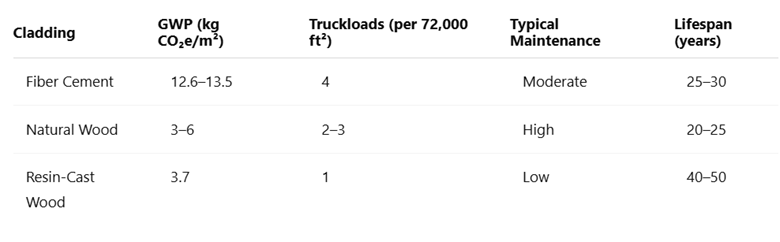
Manufacturing – The manufacture of resin-cast wood–a lightweight material–is clearly more energy-efficient than heavier cladding options. The process for making cement for fiber cement products, according to a report from the Environmental Protection Agency, produces 1 metric ton of CO2 for every 1.3 metric tons of cement.As far as the GWP of these products, fiber cement has a GWP score of 12.6-13.5 kg CO₂e/m², while resin-cast wood comes in at 3.72 kg CO₂e/m².4 According to Western Red Cedar, LP SmartSide EPDs, natural wood siding’s GWP is 3-6 kg CO₂e/m². That means that resin-cast wood now aligns with natural wood siding for embodied carbon, while fiber cement emits 2–4 × more CO₂e per m², primarily due to its high Portland cement content and energy-intensive curing.
Transportation - Flexible and lightweight, resin-cast panels take up less space during transit, resulting in fewer trucks and less gas expended to transport materials to the job site. One example, a popular resin-cast wood product allows for 72,000 ft2 of planks per truckload. Fiber cement, by contrast, allows just 15,360 ft2 planks per truck. That means it takes four times as many truckloads to carry the same amount of fiber cement. That’s four times the gas. Four times the emissions. And four times the cost.
Lightweight materials also make for a lighter load to haul, which impacts fuel efficiency. For every 1,000-pound increase in vehicle weight, fuel economy drops by approximately 0.5 percent. Reducing the weight of materials shipped across multiple truckloads can result in significantly reduced environmental impacts and diminished carbon emissions.
Installation – Again, the flexibility and light weight of resin-cast wood make installation quick and easy. Additionally, resin-cast surfaces require minimal upkeep beyond cleaning, Resin-cast wood is also easily renovated. No need to remove wood planks or fiber cement panels and deal with the waste. A new aesthetic layer can be applied over resin-cast wood, drastically reducing the carbon footprint of the renovation while offering a wide variety of aesthetics.
Maintenance – Maintenance can adversely affect a cladding’s GWP as well, if it has a short lifespan or requires frequent maintenance. Maintenance for fiber cement is primarily about extending the material's lifespan through pressure washing and minor repairs. Maintenance dominates total GWP for coated systems, such as resin cast wood shapes. However, if coatings are long-lasting or low-impact, they can rival solid wood’s carbon performance.
Cladding Comparison: Operational Carbon
The operational carbon footprint of a building is the total amount of carbon produced during its lifespan, which can span 50 years or more. Operational carbon measures all the energy associated with operating the building, such as lighting, heating, ventilation, air conditioning, and power usage.
When assessing the operational carbon of resin-cast wood, it’s important to consider that it is often installed as a fully integrated wall system designed to save energy and enhance building performance. For example, EIFS, which offers resin-cast wood as a cladding option, is a lightweight cladding system that provides a continuous insulated building envelope at about 1.5 lbs./ft2. EIFS is applied in multiple layers over exterior sheathing to create an energy-efficient, fire-resistant, low-maintenance, and versatile exterior cladding. While only one manufacturer currently offers a fully engineered system that includes resin-cast wood, others are often combined with individual components (AWRB, insulation, and, sometimes, sub-construction) to round out the system.
A 15-month Oak Ridge National Laboratory (ORNL) study demonstrated that EIFS walls outperform brick, stucco, and concrete block in both thermal and moisture performance, reducing heating and cooling demand by up to 35%.5
High-quality resin-cast and composite cladding can last 25 to 50 years or more, outperforming traditional wood that is more susceptible to weather damage. Plus, the lightweight nature and prefabricated design of many resin cladding systems allow for faster, simpler, and safer installation than heavier alternatives, reducing labor costs and project timelines.
Finally, some resin-cast claddings are made from recycled plastics and wood fibers, which diverts waste from landfills and reduces the environmental impact of manufacturing.
The Environmental Challenges of Natural Wood
While we have focused on the two most popular cladding alternatives to natural wood, natural wood is, of course, the standard by which all wood aesthetic products will be measured. As such, it’s only fair we take a look at how it performs from an environmental standpoint.
Sustainably harvested natural wood remains an important renewable material, but it carries several environmental and performance tradeoffs:6
• Harvesting – Harvesting forests requires a significant amount of energy and generates significant emissions in the process.
• Expensive to Transport – Bulky and heavy, lumber is expensive to truck to mills and, ultimately, jobsites, adding to its embodied carbon calculation.
• Maintenance Required – Natural wood requires maintenance to preserve its appearance and reduce the likelihood of cracking, fading, and splitting.
• Durability – While some species of wood, like redwood, have a natural resistance to pests and rot, other species aren’t so lucky. Often, treatments are needed.
• Higher Fire Risk – Wood is obviously flammable, making it a greater fire risk than most other cladding options. Treatment can reduce the risk of fire, but that additional protection comes at a price.
• Chemical Treatments – The treatments mentioned above to combat fire, rot, and pests are often harmful to the environment. This can offset some of the environmental benefits of using a renewable resource.
While renewable, natural wood’s maintenance cycle and shorter lifespan often outweigh its initial environmental appeal.
Resin-Cast Wood: A Case Study
In 1980, the Seminole Tribe of Florida opened the Seminole Brighton Bay Casino just west of Lake Okeechobee on the Brighton Seminole Reservation. While the reservation was in a remote area known for hunting and fishing, the casino proved to be a huge success. But as the decades passed, the “old red barn,” as some locals called it, began to show its age.
When plans for a new hotel and casino emerged, the Tribe prioritized energy efficiency, durability, and aesthetics. The project team selected an insulated cladding system paired with resin-cast wood, in which the team achieved a realistic wood look while reducing costs and construction time. The lightweight façade lowered transportation emissions and installation labor, contributing to both budget and environmental goals. The project now serves as an example of how innovative materials can balance beauty, performance, and sustainability in one solution.
By choosing an EIFS system with a resin-cast wood cladding, the team reduced estimated facade costs by 50 percent and shortened the construction schedule by approximately one month –benefits that thrilled both the architect and the Tribe.
The Rise of Low-Carbon Materials
Remember the earlier stat about 39% of annual global carbon emissions coming from buildings? There’s more: 11 percent of that total comes from embodied carbon. So, it’s understandable that there is a growing demand for low-carbon materials. According to Asuene in a blog post from August 2025, “nations and corporations alike are embracing carbon budgets and ESG mandates, compelling builders and developers to innovate and reimagine their supply chains.”
As the construction industry pursues carbon-neutral buildings by 2050, we are certain to see more innovation that aligns with our industry’s Net Zero goals.
The Final Analysis
Every project is different, and every cladding option has its pros and cons. Selecting the right cladding for the project is an important decision with many variables. So, there will always be space for all cladding options.
Having said that, EPDs and other data that go beyond manufacturers’ environmental talking points are painting a clearer picture as to which cladding options are better for our environment. And it’s clear that resin-cast wood is more than a lightweight finish fad; it is a proven solution for a beautiful, high-performance wood aesthetic and a more environmentally friendly future. Resin-cast wood avoids some of the drawbacks of natural wood—such as warping, insect infestation, and high upkeep costs—offering greater stability and longer lifespan. Resin-cast wood replicates wood’s natural grain and texture while offering superior durability, flexibility, and reduced carbon footprint.
Maybe resin-cast wood is the new natural choice for capturing a beautiful wood aesthetic.
References
1 “Material Collection, Low Embodied Carbon Materials,” healthymaterialslab.org, Healthy Materials Lab
2 ”Carbon Impacts of Engineered Wood Products in Construction,” 2021
3 “Systematic Review of Embodied Carbon Assessment and Reduction in Building Life Cycles,” 9/2024.
4 EPD 5471 (2024), Swisspearl EPD Rakennuslevyt
5 “Energy – Wet, warm wall worries.” Oak Ridge National Laboratory, https://www.ornl.gov/news/energy-wet-warm-wall-worries.
6 “The advantages and disadvantages of Timber Cladding,” Archipro, 10/23/2019
Looking for a reprint of this article?
From high-res PDFs to custom plaques, order your copy today!

.webp?height=740&t=1767036885&width=auto "Header - BE 1170x658 (002).png")

.webp?height=740&t=1755781744&width=auto "KEE(2).png")

.webp?height=200&t=1754248696&width=200 "EIFS(4).png")