Building Enclosure logo
search
cart
facebook twitter linkedin youtube instagram Spotify Podcasts Apple Podcasts Spotify Podcasts Apple Podcasts
  • Sign In
  • Create Account
  • Sign Out
  • My Account
Building Enclosure logo
  • NEWS
    • Breaking News
  • SECTIONS
    • Columns
    • Project Profiles
    • Trade Shows
    • Sponsor Insights
  • SYSTEM DESIGNS
    • Low-Slope Roofs
    • Pitched Roofs
    • Metal Roofing Materials
    • Waterproofing
    • Sustainability
    • Insulation
    • Exterior Claddings
    • Wall Systems
    • Building Envelope
  • BLOG
    • The BE Blog
  • MEDIA
    • Podcasts
    • Webinars
    • Quiz
    • Videos
    • Polls
    • Interactive Spotlights
    • Newsletter
    • Photo Galleries
  • DIRECTORIES
    • Directory: Blue Book
    • Directory: Roofing Resource
  • PRODUCTS
  • TECHNICAL
    • Codes
      • Waterproofing
      • Roofing
    • Details
      • Waterproofing
      • Roofing
  • CONTINUING ED
  • ABOUT
    • Advertise
      • Editorial Calendar
    • Contact
    • eMag Archive Issues
  • SIGN UP!
Breaking NewsTrade Shows

FGIA Annual Conference Participants Tour Seismic Shake Table Test Site
FGIA_Horizontal_RGB.jpg
February 27, 2023

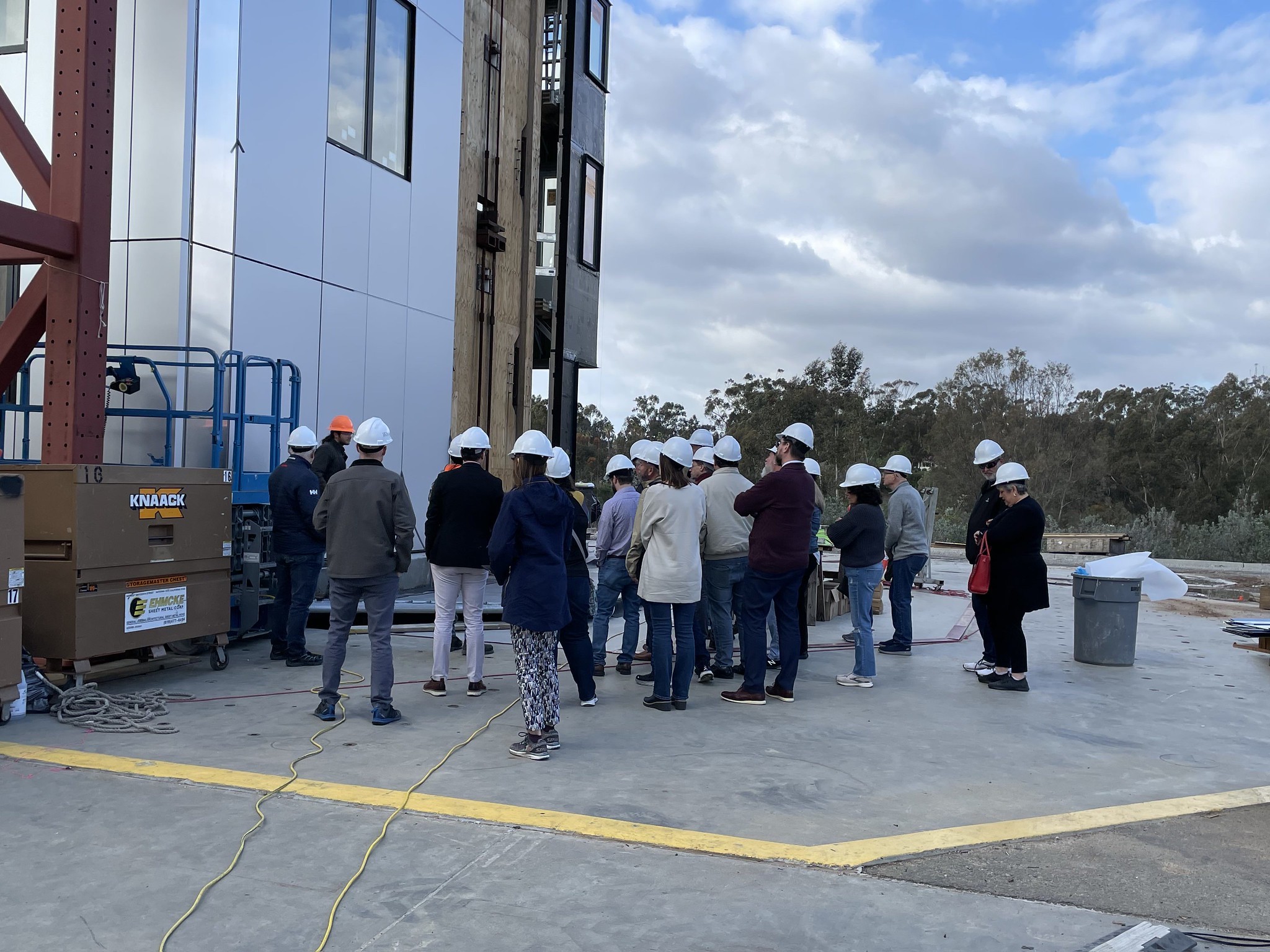
More than 40 Fenestration and Glazing Industry Alliance (FGIA) members had the opportunity to tour a one-of-a-kind seismic shake table test site as part of the FGIA 2023 Annual Conference. The Natural Hazards Engineering Research Infrastructure (NHERI) TallWood Project shake table test will take place in the San Diego area, just miles away from where the conference was held in Coronado, California. Those on the tour were able to see outside, inside and beneath the structure built on top of the shake table. At 10 stories tall, this is the largest test of its kind, and its construction is nearly complete.
 
 “My team is leading an effort to test exterior facades as part of a test of a 10-story timber building,” said Dr. Keri Ryan, University of Nevada, Reno, who is a co-investigator of the project, which began in 2016. The shake table facility completed a multi-year upgrade last spring, to extend the shaking capabilities from one direction to three axis translation and rotation. The construction of the building itself started in July. “We designed and will test a 10-story building with mass timber products. The main focus is its seismic resilient timber rocking walls, built with massive timber panels.”
 
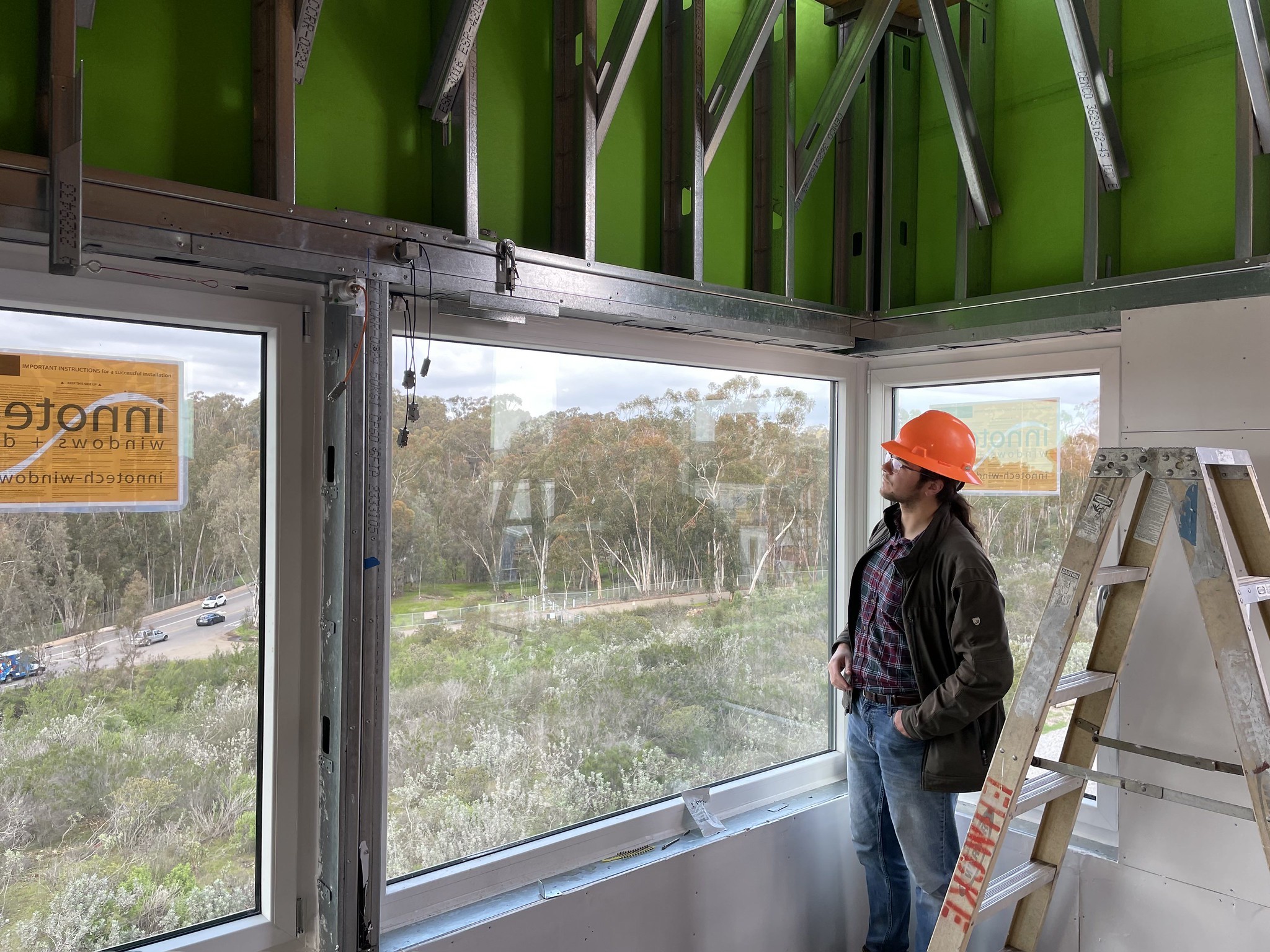
Two FGIA members donated windows to the project: Winco Window Company (https://wincowindow.com/) and Innotech Windows + Doors (https://www.innotech-windows.com/). Ryan said she and her research team anticipate the building can go through large earthquakes with very little damage. The exterior façade is made up of four sub-assemblies at the base of the building, all of which are attached to the main wood frame structure. The first three sub-assemblies feature cold-formed steel (CFS) framing with exterior aluminum composite (ACM) finish and windows, while the fourth is a curtain wall. All are detailed for drift compatibility, by providing horizontal and vertical joints. “None of this has been tested in this way before,” said Ryan.
FGIA Annual Conference Participants Tour Seismic Shake Table Test Site

 
 • CFS 1: This sub-assembly is platform framed with horizontal drift joints at the top of the wall. “Slip is intended to occur between those two tracks,” said Ryan. “The corner uses special joints that expand. We have the joint on two of the three stories.” The third story without the joints serves as a reference, so the researchers can compare the performance with and without joints.
 • CFS 2: This sub-assembly is bypass framed with drift clips that allow the studs to slip relative to its diaphragm. “In this one, we expect the floors to move, and the walls should basically stay straight,” said Ryan. “At the corner, we expect up to 10 inches of drift to be accommodated.”
 • CFS 3: Featuring spandrel units with ribbon windows, this sub-assembly also has slip joints at the top of the windows, between the window and the spandrels, while the spandrel framing is fixed to the diaphragm. The first and third story use Winco and Innotech windows that wrap around the corner. On the second story, a drift joint was used at the corner, similar to CFS 1.
 • CFS 4: This final sub-assembly is a finished, fire-rated glass curtain wall assembly whose glass rotates within its frame. It has steel mullions and 1 1/16 inches of thick fire-rated glass and was framed on site. “It was designed for two-and-a-half percent drift, which is what we expect to see in the test itself,” said Ryan.
 
 “In most cases, we don’t expect the windows to be subjected to a lot of drift,” said Ryan, with the exception of the corner window units on CFS 3.
 
 Beneath the building sits the shake table itself. Actuators drive the shake table platform in all directions. The table moves a maximum of 35 inches in the East-West direction, 15 inches in the North-South direction, and 5 inches up and down, according to Site Manager, Koorosh Loftizadeh. At a payload capacity of 1100 kips, about twice that of the timber building, the peak acceleration capacity is 1.6g, 1.2g, and 0.6g (“g” referring to acceleration of gravity at Earth’s surface) in East-West, North-South and vertical directions, respectively. To be ready for testing, more than 700 sensors and approximately 60 video cameras need to be installed in the building.
 
 During the Seismic and Wind-Induced Inter-Story Drift Review Task Group (AAMA 501.4 and 501.7) meeting held at the FGIA Annual Conference, Ryan provided an update on how testing will go. “We will impose a range of intensities over a four-week period, starting with a low level of shaking and building up to larger earthquakes through design level shaking to maximum considered earthquake (MCE),” she said. “We plan to scale up from low level drifts up to 2 percent inter-story drift. Some of the input motions will have peak acceleration over 1g.”
  

FGIA Annual Conference Participants Tour Seismic Shake Table Test Site

William Roser, research student, shared some predictions for the test. “We are modeling the structure to predict the responses during the test,” Roser said. “As we change the design of the building and the mass of the building itself, that has caused our expected drift to be different from original drifts. The drifts are not quite as high as originally predicted.” Ryan added that the team will adjust accordingly if the model is too conservative. The group hopes to begin testing at the end of March. Multi-camera streaming of the construction site can be seen online (http://nheri.ucsd.edu/video/) and will be available to view this spring when the four-week test begins.
 
 “It will be great to see it in action on that live feed,” said Tanya Dolby, Chair of the FGIA task group.
 
For more information about FGIA and its activities, visit FGIAonline.org.

KEYWORDS: fenestration glazing windows

Share This Story

Looking for a reprint of this article?
From high-res PDFs to custom plaques, order your copy today!


Recommended Content

JOIN TODAY
to unlock your recommendations.

Already have an account? Sign In

  • bar graph shows LEED v4/LEED v5/LEED v6 in various colors

    When Will LEED v4 / v4.1 and LEED v5 Expire?

    The latest version of the LEED rating system, LEED v5, is...
    Sustainability
    By: Daniel Overbey
  • Celebrating Women In AEC-2026

    Celebrating Women in The AEC Industry Part 1

    A round-up of women in the design, engineering and...
    Sustainability
    By: Lindsay Lewis
  • KEE membrane application on a roof

    A Beginner’s Guide to Single-Ply Roofing Membranes

    While PVC and TPO appear extremely similar, the chemistry...
    Low-Slope Roofs
    By: Peter Gross
Manage My Account
  • Sign up for the Newsletter
  • Online Registration
  • Manage My Preferences
  • Registration Customer Service

More Videos

Sponsored Content

Sponsored Content is a special paid section where industry companies provide high quality, objective, non-commercial content around topics of interest to the Building Enclosure audience. All Sponsored Content is supplied by the advertising company and any opinions expressed in this article are those of the author and not necessarily reflect the views of Building Enclosure or its parent company, BNP Media. Interested in participating in our Sponsored Content section? Contact your local rep!

close
  • 2 construction workers and a DEXcell panel
    Sponsored byDEXcell Roof Boards

    Designing Low-Slope Roofs for Resilience

  • Bell Bank headquarters in Fargo, North Dakota
    Sponsored bySto Corp.

    Drained and Back-Ventilated Rainscreens vs Pressurized-Equalized Rainscreens

  • A construction worker using DEXcell roof boards
    Sponsored byDEXcell Roof Boards

    The Hidden Strength of Low-Slope Roof Systems: Why Roof Cover Boards Matter

Popular Stories

a man wearing a mask installs insulation into a wall system

Quiet Rooms and Healthier Air: A Second Look at What Goes Inside the Wall Cavity

construction industry workers in hard hats stand around a city scape

Construction Industry Revolts Over New CSI Licensing Plan

Canalino Elementary School and Canalino Family School exterior

Daylighting Design to Support Rapidly Growing Trend in Modular Building Construction

Building Enclosure Newsletter

BE Poll

Events

June 17, 2025

Addressing Condensation in Low-Slope Roof Assemblies

Credits: 1 AIA LU/HSW; 0.1 ICC CEU; 1 IIBEC CEH; 0.1 IACET CEU

On Demand In modern roofing systems, vapor retarders and air barriers do more than just minimize air leakage—they’re essential to maximizing performance and longevity. This engaging course dives into the next generation of moisture control: permeable vapor retarders and air barriers. Discover how these cutting-edge technologies are transforming low-slope roofing assemblies by improving energy efficiency, managing moisture, and boosting wind uplift resistance.

April 9, 2026

Strategies for High-Performance Below-Grade Waterproofing

Credits: 1 AIA LU/HSW ; 1 IIBEC CEH; 0.1 IACET CEU

On-Demand Designing a high-performance building enclosure requires more than just surface-level protection; it demands a rigorous, performance-based mastery of below-grade water and gas mitigation. This discussion will provide an expert-level analysis of below-grade waterproofing within the comprehensive framework of the high-performance building enclosure.

View All Submit An Event

Products

Plaster and Drywall Assemblies Manual

Plaster and Drywall Assemblies Manual

This is a comprehensive manual that goes beyond codes and standards, providing expert guidance in design, detailing, material selection and troubleshooting for plaster and drywall.

See More Products

Related Articles

  • FGIA_Horizontal_RGB.jpg

    Hardware Demonstration Gives FGIA Annual Conference Participants Hands-on Knowledge

    See More
  • FGIA_Horizontal_RGB.jpg

    FGIA Annual Conference Participants Learn a Quality Systems Approach to Excellence in Commercial Glazing

    See More
  • FGIA_Horizontal_RGB.jpg

    Final Schedule Announced for 2023 FGIA Annual Conference

    See More

Related Products

See More Products
  • tall building.jpg

    Tall Building Design: Steel, Concrete, and Composite Systems

  • foundation.jpg

    Tall Building Foundation Design

  • studentguidebook.jpg

    Integrating Building Performance with Design: An Architecture Student’s Guidebook

See More Products
×

Enhance your expertise with unparalleled insights.

Join thousands of building professionals today. Shouldn’t you know what they know?

SUBSCRIBE TODAY!
  • RESOURCES
    • Advertise
    • Contact Us
    • Store
    • Want More
  • SIGN UP TODAY
    • Create Account
    • Newsletter
    • Customer Service
    • Manage Preferences
  • SERVICES
    • Marketing Services
    • Reprints
    • Market Research
    • List Rental
    • Survey/Respondent Access
  • STAY CONNECTED
    • LinkedIn
    • Facebook
    • Instagram
    • YouTube
    • X
  • PRIVACY
    • PRIVACY POLICY
    • TERMS & CONDITIONS
    • DO NOT SELL MY PERSONAL INFORMATION
    • PRIVACY REQUEST
    • ACCESSIBILITY

Copyright ©2026. All Rights Reserved BNP Media, Inc. and BNP Media II, LLC.

Design, CMS, Hosting & Web Development :: ePublishing