Building Enclosure logo
search
cart
facebook twitter linkedin youtube instagram Spotify Podcasts Apple Podcasts Spotify Podcasts Apple Podcasts
  • Sign In
  • Create Account
  • Sign Out
  • My Account
Building Enclosure logo
  • NEWS
    • Breaking News
  • SECTIONS
    • Columns
    • Project Profiles
    • Trade Shows
    • Sponsor Insights
  • SYSTEM DESIGNS
    • Low-Slope Roofs
    • Pitched Roofs
    • Metal Roofing Materials
    • Waterproofing
    • Sustainability
    • Insulation
    • Exterior Claddings
    • Wall Systems
    • Building Envelope
  • BLOG
    • The BE Blog
  • MEDIA
    • Podcasts
    • Webinars
    • Quiz
    • Videos
    • Polls
    • Interactive Spotlights
    • Newsletter
    • Photo Galleries
  • DIRECTORIES
    • Directory: Blue Book
    • Directory: Roofing Resource
  • PRODUCTS
  • TECHNICAL
    • Codes
      • Waterproofing
      • Roofing
    • Details
      • Waterproofing
      • Roofing
  • CONTINUING ED
  • ABOUT
    • Advertise
      • Editorial Calendar
    • Contact
    • eMag Archive Issues
  • SIGN UP!
Project Profiles

Home Building at Thaden School
TH070220_EDR_Thaden_Home_0180.jpg

All photos courtesy of Dero Stanford, Tim Husley, and Studio Nuvo
TH070220_EDR_Thaden_Home_0070.jpg
TH070220_EDR_Thaden_Home_0180.jpg
TH070220_EDR_Thaden_Home_0070.jpg
October 19, 2022

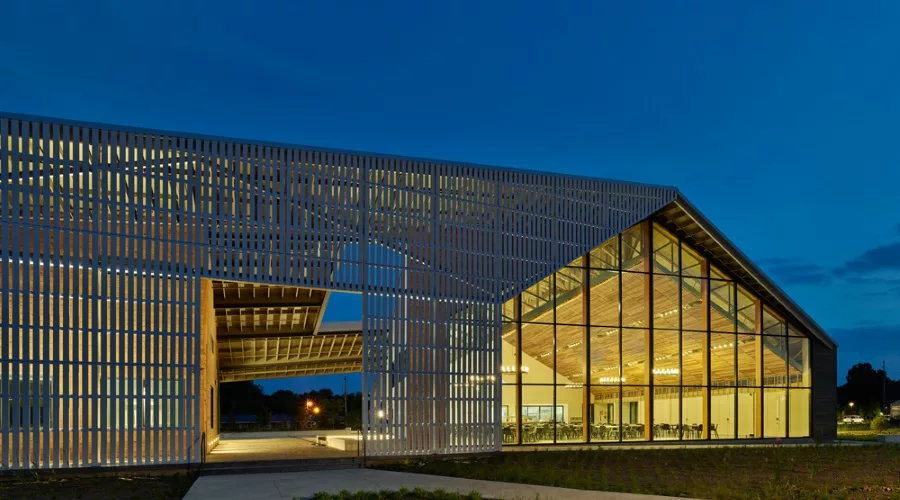
The Home Building is the central hub at Thaden School, a new high school in Bentonville, Arkansas, where students learn by doing. The building’s design, much like the school’s 26-acre campus, strives to establish an innovative vision for the future while reflecting the rich, pastoral heritage of the surrounding landscape. The Thaden School challenges traditional paradigms of education. The school’s  pedagogy is centered on three signature programs: Reels (where narrative and visual communication come alive through the production of film and video), Wheels (where physics and mechanics come alive through the construction and use of bicycles), and Meals (where biology, chemistry, and community come alive through the growing and preparation of food). After first leading the completion of the Master Plan for the campus (a collaborative effort between EskewDumezRipple, Marlon Blackwell Architects, Andropogon, and CMTA), EskewDumezRipple was tasked with designing the 34,000-square-foot Home Building, the heart of all student activities on campus. 

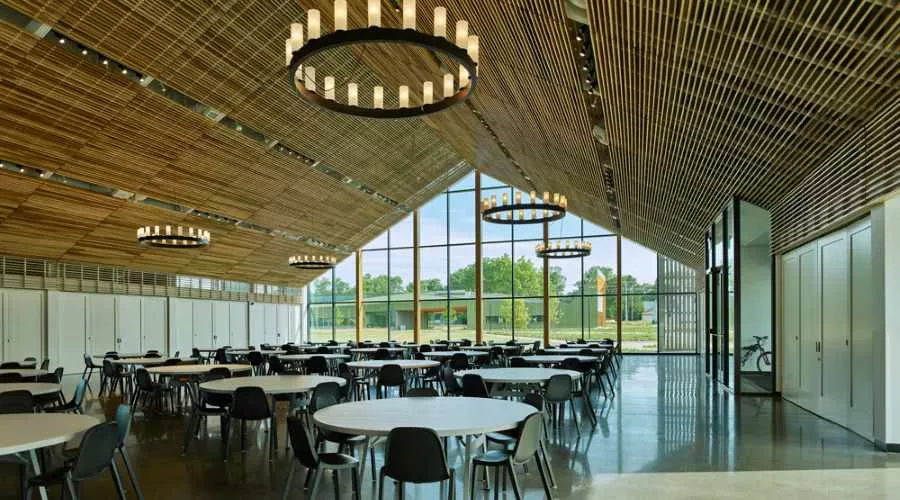
Beyond the physical centrality of its location, the Home Building serves as both the social and spiritual center for students. As the hearth of the campus, the building provides an expansive dining hall, where all of campus comes together for meals, as well as a teaching kitchen, the student bookstore, a library, and several unstructured lounge and study spaces. In the dining hall, the celebrates the material technology within. A veil of poplar slats mounted underneath enormous truss frames reveal, rather than conceal, the structural design and bring a deep warmth to a space intended for communal dining. The design reconciles seemingly contradictory notion: lofty ambitions for the building’s design with the humble nature of local, vernacular architecture.

The building takes visual cues from the region itself, with board and batten facades and all wood construction incorporating the beauty of local, vernacular architecture. The building stretches across the landscape, bending and wrapping to define a new kind of campus, creating a network of outdoor spaces of varying scales, textures, and uses that interact with the diverse interior spaces. Indoor-outdoor relationships are explored at every opportunity. An ever-present “water lab” holds a majority of the rainwater that’s collected on site. while simultaneously providing a unique opportunity for students to learn via their surroundings.

The design employs common materials and methods in uncommon ways. Using techniques typically found in residential design, the design pushed the simple form to its limit, opening the floor plan to create porches and courtyards and gently sloping the roof up to a dramatic 38-foot-tall peak at its center. The roof plane enshrouds the simple gable form of the dining hall. A skyward opening punctures the roof of the outdoor courtyard where students frequently congregate outside the dining hall. Students take classes in a state-of-the-art teaching kitchen—one of the truly unique spaces in the Home building— one that deeply espouses the school’s “learning by doing” mantra.

The building’s design places sustainability central to students’ education. Transitional spaces, protected outdoor areas, landscape that acts as a botanical textbook filled with a diversity of plants, flowers, and trees—tall grass prairie, oak and pecan woodlands, bottomland hardwood forests, freshwater wetlands—a microcosm of the region’s native plant communities. Stormwater management (91% is managed onsite) is accomplished via a distributed strategy, with several detention areas across the site. In the rear of the Home Building,  a “water lab,” detains the majority of rainwater, while offering a unique “classroom outside the classroom”—an opportunity for students to learn directly from their surroundings. Low-flow plumbing fixtures are used throughout the building which will save roughly 30, or about 100,000 gallons of water each year.

A geothermal well field sited directly on the large quad in front of the Home Building was selected instead of a traditional cooling tower, resulting in an additional 1.5M gallons of water savings annually. The Home Building was designed to achieve an Energy Use Intensity (EUI) of 23 (a school building recording 25 EUI or less is considered to be Zero Energy Ready). The later addition of a rooftop photovoltaic array could result likely achieve Zero Energy (ZE). A dedicated outdoor air system ensures that occupants have fresh air throughout the entire building. By bringing all outdoor air into the building at a single location (instead of at each heat pump zone) it can be passed through an enthalpy wheel which transfers heat from the exhaust air to the incoming air which also provides dehumidification. 


Project Team

Architect: EskewDumezRipple

Landscape Architect: Andropogon Associates, Ltd.

Civil Engineering: Ecological Design Group

MEP Engineering: CMTA Consulting Engineers

Structural Engineering: Engineering Consultants Inc. (ECI)

Project Management: Aegis Property Group | WEI 

General Contractor: Milestone 

Irrigation: Aqueous

Signage and Wayfinding: Tom Zetek

KEYWORDS: academic building net zero storm water

Share This Story

Looking for a reprint of this article?
From high-res PDFs to custom plaques, order your copy today!


Recommended Content

JOIN TODAY
to unlock your recommendations.

Already have an account? Sign In

  • bar graph shows LEED v4/LEED v5/LEED v6 in various colors

    When Will LEED v4 / v4.1 and LEED v5 Expire?

    The latest version of the LEED rating system, LEED v5, is...
    Sustainability
    By: Daniel Overbey
  • Celebrating Women In AEC-2026

    Celebrating Women in The AEC Industry Part 1

    A round-up of women in the design, engineering and...
    Sustainability
    By: Lindsay Lewis
  • KEE membrane application on a roof

    A Beginner’s Guide to Single-Ply Roofing Membranes

    While PVC and TPO appear extremely similar, the chemistry...
    Low-Slope Roofs
    By: Peter Gross
Manage My Account
  • Sign up for the Newsletter
  • Online Registration
  • Manage My Preferences
  • Registration Customer Service

More Videos

Sponsored Content

Sponsored Content is a special paid section where industry companies provide high quality, objective, non-commercial content around topics of interest to the Building Enclosure audience. All Sponsored Content is supplied by the advertising company and any opinions expressed in this article are those of the author and not necessarily reflect the views of Building Enclosure or its parent company, BNP Media. Interested in participating in our Sponsored Content section? Contact your local rep!

close
  • 2 construction workers and a DEXcell panel
    Sponsored byDEXcell Roof Boards

    Designing Low-Slope Roofs for Resilience

  • Bell Bank headquarters in Fargo, North Dakota
    Sponsored bySto Corp.

    Drained and Back-Ventilated Rainscreens vs Pressurized-Equalized Rainscreens

  • A construction worker using DEXcell roof boards
    Sponsored byDEXcell Roof Boards

    The Hidden Strength of Low-Slope Roof Systems: Why Roof Cover Boards Matter

Popular Stories

construction industry workers in hard hats stand around a city scape

Construction Industry Revolts Over New CSI Licensing Plan

Canalino Elementary School and Canalino Family School exterior

Daylighting Design to Support Rapidly Growing Trend in Modular Building Construction

construction workers on a roof, plane flies in background

Why Specifications Are Becoming the Next Critical Layer of Construction Compliance

Building Enclosure Newsletter

BE Poll

Events

June 17, 2025

Addressing Condensation in Low-Slope Roof Assemblies

Credits: 1 AIA LU/HSW; 0.1 ICC CEU; 1 IIBEC CEH; 0.1 IACET CEU

On Demand In modern roofing systems, vapor retarders and air barriers do more than just minimize air leakage—they’re essential to maximizing performance and longevity. This engaging course dives into the next generation of moisture control: permeable vapor retarders and air barriers. Discover how these cutting-edge technologies are transforming low-slope roofing assemblies by improving energy efficiency, managing moisture, and boosting wind uplift resistance.

April 9, 2026

Strategies for High-Performance Below-Grade Waterproofing

Credits: 1 AIA LU/HSW ; 1 IIBEC CEH; 0.1 IACET CEU

On-Demand Designing a high-performance building enclosure requires more than just surface-level protection; it demands a rigorous, performance-based mastery of below-grade water and gas mitigation. This discussion will provide an expert-level analysis of below-grade waterproofing within the comprehensive framework of the high-performance building enclosure.

View All Submit An Event

Products

Plaster and Drywall Assemblies Manual

Plaster and Drywall Assemblies Manual

This is a comprehensive manual that goes beyond codes and standards, providing expert guidance in design, detailing, material selection and troubleshooting for plaster and drywall.

See More Products

Related Articles

  • Nike_SWB_exterior.jpg

    Serena Williams Building at Nike World Headquarters

    See More
  • Daytona State College.png

    New Building at Daytona State College Designed to Mirror Real-World Environments

    See More
  • Raising the Bar: Innovation, Science and Technology Building at Florida Polytechnic Is a Functional Work of Art

    See More

Related Products

See More Products
  • bni book

    BNi Building News Home Builders Costbook 2026 (Print Edition)

  • building codes illustated.jpg

    Building Codes Illustrated: A Guide to Understanding the 2021 International Building Code, 7th Edition

  • ecodesign.jpg

    Successful Building Using Ecodesign

See More Products
×

Enhance your expertise with unparalleled insights.

Join thousands of building professionals today. Shouldn’t you know what they know?

SUBSCRIBE TODAY!
  • RESOURCES
    • Advertise
    • Contact Us
    • Store
    • Want More
  • SIGN UP TODAY
    • Create Account
    • Newsletter
    • Customer Service
    • Manage Preferences
  • SERVICES
    • Marketing Services
    • Reprints
    • Market Research
    • List Rental
    • Survey/Respondent Access
  • STAY CONNECTED
    • LinkedIn
    • Facebook
    • Instagram
    • YouTube
    • X
  • PRIVACY
    • PRIVACY POLICY
    • TERMS & CONDITIONS
    • DO NOT SELL MY PERSONAL INFORMATION
    • PRIVACY REQUEST
    • ACCESSIBILITY

Copyright ©2026. All Rights Reserved BNP Media, Inc. and BNP Media II, LLC.

Design, CMS, Hosting & Web Development :: ePublishing