Building Enclosure logo
search
cart
facebook twitter linkedin youtube instagram Spotify Podcasts Apple Podcasts Spotify Podcasts Apple Podcasts
  • Sign In
  • Create Account
  • Sign Out
  • My Account
Building Enclosure logo
  • NEWS
    • Breaking News
  • SECTIONS
    • Columns
    • Project Profiles
    • Trade Shows
    • Sponsor Insights
  • SYSTEM DESIGNS
    • Low-Slope Roofs
    • Pitched Roofs
    • Metal Roofing Materials
    • Waterproofing
    • Sustainability
    • Insulation
    • Exterior Claddings
    • Wall Systems
    • Building Envelope
  • BLOG
    • The BE Blog
  • MEDIA
    • Podcasts
    • Webinars
    • Quiz
    • Videos
    • Polls
    • Interactive Spotlights
    • Newsletter
    • Photo Galleries
  • DIRECTORIES
    • Directory: Blue Book
    • Directory: Roofing Resource
  • PRODUCTS
  • TECHNICAL
    • Codes
      • Waterproofing
      • Roofing
    • Details
      • Waterproofing
      • Roofing
  • CONTINUING ED
  • ABOUT
    • Advertise
      • Editorial Calendar
    • Contact
    • eMag Archive Issues
  • SIGN UP!
Breaking News

FGIA Releases New Document

FGIA
January 29, 2020

The Fenestration and Glazing Industry Alliance (FGIA) has released a new publication addressing aspects of the finite element (FE) thermal modeling process often used to predict interior surface temperatures on fenestration including non-residential windows, terrace and patio doors, curtain wall, storefront, and entrances. AAMA 515-19, "Voluntary Procedure for Determination of Fenestration Surface Temperatures by THERM Finite Element Modeling," an FGIA standard, is now available for purchase in the FGIA online store.

Per AAMA 515, condensation will occur on any interior surface that falls below the dew point temperature of interior ambient air. Condensation can be unsightly, unsanitary, and over long periods of time, can damage adjacent building materials. This voluntary procedure helps designers determine what temperatures and film coefficients to use when running a project-specific condensation analysis.

Designers often use two-dimensional finite element (FE) thermal modeling tools, such as Lawrence Berkeley National Laboratory's (LBNL) THERM, to predict interior surface temperatures for standard or project-specific condor AAMA 501.9 thermal cycling tests of full-size mockups. For products with conductive framing, such as aluminum (with or without thermal barriers), caution is advisable in attempting to correlate FE modeling with testing, or in using FE modeling to predict variable test results.

LBNL's THERM software is widely used to predict temperatures. This voluntary procedure is intended to make application of the software tool uniform between users, and to address some of the issues which arise in surface temperature prediction and condensation assessment:
* Conflicting or confusing project specifications
* Model accuracy for aluminum framing
* Repeatability and reproducibility of modeling and testing
* Effects of substrates
* End-user expectations
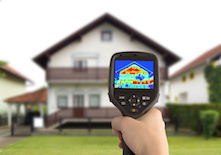
Heat loss detection of house with infrared thermal camera


"THERM software is widely used to predict surface temperatures of fenestration," said Steve Fronek (Wausau Window and Wall Systems), chair of the Architectural Finite Element Thermal Modeling Task Group. "This new, voluntary procedure, a result of seven years of detailed development, is intended to make application of the software tool uniform between users. It addresses key variables, such as boundary conditions, substrates and THERM parameters, as well as the accuracy of modeling and testing. The scope is clearly outlined and guidance provided for the specifier."

AAMA 515 outlines minimum requirements for FE thermal models used to predict surface temperatures of aluminum framing systems and is intended to be referenced in other industry standards, contract documents, proposals and marketing materials as needed.

AAMA 515-19, as well as other AAMA documents available from FGIA, may be purchased from the online store.

More information about FGIA and its activities can be found at https://fgiaonline.org.

KEYWORDS: fenestration glazing

Share This Story

Looking for a reprint of this article?
From high-res PDFs to custom plaques, order your copy today!


Recommended Content

JOIN TODAY
to unlock your recommendations.

Already have an account? Sign In

  • bar graph shows LEED v4/LEED v5/LEED v6 in various colors

    When Will LEED v4 / v4.1 and LEED v5 Expire?

    The latest version of the LEED rating system, LEED v5, is...
    Sustainability
    By: Daniel Overbey
  • Celebrating Women In AEC-2026

    Celebrating Women in The AEC Industry Part 1

    A round-up of women in the design, engineering and...
    Building Envelope
    By: Lindsay Lewis
  • KEE membrane application on a roof

    A Beginner’s Guide to Single-Ply Roofing Membranes

    While PVC and TPO appear extremely similar, the chemistry...
    Low-Slope Roofs
    By: Peter Gross
Manage My Account
  • Sign up for the Newsletter
  • Online Registration
  • Manage My Preferences
  • Registration Customer Service

More Videos

Sponsored Content

Sponsored Content is a special paid section where industry companies provide high quality, objective, non-commercial content around topics of interest to the Building Enclosure audience. All Sponsored Content is supplied by the advertising company and any opinions expressed in this article are those of the author and not necessarily reflect the views of Building Enclosure or its parent company, BNP Media. Interested in participating in our Sponsored Content section? Contact your local rep!

close
  • 2 construction workers and a DEXcell panel
    Sponsored byDEXcell Roof Boards

    Designing Low-Slope Roofs for Resilience

  • Bell Bank headquarters in Fargo, North Dakota
    Sponsored bySto Corp.

    Drained and Back-Ventilated Rainscreens vs Pressurized-Equalized Rainscreens

  • A construction worker using DEXcell roof boards
    Sponsored byDEXcell Roof Boards

    The Hidden Strength of Low-Slope Roof Systems: Why Roof Cover Boards Matter

Popular Stories

a man wearing a mask installs insulation into a wall system

Quiet Rooms and Healthier Air: A Second Look at What Goes Inside the Wall Cavity

Canalino Elementary School and Canalino Family School exterior

Daylighting Design to Support Rapidly Growing Trend in Modular Building Construction

construction workers on a roof, plane flies in background

Why Specifications Are Becoming the Next Critical Layer of Construction Compliance

Building Enclosure Newsletter

BE Poll

Events

June 17, 2025

Addressing Condensation in Low-Slope Roof Assemblies

Credits: 1 AIA LU/HSW; 0.1 ICC CEU; 1 IIBEC CEH; 0.1 IACET CEU

On Demand In modern roofing systems, vapor retarders and air barriers do more than just minimize air leakage—they’re essential to maximizing performance and longevity. This engaging course dives into the next generation of moisture control: permeable vapor retarders and air barriers. Discover how these cutting-edge technologies are transforming low-slope roofing assemblies by improving energy efficiency, managing moisture, and boosting wind uplift resistance.

April 9, 2026

Strategies for High-Performance Below-Grade Waterproofing

Credits: 1 AIA LU/HSW ; 1 IIBEC CEH; 0.1 IACET CEU

On-Demand Designing a high-performance building enclosure requires more than just surface-level protection; it demands a rigorous, performance-based mastery of below-grade water and gas mitigation. This discussion will provide an expert-level analysis of below-grade waterproofing within the comprehensive framework of the high-performance building enclosure.

View All Submit An Event

Products

Plaster and Drywall Assemblies Manual

Plaster and Drywall Assemblies Manual

This is a comprehensive manual that goes beyond codes and standards, providing expert guidance in design, detailing, material selection and troubleshooting for plaster and drywall.

See More Products

Related Articles

  • FGIA Logo

    FGIA Releases New Complimentary Skylight Selection, Daylighting Design Document

    See More
  • AAMA Releases New Fenestration Document

    See More
  • FGIA_Horizontal_RGB.jpg

    FGIA Releases New Glass Safety Standard

    See More

Related Products

See More Products
  • smo-blue-expanded-edition-log-book.png

    Log Book - Blue Expanded Edition

  • smo-green-standard-edition-log-book.png

    Log Book - Green Standard Edition

  • 41G-JcZWT+L._SX342_SY445_.jpg

    The Architect's Studio Companion: Rules of Thumb for Preliminary Design, 7th Edition

See More Products
×

Enhance your expertise with unparalleled insights.

Join thousands of building professionals today. Shouldn’t you know what they know?

SUBSCRIBE TODAY!
  • RESOURCES
    • Advertise
    • Contact Us
    • Store
    • Want More
  • SIGN UP TODAY
    • Create Account
    • Newsletter
    • Customer Service
    • Manage Preferences
  • SERVICES
    • Marketing Services
    • Reprints
    • Market Research
    • List Rental
    • Survey/Respondent Access
  • STAY CONNECTED
    • LinkedIn
    • Facebook
    • Instagram
    • YouTube
    • X
  • PRIVACY
    • PRIVACY POLICY
    • TERMS & CONDITIONS
    • DO NOT SELL MY PERSONAL INFORMATION
    • PRIVACY REQUEST
    • ACCESSIBILITY

Copyright ©2026. All Rights Reserved BNP Media, Inc. and BNP Media II, LLC.

Design, CMS, Hosting & Web Development :: ePublishing