Hall Transforms into Contemporary Space for Students
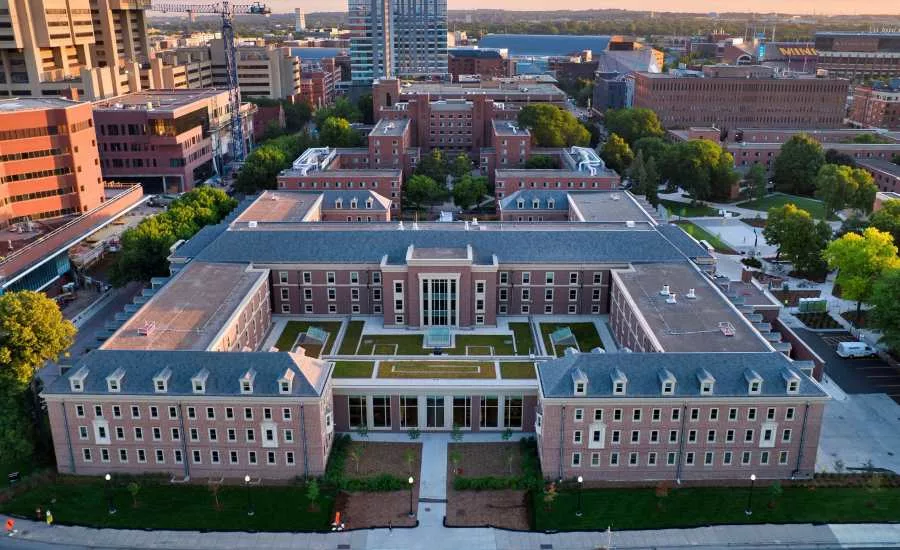
The University of Minnesota’s 90-year-old Pioneer Hall opened its doors to incoming freshmen following a much-needed expansion and renovation. KWK Architects led the design effort on the project, partnered with architecture/engineering firm-of-record TKDA of St. Paul, Minn.
The decision by the University’s Board of Regents in 2016 to preserve a significant amount of the residence hall’s signature exterior but demolish much of its interior offered a unique challenge to the project team.
The $104.5 million project increased the number of student beds from 693 on four floors to 756 on five floors while preserving the structure’s character-defining Georgian Revival-style exterior. The building now includes modernized community and recreational spaces as well as office and support spaces within a footprint that exceeds its original size by more than 40 percent. The project also expanded the dining hall from 285 seats to 850 seats, large enough to accommodate all residents within the UMN’s Superblock residential district.
Pioneer Hall, located at the southwest quadrant of the main residential neighborhood, was the on-campus home for many generations of students and holds a special place in the collective history of the university.
First opened in the early 1930s, Pioneer Hall was the university’s first dormitory for men. At that time, the building consisted of a series of houses with three- and four-room suites with separate bedrooms for each student and a common study and bathroom. The two back-to-back, C-shaped buildings formed two courtyards, with each house having its own exterior entrance off the courtyard. The main dining rooms were located in the basement level extending upward through the first floor.
Over time, the building evolved with a kitchen addition constructed in 1958 and a full-scale renovation in 1977 that introduced a corridor system to connect all houses, provided updated systems and added a small loading dock for residential life staff.
After many decades of service, Pioneer Hall was no longer meeting the needs of today’s students. The existing building lacked accessibility, with no elevator, multiple floor levels to navigate, exterior stoops with stairs at entry points, inaccessible bathrooms and inadequate circulation. The dining rooms were subterranean with the only views to the exterior from high clerestory windows. Major mechanical, plumbing and electrical systems needed improvements, and the building exterior components needed restoration.
“The corridors were narrow with jogs and offsets that resulted in difficult wayfinding and inadequate space to comfortably pass by others,” said Sara Koester, Principal at KWK Architects. “Many of the bedrooms were very small and cramped, and the bathrooms were outdated with aged fixtures and finishes. The building also lacked quality social and study spaces so vital for building community and fostering student academic and social success.”
Although the building had physical and functional deficiencies, Pioneer Hall had many excellent qualities and character-defining features, including C-shaped four-story wings, slate roofs, window fenestrations and round-arched passageways.
“Generations of students have lived in Pioneer Hall and have fond memories associated with the building and the university,” said Koester. “An important aspect of the renovation design was to respect the historical character of the original building and maintain a connection to the original hall.”
The goals for the renovation included:
- Providing housing for 700-800 students – an increase over the existing 693 residents
- Organizing double bedrooms in communities of 40 with community bathrooms
- Increasing inclusiveness with fully accessibility and single-occupancy, unisex bathrooms within each community
- Fostering student success with community-building and academic success spaces
- Providing a new dining facility to serve the entire residential neighborhood of 2,900 students
- Offering a food service option with an expanded variety of menu choices and distinct dining experiences
To achieve these goals, the renovation program called for increasing the total square footage from 177,000 SF to 257,000 SF. Demolition of the existing building was limited to the center construction and within the courtyards, with approximately 60% of the typical upper floors being retained.
“A major design challenge was to substantially increase the building area while maintaining the historical scale and sense of place,” said Koester. “The building façades have a strong presence on the streets and within the neighborhood, defining the edge and character. It was important to maintain these façades to continue the sense of place that the building provided.”
In order to minimize the impact of the additions, a new central, sub-basement level was built to accommodate the main mechanical, electrical, and telecom rooms; the new construction was concentrated in the courtyards and center to connect the building on all levels. The center addition linking the two C-shaped existing buildings extends up vertically for a full story instead of traditional attic space framing of the existing buildings and provides additional area while giving a massing hierarchy to the center linking element.
The new 42,000 SF dining facility has seating for 850 with eight venues arranged in a Main Street configuration. Fresh food will be prepared in salad/deli, grill, pasta, pizza, sauté, Mongolian stir-fry grill, home-cooking, and allergen-free stations, with emphasis on display cooking and variety of food choices. An on-site bakery offers fresh baked breads, cookies and donuts, and a breakfast venue offers traditional morning fare.
“Careful consideration was given in the design to ensure efficient flow of customers through the space at the all-you-care-to-eat facility,” said Koester.
The renovated residence hall features community-style living unit modules with a small group of residents sharing a community bathroom. These facilities are grouped with single-use private bathrooms to offer varying levels of privacy. Studies and lounges are provided for the communities, and a dedicated floor lounge allows for larger gatherings. Classroom, multipurpose, music practice, recreation rooms, large student kitchen, meditation and tech/business center provide a variety of spaces to gather, study or reflect, contributing to student academic success.
Sustainability was a major element of the project. Storm water management was a high priority for the university, given its close proximity to the Mississippi River. Large underground detention tanks are located on the north side of the site and connect to a district-wide stormwater system to serve the chilled water needs of a nearby campus medical facility.
Low-flow plumbing fixtures are used thorough the building. The project was designed to meet the Minnesota B3 sustainability standard and energy-efficient equipment was specified for all mechanical and food-service equipment and all lighting was energy-saving LED. The large, low roof over the dining area features a vegetated roof with native landscaping.
This is the third University of Minnesota student facility in recent years for the design architects from KWK and TKDA. They are currently beginning work together on a new residence tower and dining hall expansion at the Duluth campus. That project is slated to open to students in the fall of 2021.
"This project was so much more than providing room and board for freshmen,” said Tom Stoneburner, TKDA president and CEO. "The first-year university housing experience has a significant impact on students' academic and social development. We are pleased to have been able to pay tribute to Pioneer Hall's significant place in the University’s history through this important project."
Looking for a reprint of this article?
From high-res PDFs to custom plaques, order your copy today!
.webp?height=740&t=1767036885&width=auto "Header - BE 1170x658 (002).png")

.webp?height=740&t=1755781744&width=auto "KEE(2).png")