Building Enclosure logo
search
cart
facebook twitter linkedin youtube instagram Spotify Podcasts Apple Podcasts Spotify Podcasts Apple Podcasts
  • Sign In
  • Create Account
  • Sign Out
  • My Account
Building Enclosure logo
  • NEWS
    • Breaking News
  • SECTIONS
    • Columns
    • Project Profiles
    • Trade Shows
    • Sponsor Insights
  • SYSTEM DESIGNS
    • Low-Slope Roofs
    • Pitched Roofs
    • Metal Roofing Materials
    • Waterproofing
    • Sustainability
    • Insulation
    • Exterior Claddings
    • Wall Systems
    • Building Envelope
  • BLOG
    • The BE Blog
  • MEDIA
    • Podcasts
    • Webinars
    • Quiz
    • Videos
    • Polls
    • Interactive Spotlights
    • Newsletter
    • Photo Galleries
  • DIRECTORIES
    • Directory: Blue Book
    • Directory: Roofing Resource
  • PRODUCTS
  • TECHNICAL
    • Codes
      • Waterproofing
      • Roofing
    • Details
      • Waterproofing
      • Roofing
  • CONTINUING ED
  • ABOUT
    • Advertise
      • Editorial Calendar
    • Contact
    • eMag Archive Issues
  • SIGN UP!
Breaking News

UL/CLEB Compares U.S., Canadian Differences in Performance of Curtain Walls
AAMA
March 6, 2019

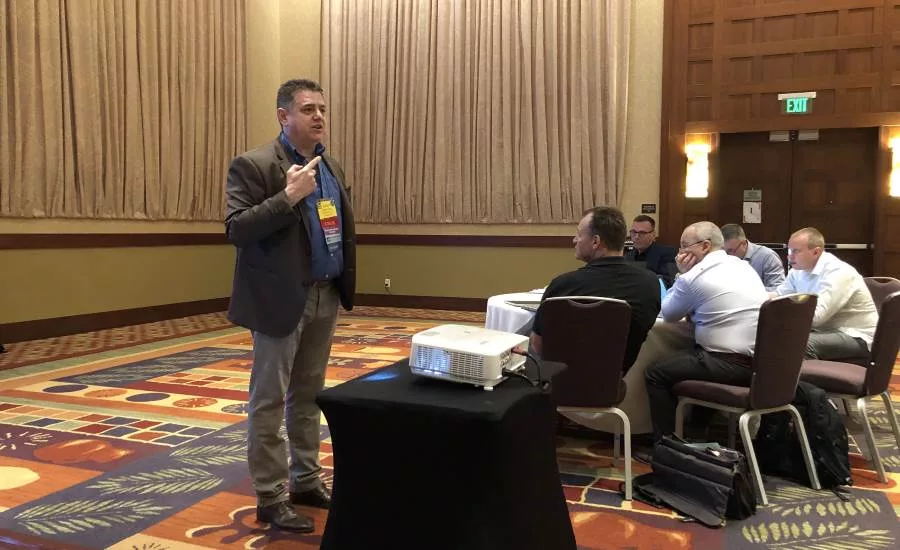
Robert Jutras (UL/CLEB) hosted a seminar on the differences between how Canada and the United States evaluate field performance of windows and curtain walls in large buildings during the American Architectural Manufacturers Association (AAMA) 82nd Annual Conference in Palm Springs (Feb. 25-28). Jutras, who is Canadian, focused more on the Canadian codes and practices for the benefit of a mostly American audience at the conference.

Jutras's presentation compared building codes, including the 2018 International Builders Code (IBC) and the 2015 National Building Code of Canada (NBC), and discussed field performance evaluation in the U.S. versus evaluation in Canada, with a focus on what differences meant for air leakage and resistance to water penetration. He also compared the two countries' takes on differential pressure versus wind speed.

In the U.S., Jutras pointed out, codes are divided by usage, either commercial (IBC) or residential (International Residential Code). In Canada, alternately, codes are not divided by usage, like commercial and residential, nor are they divided by occupancy. Instead, they are divided by size.

"Parts three, four and five of the code covers all types of occupancy, including medium to high-rise residential," said Jutras.

Building requirements for large buildings are found in NBC Part 5, Environmental Separation, which covers heat transfer, air leakage, protection from precipitation, vapor diffusion, windows, doors and skylights and other fenestration assemblies. NBC Part 5 requires that windows, doors and skylights conform to the requirements of "AAMA/WDMA/CSA 101/I.S.2/A440, NAFS – North American Fenestration Standard/Specification for Windows, Doors, and Skylights" (NAFS) and CSA A440S1, "Canadian Supplement to AAMA/WDMA/CSA 101/I.S.2/A440, NAFS – North American Fenestration Standard/Specification for Windows, Doors, and Skylights." There are no installation requirements in Part 5 of the NBC, other than the air barrier continuity requirement around penetrations through the building assembly.

AAMA standards, which can be used to evaluate the performance characteristics of other fenestration assemblies, include several in the AAMA 501 series of documents.

Jutras spoke about air leakage saying that, in Canada, the applicable laboratory test method for determining the rate of this is ASTM E283, "Determining Rate of Air Leakage Through Exterior Windows, Curtain Walls, and Doors Under Specified Pressure Differences Across the Specimen." If field testing for air leakage is to be conducted, the applicable test method is ASTM E783, "Field Measurement of Air Leakage Through Installed Exterior Windows and Doors."

In regard to water penetration, Jutras's presentation showed examples of six cities on each side of the U.S. and Canadian border, close enough to support the hypothesis that climatic conditions should be comparable. Results showed that, on average, there are two times more pressure for resistance in Canadian cities than in U.S. cities.

Jutras noted that, when evaluating the relationship between differential pressure and wind speed, it is important to account for the building's total elevation, given that the available wind speed data is usually measured near ground level.


More information about AAMA and its activities can be found via the AAMA website, https://aamanet.org.

KEYWORDS: AAMA (American Architectural Manufacturers Association) building codes Canada curtain wall windows

Share This Story

Looking for a reprint of this article?
From high-res PDFs to custom plaques, order your copy today!


Recommended Content

JOIN TODAY
to unlock your recommendations.

Already have an account? Sign In

  • bar graph shows LEED v4/LEED v5/LEED v6 in various colors

    When Will LEED v4 / v4.1 and LEED v5 Expire?

    The latest version of the LEED rating system, LEED v5, is...
    Sustainability
    By: Daniel Overbey
  • Celebrating Women In AEC-2026

    Celebrating Women in The AEC Industry Part 1

    A round-up of women in the design, engineering and...
    Sustainability
    By: Lindsay Lewis
  • KEE membrane application on a roof

    A Beginner’s Guide to Single-Ply Roofing Membranes

    While PVC and TPO appear extremely similar, the chemistry...
    Low-Slope Roofs
    By: Peter Gross
Manage My Account
  • Sign up for the Newsletter
  • Online Registration
  • Manage My Preferences
  • Registration Customer Service

More Videos

Sponsored Content

Sponsored Content is a special paid section where industry companies provide high quality, objective, non-commercial content around topics of interest to the Building Enclosure audience. All Sponsored Content is supplied by the advertising company and any opinions expressed in this article are those of the author and not necessarily reflect the views of Building Enclosure or its parent company, BNP Media. Interested in participating in our Sponsored Content section? Contact your local rep!

close
  • 2 construction workers and a DEXcell panel
    Sponsored byDEXcell Roof Boards

    Designing Low-Slope Roofs for Resilience

  • Bell Bank headquarters in Fargo, North Dakota
    Sponsored bySto Corp.

    Drained and Back-Ventilated Rainscreens vs Pressurized-Equalized Rainscreens

  • A construction worker using DEXcell roof boards
    Sponsored byDEXcell Roof Boards

    The Hidden Strength of Low-Slope Roof Systems: Why Roof Cover Boards Matter

Popular Stories

construction industry workers in hard hats stand around a city scape

Construction Industry Revolts Over New CSI Licensing Plan

a man wearing a mask installs insulation into a wall system

Quiet Rooms and Healthier Air: A Second Look at What Goes Inside the Wall Cavity

Canalino Elementary School and Canalino Family School exterior

Daylighting Design to Support Rapidly Growing Trend in Modular Building Construction

Building Enclosure Newsletter

BE Poll

Events

June 17, 2025

Addressing Condensation in Low-Slope Roof Assemblies

Credits: 1 AIA LU/HSW; 0.1 ICC CEU; 1 IIBEC CEH; 0.1 IACET CEU

On Demand In modern roofing systems, vapor retarders and air barriers do more than just minimize air leakage—they’re essential to maximizing performance and longevity. This engaging course dives into the next generation of moisture control: permeable vapor retarders and air barriers. Discover how these cutting-edge technologies are transforming low-slope roofing assemblies by improving energy efficiency, managing moisture, and boosting wind uplift resistance.

April 9, 2026

Strategies for High-Performance Below-Grade Waterproofing

Credits: 1 AIA LU/HSW ; 1 IIBEC CEH; 0.1 IACET CEU

On-Demand Designing a high-performance building enclosure requires more than just surface-level protection; it demands a rigorous, performance-based mastery of below-grade water and gas mitigation. This discussion will provide an expert-level analysis of below-grade waterproofing within the comprehensive framework of the high-performance building enclosure.

View All Submit An Event

Products

Plaster and Drywall Assemblies Manual

Plaster and Drywall Assemblies Manual

This is a comprehensive manual that goes beyond codes and standards, providing expert guidance in design, detailing, material selection and troubleshooting for plaster and drywall.

See More Products

Related Articles

  • curtainwall on a building

    Steel’s Role in the Next Generation of Glass Curtain Walls

    See More
  • FGIA_Horizontal_RGB.jpg

    FGIA Releases Updated Voluntary Specification for Field Testing of Newly Installed Storefronts, Curtain Walls, Sloped Glazing Systems

    See More
  • TGP-WRWA-4.jpg

    Transparent Glass Curtain Walls Improve Airport Design

    See More

Related Products

See More Products
  • ecology.jpg

    Architecture and Systems Ecology: Thermodynamic Principles of Environmental Building Design, in three parts

  • studentguidebook.jpg

    Integrating Building Performance with Design: An Architecture Student’s Guidebook

  • 1118458605.jpg

    Sustainable Facades: Design Methods for High-Performance Building Envelopes

See More Products
×

Enhance your expertise with unparalleled insights.

Join thousands of building professionals today. Shouldn’t you know what they know?

SUBSCRIBE TODAY!
  • RESOURCES
    • Advertise
    • Contact Us
    • Store
    • Want More
  • SIGN UP TODAY
    • Create Account
    • Newsletter
    • Customer Service
    • Manage Preferences
  • SERVICES
    • Marketing Services
    • Reprints
    • Market Research
    • List Rental
    • Survey/Respondent Access
  • STAY CONNECTED
    • LinkedIn
    • Facebook
    • Instagram
    • YouTube
    • X
  • PRIVACY
    • PRIVACY POLICY
    • TERMS & CONDITIONS
    • DO NOT SELL MY PERSONAL INFORMATION
    • PRIVACY REQUEST
    • ACCESSIBILITY

Copyright ©2026. All Rights Reserved BNP Media, Inc. and BNP Media II, LLC.

Design, CMS, Hosting & Web Development :: ePublishing