The Path to Zero Net Energy
Making Sense of Rigid Foams for Continuous Insulation
At one time, the idea of a zero net energy building seemed like science fiction, similar to flying cars and jetpacks. Yet, as of 2016, there were 332 zero net energy verified buildings in North America, according to the New Buildings Institute. As building owners demand more energy-efficient buildings, and codes become more rigorous, this number will grow, as will the requirements for building insulation.
An examination of building code trends indicates steady movement toward an eventual future of all zero net energy commercial buildings. U.S. Dept. of Energy (DOE) data show that the energy use intensity (EUI) of commercial buildings is nearly 50 percent less under ASHRAE 90.1-2013 than it was under ASHRAE 90A-1980. That trend has accelerated over time, with EUI dropping especially sharply with the adoption of the 2001 and 2007 versions of ASHRAE 90.1.
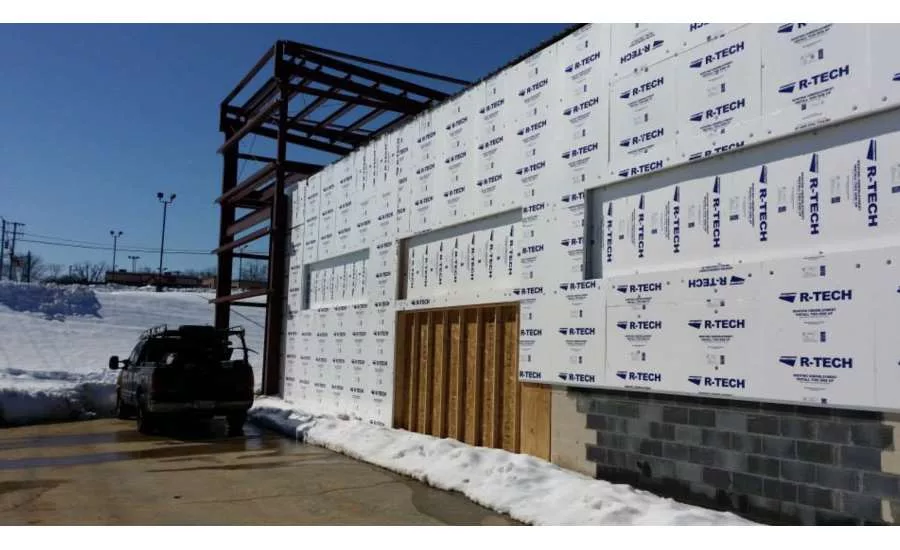
Of particular note to building envelope professionals, since 2007, ASHRAE 90.1 has required continuous insulation (CI) in most U.S. climate zones. Sixteen states have mandatory statewide commercial energy codes that meet or exceed that standard. California has gone even farther with its Title 24 Energy Efficiency Standards, which call for all new commercial buildings in the state to be zero net energy by 2030.
As a result of all these changes, architects have had to pay additional attention to creating well-insulated building envelopes.
Contributing to Energy Efficiency
While it is a somewhat self-explanatory term, continuous insulation is defined in ASHRAE 90.1, Energy Standard for Buildings Except Low-Rise Residential Buildings, as:
“Insulation that is continuous across all structural members without thermal bridges other than fasteners and service openings. It is installed on the interior, exterior, or is integral to any opaque surface of the building envelope.”
Structural framing members, such as studs and joists—whether wood or steel—conduct heat much more readily than does building insulation, so are a substantial path for heat loss. As these members account for a high portion of a wall’s area, the effective R-value of the wall assembly is well below the nominal R-value of insulation installed between the members. CI is explicitly intended to reduce this thermal bridging.
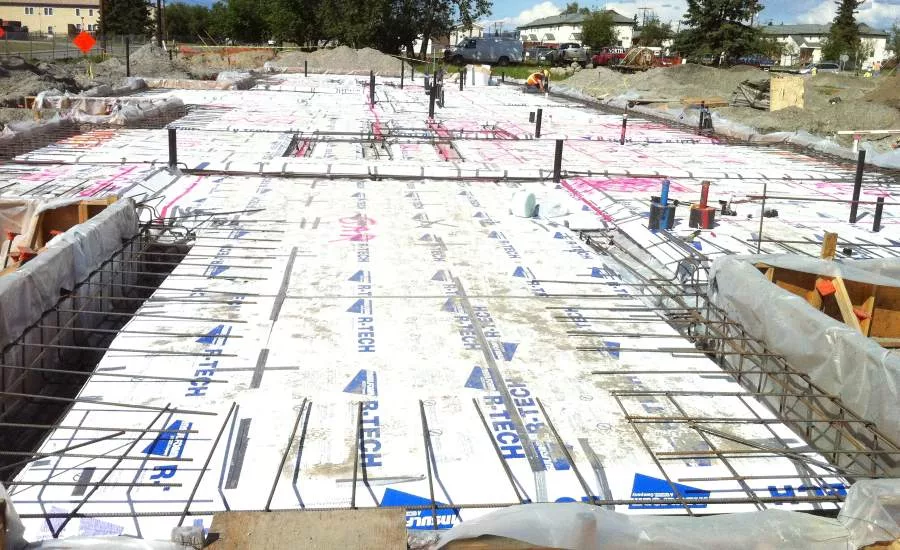
While ASHRAE 90.1 does not specifically call for underslab insulation, project teams interested in high-performance envelopes often also include a continuous layer of rigid foam under floor slabs (see “Energy savings benefits of underslab insulation”).
Continuous insulation options
Energy Savings Benefits of Under Slab Insulation
While it might seem that the earth beneath a concrete floor slab would be an effective insulator, the EPS Industry Alliance notes that a lack of insulation on below-grade foundations, crawlspaces and under slabs accounts for up to 25 percent of a building’s total energy loss. Un-insulated concrete provides a thermal bridge between a building’s heated interior and the relatively cooler earth surrounding the building, or through exposed slab edges to the outside air.
Below grade insulation not only helps reduce energy costs, it also reduces interior condensation on foundation walls and protects concrete from freeze-thaw cycling, thereby helping minimize cracking, spalling and frost heave. Commonly used below-grade insulations include EPS and XPS. When choosing between these materials, it is important to consider their crucial performance differences regarding moisture resistance and thermal performance. EPS and XPS insulations perform very differently when it comes to moisture. EPS tends to absorb small amounts of moisture quicker, but releases it much faster than XPS does. This has led to confusion about which material performs best, as XPS comes out ahead in the laboratory, while EPS is superior in real-world applications. A number of studies of insulation exposure to moisture in actual field conditions show that EPS outperforms XPS by a wide margin. For example, the independent lab Element evaluated the moisture content of EPS and XPS buried side-by-side for 15 years on a building foundation in St. Paul, Minn. At the time the insulations were removed, the EPS was four times drier than the XPS—the EPS had only 4.8 percent moisture by volume compared to 18.9 percent moisture content for the XPS. After 30 days of drying time, the EPS had dried to only 0.7 percent moisture by volume, while the XPS still contained 15.7 percent moisture. The high moisture absorption of XPS is further seen in a 2012 report from the DOE’s Oak Ridge National Laboratory. Researchers found that XPS insulation installed below grade for 15 years had absorbed 67 percent or more moisture. The resulting loss of energy savings performance for the XPS was 10 percent for a full basement (“deep basement”) and 44 percent for a slab-on-grade installation.Building teams have a range of options for providing CI to meet code requirements. The most commonly used among these are rigid foam products:
- Expanded polystyrene (EPS)
- Graphite polystyrene (GPS)
- Extruded polystyrene (XPS)
- Polyisocyanurate (polyiso)
- Structural insulated panels (SIPs)
EPS and GPS
Among rigid foam insulations, EPS and GPS have the highest R-value per dollar, which makes them well-suited for cost-effective continuous insulation. EPS provides R-4 to R-4.4 per inch of thickness, depending on the density, and GPS provide R-4.7-per-inch. Unlike other rigid foam insulations, EPS and GPS retain their R-values throughout their time in service. EPS is one of the most versatile rigid insulations because it can be used anywhere in the building envelope—roof, walls, floors and even below grade.
XPS
Mostly used in walls or below grade applications, XPS provides about R-5-per-inch of thickness, and is mid-range in price between EPS and polyiso. Although XPS is slow to absorb moisture, it is also slow to release it, which can reduce the insulation’s effective R-value as it retains moisture over time.
Polyiso
Historically polyiso was used in roof assemblies, although some manufacturers now offer wall insulation. Polyiso panels state R-6.1 (aged value) per inch of thickness. Polyiso R values start at about R-7-per-inch, but degrade over time as the thermal-enhancing blowing agents used to make them mix with air to reduce the long-term R-value.
SIPs
By integrating a building’s structural components and insulation in one unit and coming in large wall and roof sections, SIPs have far fewer gaps to seal than other structural systems, and provide continuous insulation and reduced thermal bridging. R-values depend on the panel thickness and type of rigid foam insulation used, but SIPs can help reduce heating and cooling energy use up to 60 percent compared to other construction methods.
Reducing Labor and Material Costs
Rigid foam insulation manufacturers offer a number of product options that help building teams reduce their continuous insulation labor and material costs. One example is rigid foam in “fanfold” bundles.
EPS fanfold bundles may require fewer fasteners than other exterior wall insulations, and require about 60 percent fewer man hours to install than working with individual insulation sheets.
SIPs—made with a range of rigid foam cores, including EPS and GPS—provide another way to simplify CI. The panels come in large sections (up to 8 by 24 feet) labeled for ready installation according to a coded plan. Builders can thus construct entire walls and roofs in a matter of hours, instead of days or weeks.
A number of other rigid foam insulation product configurations exist for simplifying and reducing costs of CI; check with the manufacturer for details.
Conclusion
The number of zero net energy verified buildings in the U.S. increased by 74 percent from 2014 to 2015, and many more projects are on the drawing board or under construction.
Commenting on a zero net energy education facility his firm designed in Oregon, Doug Reimer, AIA, Senior Project Architect with Hennebery Eddy Architects, said, “The first and maybe most critical step in getting a building to net-zero energy use is to reduce its energy consumption.”
Continuous insulation using rigid foam insulation can play a major role in reducing heating and cooling energy consumption, whether for a net-zero energy building, or other high-performance building envelope.
Looking for a reprint of this article?
From high-res PDFs to custom plaques, order your copy today!
.webp?height=740&t=1767036885&width=auto "Header - BE 1170x658 (002).png")

.webp?height=740&t=1755781744&width=auto "KEE(2).png")