Building Enclosure logo
search
cart
facebook twitter linkedin youtube instagram Spotify Podcasts Apple Podcasts Spotify Podcasts Apple Podcasts
  • Sign In
  • Create Account
  • Sign Out
  • My Account
Building Enclosure logo
  • NEWS
    • Breaking News
  • SECTIONS
    • Columns
    • Project Profiles
    • Trade Shows
    • Sponsor Insights
  • SYSTEM DESIGNS
    • Low-Slope Roofs
    • Pitched Roofs
    • Metal Roofing Materials
    • Waterproofing
    • Sustainability
    • Insulation
    • Exterior Claddings
    • Wall Systems
    • Building Envelope
  • BLOG
    • The BE Blog
  • MEDIA
    • Podcasts
    • Webinars
    • Quiz
    • Videos
    • Polls
    • Interactive Spotlights
    • Newsletter
    • Photo Galleries
  • DIRECTORIES
    • Directory: Blue Book
    • Directory: Roofing Resource
  • PRODUCTS
  • TECHNICAL
    • Codes
      • Waterproofing
      • Roofing
    • Details
      • Waterproofing
      • Roofing
  • CONTINUING ED
  • ABOUT
    • Advertise
      • Editorial Calendar
    • Contact
    • eMag Archive Issues
  • SIGN UP!
Columns

City Center DC: Tying Together the Roof and Building Envelope

By Todd C. Skopic
January 1, 2014

CityCenterDC is a behemoth of a project. The mixed-use development was envisioned as the centerpiece of Washington, D.C., with a mix of condominiums, apartments, offices, public spaces, restaurants, shops and a hotel. The site is 10 acres and takes up four city blocks. There are six buildings that have a total of 2.5 million square feet of space. This is a $700 million development with a construction cost of $425 million.

Groundbreaking occurred in May 2011 with substantial completion scheduled for early 2014. The design architect is Foster and Partners from London. The architect of record is the local D.C. firm, Shalom Baranes Associates.

One of the design challenges is that all six roofs are occupied or planted. This made it even more critical to have a bulletproof waterproofing/roofing system.

The system of choice here was the Henry Company 790-11 Hot Rubberized Asphalt (HRA). This is an Inverted Roof Membrane Assembly (IRMA) consisting of: 215 mils of reinforced hot rubberized asphalt, 80-mil protection base ply, Owens Corning extruded polystyrene rigid insulation, and then either a paver or vegetative overburden cover.

The applicator that masterminded and successfully executed the Division 7 (Thermal and Moisture Protection) contracts and construction was Gordon Contracting of Capital Heights, Md. Gordon Contracting was responsible for the foundation waterproofing, plaza deck waterproofing, expansion joints, air/vapor barrier, deck coating, IRMA roof with pavers and vegetative roof. The company’s work was split up into four distinct areas: Retail, Office, Condo, and Garage. The project manager for Gordon Contracting was Jeff Wooldridge. He had to manage many balls in the air over a period of 26 months and a crew that ranged in size from 8 to 30.

One of the first challenges to be identified involved the metal decks. The cast-in-place concrete roof deck was to be poured on vented metal deck. This venting allows the concrete to dry more rapidly. Fortunately, Jerry Hangsleben, a D.C.-based field tech rep for the Henry Company, immediately noted that the steel deck was non-vented. In conjunction with the envelope consultant, Simpson Gumpertz & Heger (SGH), a decision was made to drill a plethora of holes in the metal decking to receive the hot rubberized asphalt that was supplied by the Henry Company. The concrete was given a good 45-plus days to cure, so the moisture in the slab was not an issue.

Coordinating all of the elements of the various roof projects was a monumental task. Fortunately, Steve Gordon of Preservation and Protection Systems Inc. (PPSI), a mainstay in this market for more than 30 years, was up to the challenge. With his relationships, Gordon was able to tie together the entire building envelope on behalf of the Henry Company and the other building envelope manufacturers he represents. One example of Gordon’s attention to detail and his commitment to the project was a plant tour that he executed to the Hanover Paver Plant in Hanover, Pa., with representatives from both Shalom Baranes Associates and Foster and Partners.

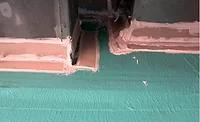
There were several critical aspects of the building envelope, including the fire-rated expansion joints. These expansion joints formed the bridge between the waterproofing membrane and the concrete deck. Brian Baker, also of PPSI, was with the expansion joint manufacturer, Emseal, at the time of the design and construction. According to Baker, “Part way into the design, the Fire Marshall determined that these joints needed to be fire rated.” To accomplish this, Emseal recommended a double system of both a primary expansion joint (Migutan) and a secondary joint (DFRZ/3) that carries a three-hour rating. The expansion joints tied into the HRA that was supplied by the Henry Company. These two manufactures can offer joint warranties for their systems when properly specified and integrated.

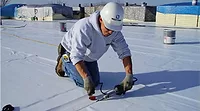
There was approximately 250,000 square feet of reinforced HRA system applied to many of the horizontal surfaces. The flashing that was used was a torch-applied modified bitumen (MB). Torch-applied flashing is more robust and longer lasting than uncured neoprene. However, uncured neoprene is still required for detailing drains as it is more flexible. MB flashing has significantly more tensile strength at 100 foot-pounds per inch (machine direction). Uncured neoprene has greater elongation at 300 percent (ASTM D412).

In addition to the IRMA roof, Henry Company supplied all the air and vapor barrier. With all the insulation being in the cavity, the design team decided to use a non-permeable air barrier system. Originally, only the Blueskin SA peel-and-stick membrane was specified. During construction, it was determined to change the overhang areas to a fluid-applied, non-permeable system, Air-Bloc 32 MR.

 This huge project presented many challenges. Due to a great team effort, the applicator, Gordon Contracting, was able to keep it all together while tying the entire building envelope together.  

KEYWORDS: asphalt roofing flashing green roofing joints Washington DC

Share This Story

Looking for a reprint of this article?
From high-res PDFs to custom plaques, order your copy today!


Todd C. Skopic, CSI, CDT, LEED AP, is the Northeast Regional Building Science Specialist with the Henry Company. He has been involved in the design and construction industry for 28 years, specializing in water, moisture and air intrusion prevention into the building envelope. Skopic is active in CSI, RCI, BEC (Building Enclosure Council), and serves on committees for ABAA (Air Barrier Association of America). He can be reached at tskopic@henry.com or 410-960-3059.

Recommended Content

JOIN TODAY
to unlock your recommendations.

Already have an account? Sign In

  • bar graph shows LEED v4/LEED v5/LEED v6 in various colors

    When Will LEED v4 / v4.1 and LEED v5 Expire?

    The latest version of the LEED rating system, LEED v5, is...
    Sustainability
    By: Daniel Overbey
  • Celebrating Women In AEC-2026

    Celebrating Women in The AEC Industry Part 1

    A round-up of women in the design, engineering and...
    Building Envelope
    By: Lindsay Lewis
  • KEE membrane application on a roof

    A Beginner’s Guide to Single-Ply Roofing Membranes

    While PVC and TPO appear extremely similar, the chemistry...
    Low-Slope Roofs
    By: Peter Gross
Manage My Account
  • Sign up for the Newsletter
  • Online Registration
  • Manage My Preferences
  • Registration Customer Service

More Videos

Sponsored Content

Sponsored Content is a special paid section where industry companies provide high quality, objective, non-commercial content around topics of interest to the Building Enclosure audience. All Sponsored Content is supplied by the advertising company and any opinions expressed in this article are those of the author and not necessarily reflect the views of Building Enclosure or its parent company, BNP Media. Interested in participating in our Sponsored Content section? Contact your local rep!

close
  • 2 construction workers and a DEXcell panel
    Sponsored byDEXcell Roof Boards

    Designing Low-Slope Roofs for Resilience

  • Bell Bank headquarters in Fargo, North Dakota
    Sponsored bySto Corp.

    Drained and Back-Ventilated Rainscreens vs Pressurized-Equalized Rainscreens

  • A construction worker using DEXcell roof boards
    Sponsored byDEXcell Roof Boards

    The Hidden Strength of Low-Slope Roof Systems: Why Roof Cover Boards Matter

Popular Stories

construction industry workers in hard hats stand around a city scape

Construction Industry Revolts Over New CSI Licensing Plan

a man wearing a mask installs insulation into a wall system

Quiet Rooms and Healthier Air: A Second Look at What Goes Inside the Wall Cavity

Canalino Elementary School and Canalino Family School exterior

Daylighting Design to Support Rapidly Growing Trend in Modular Building Construction

Building Enclosure Newsletter

BE Poll

Events

June 17, 2025

Addressing Condensation in Low-Slope Roof Assemblies

Credits: 1 AIA LU/HSW; 0.1 ICC CEU; 1 IIBEC CEH; 0.1 IACET CEU

On Demand In modern roofing systems, vapor retarders and air barriers do more than just minimize air leakage—they’re essential to maximizing performance and longevity. This engaging course dives into the next generation of moisture control: permeable vapor retarders and air barriers. Discover how these cutting-edge technologies are transforming low-slope roofing assemblies by improving energy efficiency, managing moisture, and boosting wind uplift resistance.

April 9, 2026

Strategies for High-Performance Below-Grade Waterproofing

Credits: 1 AIA LU/HSW ; 1 IIBEC CEH; 0.1 IACET CEU

On-Demand Designing a high-performance building enclosure requires more than just surface-level protection; it demands a rigorous, performance-based mastery of below-grade water and gas mitigation. This discussion will provide an expert-level analysis of below-grade waterproofing within the comprehensive framework of the high-performance building enclosure.

View All Submit An Event

Products

Plaster and Drywall Assemblies Manual

Plaster and Drywall Assemblies Manual

This is a comprehensive manual that goes beyond codes and standards, providing expert guidance in design, detailing, material selection and troubleshooting for plaster and drywall.

See More Products

Related Articles

  • World-Class Research Center Protected by State-of-the-Art Building Envelope System

    See More
  • Western roofing0web.jpg

    Maintaining Transitions Between Components Equals Better Waterproofing for the Entire Building Envelope

    See More
  • interior AVB (Air & Vapor Barrier) and exterior facade repairs to a building

    Western Specialty Contractors Mitigates Building Envelope Air, Moisture Infiltration Issues at Chicago Medical Center

    See More

Related Products

See More Products
  • energy modeling.jpg

    Energy Modeling and Computations in the Building Envelope

  • 0470872616.jpg

    Sustainable Renovation: Strategies for Commercial Building Systems and Envelope

See More Products
×

Enhance your expertise with unparalleled insights.

Join thousands of building professionals today. Shouldn’t you know what they know?

SUBSCRIBE TODAY!
  • RESOURCES
    • Advertise
    • Contact Us
    • Store
    • Want More
  • SIGN UP TODAY
    • Create Account
    • Newsletter
    • Customer Service
    • Manage Preferences
  • SERVICES
    • Marketing Services
    • Reprints
    • Market Research
    • List Rental
    • Survey/Respondent Access
  • STAY CONNECTED
    • LinkedIn
    • Facebook
    • Instagram
    • YouTube
    • X
  • PRIVACY
    • PRIVACY POLICY
    • TERMS & CONDITIONS
    • DO NOT SELL MY PERSONAL INFORMATION
    • PRIVACY REQUEST
    • ACCESSIBILITY

Copyright ©2026. All Rights Reserved BNP Media, Inc. and BNP Media II, LLC.

Design, CMS, Hosting & Web Development :: ePublishing