Boston Harbor Islands Pavilion Provides a Gateway to a Natural Environment
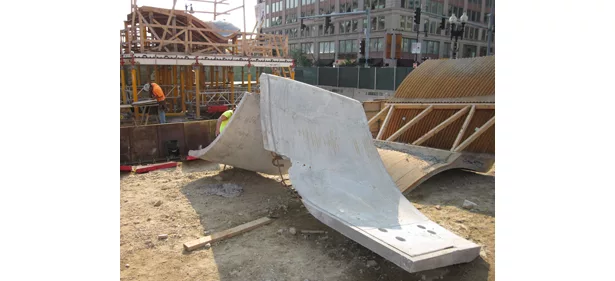
This mockup revealed that self-consolidating concrete would not be viable to produce the tight edge details and reveal desired. Photo Credit: Simpson Gumpertz & Heger Inc.
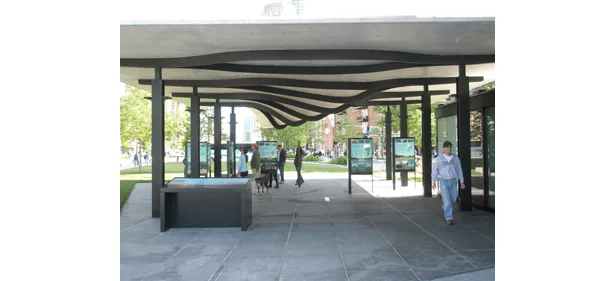
The structural geometry is designed to gently lead visitors through the pavilion. All lights and other requirements are hidden into carefully detailed steel columns. Photo Credit: Simpson Gumpertz & Heger Inc.
In 2008, the Boston Harbor Island Alliance and National Park Service held a competition for a visitor information pavilion for the Boston Harbor Islands, a national park composed of 38 islands that are accessible by ferryboat from the Boston waterfront. Intended to increase awareness and visitation of the islands by giving them a strong physical presence in the city, the pavilion would provide a much-needed space to learn about the islands and to purchase a ferry ticket. It would be the first structure built on the Rose Fitzgerald Kennedy Greenway, a new city park created when an elevated highway through the city was dismantled and re-routed underground. This location would allow it to link two park systems — the Greenway and the Islands — making it an important gateway and threshold from a dense urban setting to a natural environment, perceptually far-removed from the city.
“When the winning competition entry, a glass building at the corner of the parcel, proved too costly to build and maintain, the client sought ideas for a new direction for the project,” said Chris Genter, architect at Utile, Inc. in Boston. “Our design team at Utile, Inc.reconceived the structure as a three-season open-air exhibit and relocated it to the center of the parcel where it could take full advantage of the park.”
Key Design Goals
|
Boston Harbor Islands Pavilion |
|
Location: Parcel 14, Rose Fitzgerald Kennedy Greenway, Boston, Mass. Dates: Completed May 2011 Client: Boston Harbor Island Alliance (Client) Landowner: Rose Fitzgerald Kennedy Greenway Conservancy Architect: Utile, Inc. Structural Engineer: Simpson Gumpertz & Heger Inc. (SGH) Landscape Architect: Reed Hilderbrand Associates, Inc. MEP/FP: Allied Consulting Engineering Services, Inc. Civil: Vanasse Hangen Brustlin, Inc. (VHB) Photovoltaics: Solar Design Associates Lighting: LAM Lighting & Design User Experience: IDEO Types of Roof Systems: TPO membrane was installed on the two slate kiosks. A liquid-applied Methyl Methacrylate (MMA), typically employed on parking garage decks, was used to protect the upper surface of the two concrete canopies. |
Utile was the lead project designer from concept through detail drawings and construction. Utile closely collaborated with Simpson Gumpertz & Heger Inc. (SGH) on the form, structural design, fabrication logic, detailing, and construction of the concrete roof canopies.
Utile conceived of the project as an outdoor pavilion both to better connect the building to the surrounding park and to reduce operating and maintenance costs. “Because much of the project is open to the park, the roof became a key functional and expressive design element. The roof canopies define a space for outdoor exhibits and visitor spaces, providing shade and protection from the rain. The curved roof shape collects water, which pours onto a splash block to create a rain event. The allusive sculptural shape of the canopies is also meant to engage park users, who identify it as the hull of a ship, a bird in flight, or a whale,” said Genter.
Genter explained the strategy behind designing the zero net energy building. “Minimizing the interior space of the pavilion significantly reduced the energy consumption of the project,” he said. “No cooling is required and heating needs are minimal. The remainder of the energy needed to power the pavilion — primarily lighting and two 8-foot-by-10-foot LED video screens — is provided by photovoltaic panels on the two roof canopies.”
Paul Kassabian, senior project manager at SGH in Waltham, Mass., mentioned how they got one of their detail ideas for the striking thin concrete roofs. “They’re not as thin as they look! The first Macbook Air had just come out during the design of the roofs, so we ‘borrowed’ the edge detail where you visually read a vertical edge. There’s a smooth curve that flows underneath, so we have depth where we need it.”
Genter noted thata bifacial panel was used for the solar panels on the project. “There were two primary challenges: The curved shape of the roof and its thin profile,” he said. “Rather than have the panels clumsily conform to the roof shape, they seem to float as a plane above the curved roof. The locations of the panels are limited to areas of the roof with a more subtle curvature. The attachment point locations of the support rails for the photovoltaics were carefully coordinated to avoid the rebar in the thin concrete roof.”
Obstacles
Designers had to overcome numerous challenges on the project. “Rediscovering how to make double-curved concrete was the biggest challenge,” said Kassabian. “Many thin-shell concrete roof structures were designed and built in the mid-20th century. Much of the construction knowledge and experience is no longer in existence and, in addition, labor costs have dramatically increased. So, we had to work on how to make this happen while doing so in a cost-effective manner.”
To accomplish this feat SGH worked with C.W. Keller & Associates, Inc., a timber millwork company out of New Hampshire, who created accurate double-curved timber forms. They also did their own background research on the concrete mixes used for the early concrete shells.
There was an extensive mockup process including four curved and fully reinforced mock-ups, according to Kassabian. “We took away lessons learned from each one, but the process itself was fraught with disappointment and concern,” he said. “We’re thrilled it worked out in the end.”
Kassabian said that many site safety aspects were standard on the project. But a site-specific issue was building above the Central Artery/Tunnel Project, known also as the Big Dig. The underground tunnels are the chief highway that takes motorists underneath the heart of the city. “This was the first permanent project built above the tunnels, so there was a wide array of procedural and contractual risk issues to navigate. In the end, we worked with the general contractor to develop load limits for their construction vehicles and how they should maintain distance from each other to prevent local high combined wheel loads.”
The challenges on the project were numerous, but Genter stated his firm thrives on solving complex urban problems in intelligent, pragmatic ways. “From theoretical issues that frame policy to the practical implementation of architectural commissions, we develop a rigorous, research-based approach to finding the best answers. Our work yields fresh ways to think about how we develop and build our cities, presented with useful, compelling clarity (it’s why we're called Utile).”
Kassabian credits everyone on the team for bringing the project to a successful conclusion. “This project is an example of integrated architecture and engineering. The architecture is the structure and the structure is the architecture. Hence decisions on all details impact the outcome for us all. SGH worked extremely closely with both the architect and the concrete formwork manufacturers while drawing on our in-house materials expertise for the right concrete mix. This was a combination of design skill, leading-edge design, material knowledge, and practical manufacturing to produce the final project. It took a lot of work to produce something so simple!”
Looking for a reprint of this article?
From high-res PDFs to custom plaques, order your copy today!
.webp?height=740&t=1767036885&width=auto "Header - BE 1170x658 (002).png")

.webp?height=740&t=1755781744&width=auto "KEE(2).png")