Air Barriers: A Progressive Solution
What to know regarding the form, function and benefits of an air barrier in the design, engineering and construction market.
Air barriers have recently been identified as one of several effective and viable solutions toward better high-performance buildings. The International Energy Conservation Code and several state energy codes now require their use in all new commercial construction as well as some residential construction. More importantly, energy efficiency and occupant comfort—two key ingredients of sustainable design—are driving the use of air barriers across a variety of market sectors. With today’s high cost of energy and concerns about indoor environmental quality (IEQ), air barriers are one of several construction systems with a critical role to play.
Air barrier systems in commercial/industrial buildings are estimated to reduce air leakage by up to 83 percent, save on gas bills by more than 40 percent, and cut down on electrical consumption as much as 25 percent, according to simulations by the National Institute of Standards and Technology. Statistics from the NIST, and other academic and professional research groups, have caught the attention of certain entities, such as the American Society of Heating, Refrigerating and Air-Conditioning Engineers and code officials in several states. They have led to a new awareness that air barriers can increase both the longevity and durability of the building envelope. Many professionals, however, do not understand the form, function and benefits of an air barrier in the design, engineering and construction market.
AIR BARRIERS
The uncontrolled movement of air into and out of a building can have numerous detrimental effects. With the growing global awareness of energy use, buildings are quickly being recognized as the low-hanging fruit of energy savings. The U.S. Department of Energy estimates building operation accounts for roughly 40 percent of the nation’s energy expenditure, not including process loads within the buildings. The majority of this energy is used to condition the indoor environment. The air barrier system is one component of this building envelope and works to minimize air leakage. The three main forces causing envelope air leakage include: wind (rapidly changing pressures), stack effect (rising warm air pressure differentials) and mechanical systems (heating and cooling system pressurizations).
Any individual or combination of these driving forces can cause air leakage through cracks or gaps in the building envelope. Over the years, many strategies were incorporated into the design and construction of buildings, leading to more energy-efficient buildings. But the addition of a continuous air barrier to the building envelope saves more than energy. The air barrier system works to improve the building enclosure by eliminating occupant discomfort from drafts, degradation of building materials, poor indoor air quality, achievement of controlled pressurization and other benefits.
The current push for energy conservation bears many similarities to that of the 1970s oil crisis, and the strategy of tightening buildings is as applicable today as it was then. In the 1970s, many buildings suffered from the adverse effects of improperly employed methods of energy conservation. In-wall condensation was the cause of many failures in 1970’s buildings, and well-intentioned but ill-informed air tightness strategies are partially to blame. When more insulation is added to the interior side of the wall system, less energy is lost through the wall, and the condensation plane, or dew point, moves inward. The addition of a vapor retarder worked to prevent this condensation by eliminating vapor diffusion but failed to address condensation from vapor-laden air leakage. As the design and construction of today’s buildings requires greater insulation packages, we must be aware of moving the dew point further inward in our building assemblies. Although strategies exist to address this phenomenon, none should be incorporated without a continuous air barrier system. The design of an air barrier system is complex and requires an in-depth understanding of building science principles to be effective.
DESIGN
Many new materials and construction principles have begun to surface as more building designs include air barriers. Like all building materials and systems, time and experience will eliminate the concepts that don’t work or are not constructible, and certain strategies will become the predominant design standard. The Air Barrier Association of America is the accepted authority of air barrier design and construction, and has established a list of requirements that a system must meet. These include: continuous installation, specific air permeability levels, withstanding pressurizations, durability, air tightness, flexibility and others.
From a design perspective, the air barrier must be included in the initial phases of the project to ensure the building is acceptable at delivery. The design team must prepare plans and specifications that account for proper design and clearly translate the project’s needs and goals to the contractor performing the work. Plans need to clearly show the boundaries of the air barrier and specific details at all critical interfaces.
To many design firms, the air barrier is a new component with which they have little experience. As such, many design teams subcontract with other air barrier consulting firms for this portion of the design process. Independent technical reviews are typically completed at 65 percent and 95 percent submittals to ensure proper design.
CONSTRUCTION
Unfortunately, industry standard practices do not currently yield an airtight building regardless of what the design documents say. This is not necessarily due to an unwillingness to perform quality work, but rather a lack of communication and air-barrier-specific expertise between the design team and contractor. It is essential to discuss the air barrier in detail at the pre-construction meeting. Frequently, the project team finds it useful to construct a mock-up building section to become familiar with materials selected and installation methods. Feedback from the contractor during this process often provides the design team with a greater understanding of construction methods and encourages collaboration on solutions. Onsite observation by an air barrier consultant throughout the construction phase is highly recommended. This provides the opportunity to observe work for defects or errors, perform sample tests, assist in answering requests for information, and act as liaison between the contractor and the materials manufacturer. This work is similar to that of a quality assurance engineer but specific enough to require an individual or group specialized in air barrier consulting.
TESTING
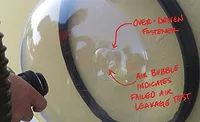
The performance of the air barrier system must be verified once construction is complete. ASHRAE’s Handbook of Fundamentals defines building air leakage rates as “tight,” “average” and “leaky” through established, normalized flow rates. If a building is found to leak more air than the specified rate, it is considered a failed test and the contractor must find and fix air leaks until the building reaches passing levels. As new codes and requirements are introduced, requirements and directives similar to those instituted by such agencies as the U.S. Army Corps of Engineers will apply to high-rise, commercial and residential buildings, depending on the relevant jurisdiction.
Performance testing requires the use of calibrated, industrial fans placed in exterior doors. These fans range in size from single door units to large trailer-mounted fans. Preparation for a test such as this involves a process of identifying and sealing all intended paths of airflow into or out of the building envelope, shutting down HVAC systems and opening all interior partitions. W&C
All images courtesy of BCRA.
Looking for a reprint of this article?
From high-res PDFs to custom plaques, order your copy today!
.webp?height=740&t=1767036885&width=auto "Header - BE 1170x658 (002).png")

.webp?height=740&t=1755781744&width=auto "KEE(2).png")
.webp?height=200&t=1782473009&width=200 "insulation(16).png")