Leave the Safety Railings to Us
Liberty Lines Inc. is one of the largest privately owned transportation companies in New York. Headquartered in Yonkers, the company has 750 employees and operates a fleet of 350 vehicles.
Liberty Lines Inc. is one of the largest privately owned transportation companies in New York. Headquartered in Yonkers, the company has 750 employees and operates a fleet of 350 vehicles. In conjunction with the Westchester County Department of Transportation, Liberty Lines provides safe, reliable and efficient local bus transportation services throughout the county on 59 routes.
While their buses were certified as safe, the roof on the company’s headquarters was not. The building’s 300,000-square-foot multi-level roof was not in compliance with OSHA regulations because it lacked fall protection at the roof’s edge. The building’s ladders were also out of code.
 Josh Crespo, Service Manager for Hayden Building
Maintenance Corp., a West Nyack, N.Y.-based
company hired to do the roof maintenance for the building, was aware of the
problem. Crespo and Ray Pereira, Vice President of Maintenance for Liberty
Lines, put their heads together to find an answer to the safety problems that
wouldn’t cause any damage to the existing roof.
Josh Crespo, Service Manager for Hayden Building
Maintenance Corp., a West Nyack, N.Y.-based
company hired to do the roof maintenance for the building, was aware of the
problem. Crespo and Ray Pereira, Vice President of Maintenance for Liberty
Lines, put their heads together to find an answer to the safety problems that
wouldn’t cause any damage to the existing roof.
“We’d been trying to work with them on fall protection,” said Crespo. “Originally we thought of anchoring a railing system to the deck, which would involve cutting the roof, and we wanted to avoid weakening it.”
They found the ideal solution in the KeeGuard, a non-penetrating safety rail system from Safety Rail Source.
In a joint effort, Safety Rail Source, Hayden Building Maintenance and architect Mitchell Koch worked with Liberty Lines to install an OSHA-compliant safety railing system and replace the ladders to bring the building into compliance with OSHA requirements. As an added bonus for the building owner, Liberty Lines was able to tap into federal dollars through the government’s stimulus package to help subsidize the installation.
The job was started in December 2009 and completed in three weeks. Approximately 4,342 feet of KeeGuard roof edge railing was installed and six fixed ladders were replaced with OSHA-compliant ladders.
 Safety Rail Source
Hal Swindell of Safety Rail Source consults to help contractors solve rooftop safety problems. “We sell OSHA-compliant safety railings, roof hatch railings and skylight railings,” said Swindell. “We’re most interested in rooftop and roof edge protection.”
The company has been in business since 1999, when Swindell developed his products out of necessity.
“I own a mechanical contracting company,” Swindell recalled. “I had a customer call me who said he received a fine for having no railing around a roof hatch. He asked me to find one for him. I couldn’t find one, so I invented one and got a patent for it. That’s how we got our start.”
He teamed up with partner Jan Carl Vanning to form Safety Rail Source.
“When a contractor calls us, we ask where the building is and what type of roof system is involved,” Vanning said. “We need something in writing - a layout, CAD drawing, photos, Google Earth - or we do a site visit. That’s what we did at Liberty Lines. Once we understand what they’re looking for, we design a non-penetrating, freestanding, OSHA-compliant railing system. We provide a quote and review exactly what they need and refine it if necessary. ”
The company offers on-site assistance when the material is delivered and final inspection once the job is completed. “We tell them we will work with them from start to finish, and we mean that,” Vanning said.
The Liberty Lines project was a big one, with some 4,342 linear feet of railing installed on the five-level roof, but it isn’t the largest they’ve done; a Seattle project with 15,000 linear feet is the company’s biggest job to date.
 Loading the Material
According to Pereira and Crespo, the logistics of loading the material in a relatively tight space without disrupting a busy bus depot posed the biggest challenge on the project. Liberty Lines has about 500 employees at the site, and parking space was limited. The 90,000 pounds of safety rail material arrived on two flatbed trucks. “We needed to put it on the roof as soon as possible,” said Pereira.
The key was to keep a crane on site and keep everyone apprised of incoming shipments. “We pulled it off the trucks and to the parking lot as soon as the trucks came in, and as soon as the trucks left we started to move it up to the roof,” said Pereira. “In about a business day we were able to resume regular parking.”
“Loading the roof may have been the most difficult part,” agreed Crespo. “The highest section of the roof is about three to four stories high. We were only able to load from three locations, as this is a very busy bus depot/garage. We had to load some of the crates onto roof carts and wheel them as much as 700 feet. Fortunately for us, the crane was able to get materials to the highest roofs, which helped us out a lot.”
The Installation
The KeeGuard railing system is put together with Kee Klamps and galvanized steel fittings. There are no penetrations, and no metal touches the roof.
“Each system is engineered according to the application it’s going to be used on,” said Vanning. “The system is a counterbalanced system. The counterbalance weights we use now are 100 percent recycled PVC from wire sheathing. We grind it and make a solid 30-pound base. So what we have is a green product.”
At least one counterbalance is used on each upright piece of railing, with more weight at the terminations. Each counterbalance has a quarter-inch non-skid pad made of neoprene rubber. A final inspection ensures that the installation was done properly. The system must pass a 200 pound push-pull test for 30 seconds, anywhere along the span. “At the end of the job everyone’s amazed at the sturdiness of the system and at the aesthetics,” said Vanning.
Each custom-designed system includes detailed instructions and diagrams, and crates are numbered for each roof level for easy installation. The goal is to make installation as simple as possible for the installing contractor. “It’s their roof,” Swindell said. “It’s our product. In the training and installation we start with the hardest part of the railing system - the turns, etc. Straight runs are really easy.”
Despite its size, the Liberty Lines project was pretty straightforward, Swindell noted, with one exception. “On one of the higher roofs, the roof sloped down to the middle of the roof, with a drain in the middle,” he said. “We had to design longer railing posts sloped downward so the top and mid rails would be parallel.”
While Crespo had not worked with the KeeGuard system before, others at Hayden Building Maintenance had prior experience working with it. “We were able to borrow a foreman with experience, and he worked with us for two or three days,” Crespo said. “It’s easy to install with a little common sense. On a good day we could do 400 linear feet with three or four guys, which is pretty good. We also had a lot of straight runs, which helped us out.”
“Laying out the railing itself was very, very smooth,” Pereira stated. “The most important thing in a project like this, with a rubber membrane roof, is that you have to be very careful. You don’t want to have any punctures or other damage, and with a lot of people on the roof carrying tools, that’s always a danger. You have to be very careful. And we were. There was no damage to the roof.”
Crespo agreed that, despite a couple of snowstorms, the project went off without a hitch. “Knock on wood, everything went right,” he said. “The KeeGuard people, Safety Rail Source, they lay everything out and diagram what goes where. The crates are numbered and the diagram indicates where everything is supposed to go. From there it’s just a puzzle, and you have the blueprint. With a little common sense, you’ll be very profitable working with this system.”
 Shoots and Ladders
There were several concerns about the building’s existing roof access ladders. First of all, they had round rungs, and square ones are required by OSHA. The ladders did not extend 36 inches above the roofline, as required, and some were only 2 inches from the wall, when they should have been 4 inches away.
The new ladders were custom fabricated. Replacing the ladders had its own set of challenges, said Crespo. “The old ones were heavy and hard to handle, and when we pulled them out, we discovered that they were not properly supported,” he said. “But with a joint effort by Hayden Building Maintenance, Safety Rail Source, and Mitchell Koch, the engineer on the job, we were able to come up with the right solution.”
The old ladders were attached to wood, and the team developed an angle bar system with pre-drilled holes so the new ladders could be anchored to metal.
“When ladders are mounted to brick walls, you know what you’re working with,” Swindell said. “Some of the short ladders had a sidewall with sheet metal. You weren’t sure what was underneath. We found there was nothing to mount to. We installed some custom fittings, and it worked out very well.”
 Additional Benefits
The KeeGuard system is designed to make future roofing work easy to accommodate. “Even if you have a roof leak under a counterbalance weight, for example, you can loosen the set screws on that railing and move one post up without dismantling the railing,” Swindell said. “You could even tear off and replace the roof by lifting sections without losing the railing, so you don’t need additional fall protection.”
Those involved with the project agree that Liberty Lines’ headquarters is now not only up to code - it looks better, too. “We’re very satisfied with the installation,” Pereira said. “We’re not only satisfied, but it helps the building look better from the street level - and we’re in compliance with OSHA.”
Crespo agreed. “When you drive in, you see it from the hills, and it really does look good,” he said. “It actually is a very attractive system.”
According to Vanning, the KeeGuard system presents a great opportunity for contractors to help their customers and generate more revenue at the same time. “It’s a clean, easy installation and a great upsell,” he said. “It’s an opportunity with new customers and existing business that helps the contractor bring the building up to code. Many buildings are out of code and the building owners don’t even know it. It’s up to the contractor to inform them.”
For more information about Safety Rail Source, visit www.safetyrailsource.com.
Liberty Lines Inc. is one of the largest privately owned transportation companies in New York. Headquartered in Yonkers, the company has 750 employees and operates a fleet of 350 vehicles. In conjunction with the Westchester County Department of Transportation, Liberty Lines provides safe, reliable and efficient local bus transportation services throughout the county on 59 routes.
While their buses were certified as safe, the roof on the company’s headquarters was not. The building’s 300,000-square-foot multi-level roof was not in compliance with OSHA regulations because it lacked fall protection at the roof’s edge. The building’s ladders were also out of code.
“We’d been trying to work with them on fall protection,” said Crespo. “Originally we thought of anchoring a railing system to the deck, which would involve cutting the roof, and we wanted to avoid weakening it.”
They found the ideal solution in the KeeGuard, a non-penetrating safety rail system from Safety Rail Source.
In a joint effort, Safety Rail Source, Hayden Building Maintenance and architect Mitchell Koch worked with Liberty Lines to install an OSHA-compliant safety railing system and replace the ladders to bring the building into compliance with OSHA requirements. As an added bonus for the building owner, Liberty Lines was able to tap into federal dollars through the government’s stimulus package to help subsidize the installation.
The job was started in December 2009 and completed in three weeks. Approximately 4,342 feet of KeeGuard roof edge railing was installed and six fixed ladders were replaced with OSHA-compliant ladders.
A crane was used to hoist the 90,000 pounds of
safety rail material to the multi-level roof of the Liberty Lines Inc.
headquarters in Yonkers. (Photos courtesy of Safety Rail Source.)
Hal Swindell of Safety Rail Source consults to help contractors solve rooftop safety problems. “We sell OSHA-compliant safety railings, roof hatch railings and skylight railings,” said Swindell. “We’re most interested in rooftop and roof edge protection.”
The company has been in business since 1999, when Swindell developed his products out of necessity.
“I own a mechanical contracting company,” Swindell recalled. “I had a customer call me who said he received a fine for having no railing around a roof hatch. He asked me to find one for him. I couldn’t find one, so I invented one and got a patent for it. That’s how we got our start.”
He teamed up with partner Jan Carl Vanning to form Safety Rail Source.
“When a contractor calls us, we ask where the building is and what type of roof system is involved,” Vanning said. “We need something in writing - a layout, CAD drawing, photos, Google Earth - or we do a site visit. That’s what we did at Liberty Lines. Once we understand what they’re looking for, we design a non-penetrating, freestanding, OSHA-compliant railing system. We provide a quote and review exactly what they need and refine it if necessary. ”
The company offers on-site assistance when the material is delivered and final inspection once the job is completed. “We tell them we will work with them from start to finish, and we mean that,” Vanning said.
The Liberty Lines project was a big one, with some 4,342 linear feet of railing installed on the five-level roof, but it isn’t the largest they’ve done; a Seattle project with 15,000 linear feet is the company’s biggest job to date.
Despite the winter weather, the crew from Hayden
Building Maintenance installed 4,342 feet of Safety Rail Source’s KeeGuard
non-penetrating safety rail system in three weeks.
According to Pereira and Crespo, the logistics of loading the material in a relatively tight space without disrupting a busy bus depot posed the biggest challenge on the project. Liberty Lines has about 500 employees at the site, and parking space was limited. The 90,000 pounds of safety rail material arrived on two flatbed trucks. “We needed to put it on the roof as soon as possible,” said Pereira.
The key was to keep a crane on site and keep everyone apprised of incoming shipments. “We pulled it off the trucks and to the parking lot as soon as the trucks came in, and as soon as the trucks left we started to move it up to the roof,” said Pereira. “In about a business day we were able to resume regular parking.”
“Loading the roof may have been the most difficult part,” agreed Crespo. “The highest section of the roof is about three to four stories high. We were only able to load from three locations, as this is a very busy bus depot/garage. We had to load some of the crates onto roof carts and wheel them as much as 700 feet. Fortunately for us, the crane was able to get materials to the highest roofs, which helped us out a lot.”
The Installation
The KeeGuard railing system is put together with Kee Klamps and galvanized steel fittings. There are no penetrations, and no metal touches the roof.
“Each system is engineered according to the application it’s going to be used on,” said Vanning. “The system is a counterbalanced system. The counterbalance weights we use now are 100 percent recycled PVC from wire sheathing. We grind it and make a solid 30-pound base. So what we have is a green product.”
At least one counterbalance is used on each upright piece of railing, with more weight at the terminations. Each counterbalance has a quarter-inch non-skid pad made of neoprene rubber. A final inspection ensures that the installation was done properly. The system must pass a 200 pound push-pull test for 30 seconds, anywhere along the span. “At the end of the job everyone’s amazed at the sturdiness of the system and at the aesthetics,” said Vanning.
Each custom-designed system includes detailed instructions and diagrams, and crates are numbered for each roof level for easy installation. The goal is to make installation as simple as possible for the installing contractor. “It’s their roof,” Swindell said. “It’s our product. In the training and installation we start with the hardest part of the railing system - the turns, etc. Straight runs are really easy.”
Despite its size, the Liberty Lines project was pretty straightforward, Swindell noted, with one exception. “On one of the higher roofs, the roof sloped down to the middle of the roof, with a drain in the middle,” he said. “We had to design longer railing posts sloped downward so the top and mid rails would be parallel.”
While Crespo had not worked with the KeeGuard system before, others at Hayden Building Maintenance had prior experience working with it. “We were able to borrow a foreman with experience, and he worked with us for two or three days,” Crespo said. “It’s easy to install with a little common sense. On a good day we could do 400 linear feet with three or four guys, which is pretty good. We also had a lot of straight runs, which helped us out.”
“Laying out the railing itself was very, very smooth,” Pereira stated. “The most important thing in a project like this, with a rubber membrane roof, is that you have to be very careful. You don’t want to have any punctures or other damage, and with a lot of people on the roof carrying tools, that’s always a danger. You have to be very careful. And we were. There was no damage to the roof.”
Crespo agreed that, despite a couple of snowstorms, the project went off without a hitch. “Knock on wood, everything went right,” he said. “The KeeGuard people, Safety Rail Source, they lay everything out and diagram what goes where. The crates are numbered and the diagram indicates where everything is supposed to go. From there it’s just a puzzle, and you have the blueprint. With a little common sense, you’ll be very profitable working with this system.”
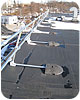
With the KeeGuard railing system there are no penetrations,
and no metal touches the roof. Counterbalance weights are made from recycled
PVC and feature a non-skid pad made of neoprene rubber.
There were several concerns about the building’s existing roof access ladders. First of all, they had round rungs, and square ones are required by OSHA. The ladders did not extend 36 inches above the roofline, as required, and some were only 2 inches from the wall, when they should have been 4 inches away.
The new ladders were custom fabricated. Replacing the ladders had its own set of challenges, said Crespo. “The old ones were heavy and hard to handle, and when we pulled them out, we discovered that they were not properly supported,” he said. “But with a joint effort by Hayden Building Maintenance, Safety Rail Source, and Mitchell Koch, the engineer on the job, we were able to come up with the right solution.”
The old ladders were attached to wood, and the team developed an angle bar system with pre-drilled holes so the new ladders could be anchored to metal.
“When ladders are mounted to brick walls, you know what you’re working with,” Swindell said. “Some of the short ladders had a sidewall with sheet metal. You weren’t sure what was underneath. We found there was nothing to mount to. We installed some custom fittings, and it worked out very well.”
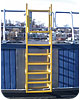
OSHA-compliant ladders were custom manufactured.
The KeeGuard system is designed to make future roofing work easy to accommodate. “Even if you have a roof leak under a counterbalance weight, for example, you can loosen the set screws on that railing and move one post up without dismantling the railing,” Swindell said. “You could even tear off and replace the roof by lifting sections without losing the railing, so you don’t need additional fall protection.”
Those involved with the project agree that Liberty Lines’ headquarters is now not only up to code - it looks better, too. “We’re very satisfied with the installation,” Pereira said. “We’re not only satisfied, but it helps the building look better from the street level - and we’re in compliance with OSHA.”
Crespo agreed. “When you drive in, you see it from the hills, and it really does look good,” he said. “It actually is a very attractive system.”
According to Vanning, the KeeGuard system presents a great opportunity for contractors to help their customers and generate more revenue at the same time. “It’s a clean, easy installation and a great upsell,” he said. “It’s an opportunity with new customers and existing business that helps the contractor bring the building up to code. Many buildings are out of code and the building owners don’t even know it. It’s up to the contractor to inform them.”
For more information about Safety Rail Source, visit www.safetyrailsource.com.
Looking for a reprint of this article?
From high-res PDFs to custom plaques, order your copy today!
.webp?height=740&t=1767036885&width=auto "Header - BE 1170x658 (002).png")

.webp?height=740&t=1755781744&width=auto "KEE(2).png")