Metal Roof Decking and UL's Roll Forming Program
For many years metal roof decking has been used as a viable roof-covering product that demonstrates good fire-resistant and wind-resistant performance characteristics. According to the Metal Construction Association (MCA), recent studies are showing shifts in the market and trends toward metal roofing in residential and nonresidential applications.
For many years metal roof decking has been used as a viable roof-covering product that demonstrates good fire-resistant and wind-resistant performance characteristics. According to the Metal Construction Association (MCA), recent studies are showing shifts in the market and trends toward metal roofing in residential and nonresidential applications. This trend has been shown over the last five years and estimates project more growth through 2011.
With the increasing number of wind events occurring throughout the United States, code officials, engineers, contractors, and architects should be able to readily identify metal roof deck products and systems that meet code specifications for wind performance. Major building codes throughout the nation, such as International Building Code, NFPA 5000, Florida Building Code, and others identify compliance with UL 580, “Tests For Uplift Resistance of Roof Assemblies,” as one of the key performance requirements for metal panel roof systems that are through fastened, or those panels with standing seams. Others standards used are UL 1897, “Standard for Uplift Tests for Roof Covering Systems”; ASTM E1592, “Standard Test Method for Structural Performance of Sheet Metal Roof and Siding Systems by Uniform Static Air Pressure Difference”; and FM 4471, “Approval Standard for Class I Panel Roofs.” Note that there are specific exceptions in the codes for metal roof systems constructed of cold-formed steel, where the roof deck acts as the roof covering and provides both weather protection and support for structural loads.
 UL 580
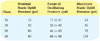
UL 580 provides a standard test method for the evaluation of damageability from both external and internal static pressures on the deck associated with high-velocity winds. The method subjects a 10-foot by 10-foot test sample to various positive and negative static and oscillating air pressures to index performance under uplift loads imposed on roof decks, thus providing a comparative measure of uplift resistance of roof deck constructions. The uplift performance of the roof deck systems is classified according to varying levels of uplift resistance performance. The nominal static uplift pressure, the oscillating uplift pressures and the maximum static uplift pressure for each class are shown in Figure 1.
 Factory-Produced UL 580 Metal
Panels
Factory-Produced UL 580 Metal
Panels
The method of identifying factory-produced metal roof deck panels evaluated by Underwriters Laboratories suitable for use in a UL 580 roof deck construction is the evidence of the UL Mark on the panel or the bundle of panels. Through UL’s Classification and Follow-Up Service Program, UL field representatives conduct follow-up service audits and examine the finished product. These audits are conducted on a quarterly basis to verify that the manufacturer is producing the product in accordance with all specifications and requirements. The UL Mark will contain key elements such as the UL symbol, the word “Classified,” the uplift Class, and the UL Construction number. Each UL Construction outlines the complete system as tested to achieve the UL 580 Class. An example of a typical Classification Mark is shown in Figure 2.
A certificate may be used in lieu of marking each factory-formed panel with the UL Classification Mark. If the Certificate Program is used, the smallest unit package of panels is marked “See UL Certificate.”
 UL’s Machine Certificate Program (Roll
Forming)
UL’s Machine Certificate Program (Roll
Forming)
For panels that are produced on site using roll-forming equipment, it would be cost prohibitive for UL representatives to visit each jobsite for the purpose of facilitating a labeling program. Consequently, UL offers the Machine Certificate Program (also called the Roll Forming Program) as a means to evaluate a company’s ability to produce metal roof deck panels in the field and in compliance with UL’s requirements. In this program, UL authorizes companies to display a certificate with each forming machine as representation that metal roof deck panels produced by the machine, and installed in accordance with the referenced Construction Design Number, are in compliance with the specification requirements established by UL. The Roll Forming Program requires that the certificate accompany the machine at all times in order to produce the UL Classified panels. The roll forming machinery is brought to an assigned non-jobsite physical location every six months where a UL field representative conducts the inspections and recertifies the machine. As part of that evaluation, panel profiles are examined to ensure that they meet all specifications. The certificate includes the Classification Mark with the product identification “Field Formed Metal Roof Deck Panels,” the forming machine model and serial number, and the panel specifications. Included with the certificate is a drawing of the panel. Copies of the certificate can be made available to authorities having jurisdiction, such as the local building inspector or a specifier such as an architect. The certificate does not, however, indicate proper application or use of the panels, and does not apply to other materials that may be fabricated or installed at the location where the panels are formed.
If a machine is in use beyond the certificate expiration date, the machine is no longer considered valid to produce certified panels. In the event that a machine is near its six-month expiration and is in use on a job that is under deadline to be finished, the authority having jurisdiction should determine acceptance or non-acceptance in this situation. If the certification period has lapsed, roll forming companies should contact UL to discuss recertification of the machine or establishment of the program under another company name.
Since field-formed panels are not eligible to bear a UL Mark, as they are when produced at a manufacturing facility, it is important to look to the certificate as evidence of the UL classification. The classified company on the certificate is the party responsible to UL for the roll-forming program, and thus responsible for the continuation of the program through the six-month recertifications.
 Summary
Roof deck systems using metal roof panels can demonstrate good wind-resistant performance utilizing UL 580 and other acceptable test procedures. It is important to be able to identify those panels that have been found to comply with the code-referenced performance standards, such as UL 580. Third-party certified factory-produced panels Classified by UL are identified by the appropriate UL Mark. Panels may also be produced at the jobsites using roll-forming equipment when an appropriate UL certificate accompanies the equipment.
Companies authorized to apply UL Marks to factory-formed metal roof deck panels and companies authorized to provide certificates for field-formed panels under the Roll-forming Program can be identified under UL’s product category “Metal Roof Deck Panels” (TJPV) in UL’s Roofing Materials and Systems Directory, or on UL’s Online Certification Directory.
UL offers the Machine Certificate Program (also called the Roll Forming Program) as a means to evaluate a company’s ability to produce metal roof deck panels in the field and in compliance with UL’s requirements.
For many years metal roof decking has been used as a viable roof-covering product that demonstrates good fire-resistant and wind-resistant performance characteristics. According to the Metal Construction Association (MCA), recent studies are showing shifts in the market and trends toward metal roofing in residential and nonresidential applications. This trend has been shown over the last five years and estimates project more growth through 2011.
With the increasing number of wind events occurring throughout the United States, code officials, engineers, contractors, and architects should be able to readily identify metal roof deck products and systems that meet code specifications for wind performance. Major building codes throughout the nation, such as International Building Code, NFPA 5000, Florida Building Code, and others identify compliance with UL 580, “Tests For Uplift Resistance of Roof Assemblies,” as one of the key performance requirements for metal panel roof systems that are through fastened, or those panels with standing seams. Others standards used are UL 1897, “Standard for Uplift Tests for Roof Covering Systems”; ASTM E1592, “Standard Test Method for Structural Performance of Sheet Metal Roof and Siding Systems by Uniform Static Air Pressure Difference”; and FM 4471, “Approval Standard for Class I Panel Roofs.” Note that there are specific exceptions in the codes for metal roof systems constructed of cold-formed steel, where the roof deck acts as the roof covering and provides both weather protection and support for structural loads.
Figure 1. The nominal static uplift pressure, the oscillating uplift pressures and the maximum static uplift pressure for each class under UL 580.
UL 580 provides a standard test method for the evaluation of damageability from both external and internal static pressures on the deck associated with high-velocity winds. The method subjects a 10-foot by 10-foot test sample to various positive and negative static and oscillating air pressures to index performance under uplift loads imposed on roof decks, thus providing a comparative measure of uplift resistance of roof deck constructions. The uplift performance of the roof deck systems is classified according to varying levels of uplift resistance performance. The nominal static uplift pressure, the oscillating uplift pressures and the maximum static uplift pressure for each class are shown in Figure 1.
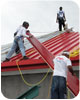
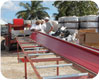
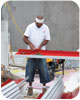
Shown using a portable roll former at the Kirk Harbour Centre in Grand Cayman, British WestIndies, are employees of Watler Metal Products. The product was supplied by Englert Inc. (Photosby Rick Damato.)
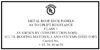
The method of identifying factory-produced metal roof deck panels evaluated by Underwriters Laboratories suitable for use in a UL 580 roof deck construction is the evidence of the UL Mark on the panel or the bundle of panels. Through UL’s Classification and Follow-Up Service Program, UL field representatives conduct follow-up service audits and examine the finished product. These audits are conducted on a quarterly basis to verify that the manufacturer is producing the product in accordance with all specifications and requirements. The UL Mark will contain key elements such as the UL symbol, the word “Classified,” the uplift Class, and the UL Construction number. Each UL Construction outlines the complete system as tested to achieve the UL 580 Class. An example of a typical Classification Mark is shown in Figure 2.
A certificate may be used in lieu of marking each factory-formed panel with the UL Classification Mark. If the Certificate Program is used, the smallest unit package of panels is marked “See UL Certificate.”
For panels that are produced on site using roll-forming equipment, it would be cost prohibitive for UL representatives to visit each jobsite for the purpose of facilitating a labeling program. Consequently, UL offers the Machine Certificate Program (also called the Roll Forming Program) as a means to evaluate a company’s ability to produce metal roof deck panels in the field and in compliance with UL’s requirements. In this program, UL authorizes companies to display a certificate with each forming machine as representation that metal roof deck panels produced by the machine, and installed in accordance with the referenced Construction Design Number, are in compliance with the specification requirements established by UL. The Roll Forming Program requires that the certificate accompany the machine at all times in order to produce the UL Classified panels. The roll forming machinery is brought to an assigned non-jobsite physical location every six months where a UL field representative conducts the inspections and recertifies the machine. As part of that evaluation, panel profiles are examined to ensure that they meet all specifications. The certificate includes the Classification Mark with the product identification “Field Formed Metal Roof Deck Panels,” the forming machine model and serial number, and the panel specifications. Included with the certificate is a drawing of the panel. Copies of the certificate can be made available to authorities having jurisdiction, such as the local building inspector or a specifier such as an architect. The certificate does not, however, indicate proper application or use of the panels, and does not apply to other materials that may be fabricated or installed at the location where the panels are formed.
If a machine is in use beyond the certificate expiration date, the machine is no longer considered valid to produce certified panels. In the event that a machine is near its six-month expiration and is in use on a job that is under deadline to be finished, the authority having jurisdiction should determine acceptance or non-acceptance in this situation. If the certification period has lapsed, roll forming companies should contact UL to discuss recertification of the machine or establishment of the program under another company name.
Since field-formed panels are not eligible to bear a UL Mark, as they are when produced at a manufacturing facility, it is important to look to the certificate as evidence of the UL classification. The classified company on the certificate is the party responsible to UL for the roll-forming program, and thus responsible for the continuation of the program through the six-month recertifications.
Figure 2. An example of a typical UL Classification Mark.
Roof deck systems using metal roof panels can demonstrate good wind-resistant performance utilizing UL 580 and other acceptable test procedures. It is important to be able to identify those panels that have been found to comply with the code-referenced performance standards, such as UL 580. Third-party certified factory-produced panels Classified by UL are identified by the appropriate UL Mark. Panels may also be produced at the jobsites using roll-forming equipment when an appropriate UL certificate accompanies the equipment.
Companies authorized to apply UL Marks to factory-formed metal roof deck panels and companies authorized to provide certificates for field-formed panels under the Roll-forming Program can be identified under UL’s product category “Metal Roof Deck Panels” (TJPV) in UL’s Roofing Materials and Systems Directory, or on UL’s Online Certification Directory.
Looking for a reprint of this article?
From high-res PDFs to custom plaques, order your copy today!
.webp?height=740&t=1767036885&width=auto "Header - BE 1170x658 (002).png")

.webp?height=740&t=1755781744&width=auto "KEE(2).png")