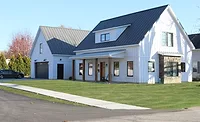
The Net Zero Home
The
Dow Chemical Company held a press conference in Bay City, Mich., to introduce
people to its Vision Zero home, which is designed to use 60 percent to 70
percent less energy than a conventional home.
The rising cost of monthly energy bills might be a thing of the past thanks to a home that essentially sustains itself.
Vision Zero - a home that uses up to 70 percent less energy than a conventional home - could even result in eliminating monthly energy bills entirely.
The U.S. Department of Energy defines a net-zero energy home as one that uses about 60 percent to 70 percent less energy than a typical home, with the balance of its energy needs supplied by renewable technologies.
It is essentially a home that sustains itself, energy-wise. That doesn’t mean that it is “off the grid,” as it may use some energy from the local utility.
A net-zero energy home generates the bulk of its own energy and makes enough extra energy to sell it back to the utility through “net metering,” offsetting the amount purchased, officials from The Dow Chemical Company said during a recent press conference in Bay City, Mich., that served as an Open House for Vision Zero.
Because of the energy-efficient products used in a net-zero energy home and because it requires so little energy from the utility companies, net-zero energy homes also have the potential to reduce greenhouse gas emissions and reduce dependence on foreign oil.
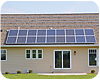
The
residence also features a solar array on the rear of the home.
Energy Efficiency Technology
The use of readily available energy efficiency technologies from Midland, Mich.-based Dow Chemical in the net-zero energy home is expected to save $3,507 in energy costs and avert 44,855 pounds of CO2 annually, according to Dow officials.The net-zero energy home project is another example of Dow’s collaboration with partners like Cobblestone Builders - a Great Lakes Bay region homebuilder focused on energy efficiency - and the State of Michigan to meet the shared goal of increasing the nation’s energy security, creating jobs and addressing the goal of combating climate change.
“As a world leader in applied chemistry, Dow is uniquely positioned to provide real-life solutions to address some of the world’s most pressing energy challenges,” said Doug May, Dow’s vice president of energy, climate change and alternative feedstocks. “The Vision Zero home utilizes a variety of energy solutions from Dow and is proof that homeowners can affordably enjoy all the comforts of the modern home, with a reduced environmental impact and still achieve a net-zero utility bill.”
The home also represents an important proof point for the progress of Michigan and the region to become a technology leader in both the creation and application of next generation building systems and technologies. It aligns with Gov. Jennifer Granholm’s vision for Michigan to be at the forefront nationally in the effort to promote a new clean energy economy and programs leading to good jobs.
Solar Shingles
Vision Zero was built using a variety of insulation and sealant materials from Dow to produce an energy-efficient building envelope.Photovoltaic and geothermal technologies, including the new Dow Powerhouse Solar Shingle, were incorporated to power the home. It’s the first Zero Energy Home to have Dow Powerhouse Solar Shingles installed and in operation.
“Did you ever think shingles could power your house?” Cobblestone co-founder Melissa Wahl asked those in attendance at the press conference announcing the opening of the home.
The new Dow Powerhouse Solar Shingles provides weather protection like asphalt shingles, while harnessing the power of the sun to offset a portion of the home’s energy usage.
“The solar shingle product will launch in mid 2011 with the thrust of the launch in the top solar markets like California, Florida, Georgia, Michigan, New Jersey, North Carolina,” said Dan Pezolt, Dow Solar Solutions Product Director. “We will continue to expand our reach to other markets as well.”
More Renewable Resources
Cobblestone Homes has also incorporated a wide range of products from a number of other leading suppliers that will conserve energy or harness renewable resources to keep the Vision Zero home comfortable, while meeting the zero-energy threshold.The house uses geothermal heat pumps to heat and cool the home, solar water heating systems to provide hot water, as well as LED light bulbs and ultra-high efficiency appliances that can be found throughout the house.
When you combine the energy-efficient insulation materials, energy-saving appliances, geothermal energy, and solar power, you get a net-zero energy home - a home that essentially sustains itself.
“For years, we’ve been a leading advocate for energy-efficient, healthy and environmentally friendly homes here in Michigan,” said Mark Wahl, co-owner of Cobblestone Homes. “Our collaboration with Dow to build the Vision Zero home provides us with a unique opportunity to educate consumers and the industry about the attainability of net-zero energy homes. It will serve as a real-world example that net-zero is achievable, affordable and replicable, even in harsh Northern climates.”
The Vision Zero house, located in Bay City, Mich., will also be an educational center for builders and consumers for one year, providing tours, training, and hands-on demonstrations.
A More Efficient World
The companies behind the Vision Zero project are committed to developing sustainable solutions to help improve energy efficiency and reduce greenhouse gas emissions.Dow Chemical Company’s sustainable technologies include building insulation and sealants to reduce air infiltration and improve thermal performance, as well as heat transfer fluids and photovoltaic shingles that enable homeowners to capture the earth’s renewable energy. It was the first to market with new zero ozone-depleting, no-VOC blowing agent foaming technology for its STYROFOAM Brand. The company was named the 2008 ENERGY STAR Partner of the Year, and it has garnered six U.S. Presidential Green Chemistry Awards.
Cobblestone Homes has been building energy-efficient, healthy, and environmentally friendly homes in mid-Michigan since Mark and Melissa Wahl founded the company in 2000.
According to Mark Wahl, the company is loyal to products that work, from large corporations, such as Dow Chemical and Dow Corning, to a lighting store in Bay City to a Midland tile company. “We try to capitalize on local and state products when possible,” he said. “Partnerships are formed with companies like Dow that want to showcase their products in a successful project.”
The company has dedicated itself to building affordable quality homes that help preserve these resources and leave a lighter environmental footprint, and Melissa Wahl points to the Vision Zero home as proof of that commitment.
“Have you ever wanted to see the future ahead of time?” she asked. “The home of tomorrow is here today.”
Looking for a reprint of this article?
From high-res PDFs to custom plaques, order your copy today!
.webp?height=740&t=1767036885&width=auto "Header - BE 1170x658 (002).png")

.webp?height=740&t=1755781744&width=auto "KEE(2).png")