Cool Roofs: A Piece of the Green Puzzle
As green building strategies evolve to keep up with increasingly stringent building energy codes and standards, so do cool roofs. A roof, as any other building component, can be selected to best serve a particular purpose, such as weather resistance or thermal regulation. Cool roofs are optimally designed to minimize the transfer of heat from the sun to the interior of a building.
As green building strategies evolve to keep up with increasingly stringent building energy codes and standards, so do cool roofs. A roof, as any other building component, can be selected to best serve a particular purpose, such as weather resistance or thermal regulation. Cool roofs are optimally designed to minimize the transfer of heat from the sun to the interior of a building.
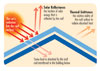
 A cool roof is defined by the radiative properties of the roof’s outer layer, or more specifically, by its solar reflectance and thermal emittance properties. Solar reflectance is a measure of the portion of initial solar radiation that is immediately reflected off the roof surface back in the atmosphere without heating the roof itself. Thermal emittance is a measure of the solar energy that the roof re-emits, or re-releases into the atmosphere as infrared light, after being initially absorbed. The remainder of the solar energy, that which is neither reflected nor re-emitted, is transferred to the building as heat or is convected by ambient breezes into the surrounding atmosphere, heating the surrounding air. The amount of solar energy transferred to a building can therefore be influenced by the roof design and construction. (See Figure 1.)
Thanks to advances in materials technology, white roofs are no longer the only type of cool roof available. Cool color pigments have been developed to efficiently reflect solar energy (light) in the Near Infrared (NIR) spectrum, whereas standard colors tend to absorb NIR energy. The NIR spectrum is invisible to the human eye, so two seemingly identical colors in the visible spectrum can perform differently in the NIR spectrum. With vast color and material choices, selecting an aesthetically pleasing roof design while maintaining cool roof performance is now possible.
Cool roofs reduce greenhouse gas emissions by conserving electricity and reducing power plant production demand incurred from air conditioning use. Creating electricity not only wastes a great deal of energy in the conversion process, but also produces CO2, particulate matter and other air pollutants.
 Cities can be 2 degrees to 8 degrees warmer than surrounding environments due to the large areas of dark surfaces, consisting mainly of roads, parking lots and dark-colored roofs. The extra heat absorbed through dark surfaces during the day is convected away by ambient breezes, raising air temperature averages; this phenomenon is referred to as the urban heat island effect. Cool roofs help mitigate the intensity of the urban heat island effect by reducing heat absorption and transfer to the surrounding air.
Lower ambient air temperatures resulting from cool roof applications also reduce the production of smog, a process accelerated by warmer temperatures. Reduced greenhouse gas emissions and smog production benefit public health by reducing the prevalence of asthma and other respiratory health conditions aggravated by air pollution.
Two primary organizations, the International Code Council (ICC) and the American Society of Heating and Air- Conditioning Engineers (ASHRAE), have developed National Model Energy Codes. These codes are not mandatory or enforceable until a jurisdiction adopts the documents as part of regulation or law. In the United States, many states and jurisdictions have adopted these codes, while others like California have developed their own.

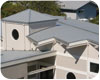
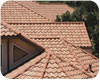
Figure 1. Radiative properties of roofs. (Image courtesy of the Cool Roof Rating Council.)
As green building strategies evolve to keep up with increasingly stringent building energy codes and standards, so do cool roofs. A roof, as any other building component, can be selected to best serve a particular purpose, such as weather resistance or thermal regulation. Cool roofs are optimally designed to minimize the transfer of heat from the sun to the interior of a building.
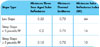
Figure 2. This chart outlines of the requirements of California’s Title 24. SRI is a measure of a roof’s ability to reject solar heat, as shown by temperature rise, and is calculated based on the roof’s radiative properties.
Thanks to advances in materials technology, white roofs are no longer the only type of cool roof available. Cool color pigments have been developed to efficiently reflect solar energy (light) in the Near Infrared (NIR) spectrum, whereas standard colors tend to absorb NIR energy. The NIR spectrum is invisible to the human eye, so two seemingly identical colors in the visible spectrum can perform differently in the NIR spectrum. With vast color and material choices, selecting an aesthetically pleasing roof design while maintaining cool roof performance is now possible.
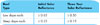
Figure 3. ENERGY STAR’s minimum specifications.
Beyond Energy Bills
In addition to reduced building energy consumption from diminished air conditioning requirements, cool roofs have numerous indirect benefits, including cutting greenhouse gas emissions, alleviating the urban heat island effect, reducing smog, as well as various public health benefits.Cool roofs reduce greenhouse gas emissions by conserving electricity and reducing power plant production demand incurred from air conditioning use. Creating electricity not only wastes a great deal of energy in the conversion process, but also produces CO2, particulate matter and other air pollutants.
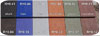
The top row of colors displays advances in pigment technology shown by the higher R-values, a measure of thermal resistance. (Photo courtesy of American Rooftile Coatings.)
Lower ambient air temperatures resulting from cool roof applications also reduce the production of smog, a process accelerated by warmer temperatures. Reduced greenhouse gas emissions and smog production benefit public health by reducing the prevalence of asthma and other respiratory health conditions aggravated by air pollution.
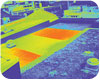
This thermal image illustrates the reflected solar radiation of varying roof surfaces. The bright orange areas correspond to highly reflective surfaces, the yellow to moderately reflective surfaces, and the dark areas to low or non-reflective surfaces. (Image courtesy of A3C Collaborative Architecture and the University of Michigan Sustainable Research Laboratory.)
Codes and Programs
As building technologies improve, building codes and programs have evolved to enforce strategic green building design and construction practices. The following section provides an overview of some cool roofing codes, green building programs, rebate programs and tax credits. For more information, please visit www.coolroofs.org.Two primary organizations, the International Code Council (ICC) and the American Society of Heating and Air- Conditioning Engineers (ASHRAE), have developed National Model Energy Codes. These codes are not mandatory or enforceable until a jurisdiction adopts the documents as part of regulation or law. In the United States, many states and jurisdictions have adopted these codes, while others like California have developed their own.
Cool Roofs in Energy Codes: California’s Title 24, The California Energy Commission’s Building Energy Efficiency Standard, includes a cool roof prescriptive requirement. A new version goes into effect on Jan. 1, 2010. It includes prescriptive requirements for low-slope and steep-slope roofs and for residential and non-residential building applications. The table in Figure 2 provides a brief overview of Title 24 requirements, but please note that there are many exceptions. For more information, please visit www.coolroofs.org or the California Energy Commissions Title 24 Web site, www.energy.ca.gov/title24/.
Green Building Programs: In 2009, the U.S. Green Building Council updated their Leadership in Energy and Environmental Design (LEED) program. LEED 2009 includes several structural changes to the rating program as well as changes to individual credits. LEED 2009 includes new point allocations for the various credits. There are now a total of 100 possible points for a given project (as opposed to the 69 points possible in previous versions). The cool roofing credit is still worth a single point and is available for every LEED program offered, including LEED for Schools, LEED for Existing Buildings, LEED for Core and Shell, and LEED for Homes.
Rebate Programs: As the green building movement sweeps the country, more utilities across the United States are providing incentives for cool roofs. States with current utility rebate programs include Arizona, California, North Carolina, South Carolina, Colorado, Florida, Idaho, New Jersey, New York and Texas. Please check with your local utility company if they have a cool roof rebate program in your area.
Green Building Programs: In 2009, the U.S. Green Building Council updated their Leadership in Energy and Environmental Design (LEED) program. LEED 2009 includes several structural changes to the rating program as well as changes to individual credits. LEED 2009 includes new point allocations for the various credits. There are now a total of 100 possible points for a given project (as opposed to the 69 points possible in previous versions). The cool roofing credit is still worth a single point and is available for every LEED program offered, including LEED for Schools, LEED for Existing Buildings, LEED for Core and Shell, and LEED for Homes.
Rebate Programs: As the green building movement sweeps the country, more utilities across the United States are providing incentives for cool roofs. States with current utility rebate programs include Arizona, California, North Carolina, South Carolina, Colorado, Florida, Idaho, New Jersey, New York and Texas. Please check with your local utility company if they have a cool roof rebate program in your area.
Cool roofing can come in a variety of colors and materials. Pictured here is a grey metal roof. (Photo courtesy of Custom-Bilt Metals.)
Rating Programs: The Cool Roof Rating Council (CRRC), an independent nonprofit organization that has developed and administers a third party rating system for the radiative properties of roofing materials, provides unbiased and credible ratings that are available online in the Rated Products Directory (www.coolroofs.org/products/search.php).
The CRRC does not set minimum requirements for solar reflectance and thermal emittance. It is up to the code bodies, green building programs, and utilities to set and define cool roof minimum radiative property requirements. The U.S. Environmental Protection Agency’s ENERGY STAR hosts a Reflective Roof Program that provides an ENERGY STAR label recognized by consumers as an indication of energy-efficiency.
Manufacturers can choose to rate their products with ENERGY STAR as long as they meet ENERGY STAR’s minimum specifications. (See Figure 3.)
Tax Credits: Through Dec. 31, 2010 the IRS will provide a tax credit for ENERGY STAR metal and asphalt roofing products. The tax credit is for 30 percent of the cost of the roof, up to $1,500. Please visit the ENERGY STAR Web site (www.energystar.gov) for details on how to receive a rebate.
The CRRC does not set minimum requirements for solar reflectance and thermal emittance. It is up to the code bodies, green building programs, and utilities to set and define cool roof minimum radiative property requirements. The U.S. Environmental Protection Agency’s ENERGY STAR hosts a Reflective Roof Program that provides an ENERGY STAR label recognized by consumers as an indication of energy-efficiency.
Manufacturers can choose to rate their products with ENERGY STAR as long as they meet ENERGY STAR’s minimum specifications. (See Figure 3.)
Tax Credits: Through Dec. 31, 2010 the IRS will provide a tax credit for ENERGY STAR metal and asphalt roofing products. The tax credit is for 30 percent of the cost of the roof, up to $1,500. Please visit the ENERGY STAR Web site (www.energystar.gov) for details on how to receive a rebate.
Cool roofs are optimally designed to minimize the transfer of heat from the sun to the interior of a building. (Photo courtesy of Decra Roofing.)
CRRC as a Resource
CRRC ratings include both initial and three-year aged ratings for solar reflectance and thermal emittance. For three years, the roofing material is exposed to natural weathering conditions on three test farms representing three key climate zones (hot/dry, hot/humid, and cold/temperate) to determine aged product performance. The CRRC also has a mandatory random testing program for all rated products in the directory to ensure accurately reported ratings. Currently, there are over 1,390 rated products in the directory.
Nationally recognized, CRRC ratings are often either required or recommended to meet cool roofing standards for building codes and programs.
California’s Title 24 requires CRRC ratings, while other jurisdictions including Austin, Dallas, Houston, Chicago and the state of Florida have cool roof building codes with minimum radiative properties that reference the CRRC. Both draft ASHRAE Standard 189.1 and LEED 2009 now reference the CRRC.
Advances in technology now allow cool roofs to come in a variety of colors and materials, no longer limiting aesthetic and architectural design preferences. Suppliers, manufacturers, and architects using the CRRC directory and educational resources now have access to a wealth of product information that can make cool roofs a viable option for achieving a green building vision. Therefore, when looking for an effective energy saving building strategy, consider a cool roof.
Nationally recognized, CRRC ratings are often either required or recommended to meet cool roofing standards for building codes and programs.
California’s Title 24 requires CRRC ratings, while other jurisdictions including Austin, Dallas, Houston, Chicago and the state of Florida have cool roof building codes with minimum radiative properties that reference the CRRC. Both draft ASHRAE Standard 189.1 and LEED 2009 now reference the CRRC.
Advances in technology now allow cool roofs to come in a variety of colors and materials, no longer limiting aesthetic and architectural design preferences. Suppliers, manufacturers, and architects using the CRRC directory and educational resources now have access to a wealth of product information that can make cool roofs a viable option for achieving a green building vision. Therefore, when looking for an effective energy saving building strategy, consider a cool roof.
Looking for a reprint of this article?
From high-res PDFs to custom plaques, order your copy today!
.webp?height=740&t=1767036885&width=auto "Header - BE 1170x658 (002).png")

.webp?height=740&t=1755781744&width=auto "KEE(2).png")
.webp?height=200&t=1744403834&width=200 "Alucobond(2).png")