Detroit School of Arts: Cool as it Gets
When Hamilton Anderson Associates of Detroit designed the Detroit School of Arts, the firm believed that sustainability of the project would lead to LEED certification.
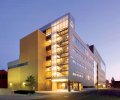
 When Hamilton Anderson Associates of Detroit designed the Detroit School of Arts, the firm believed that sustainability of the project would lead to LEED certification. Hamilton Anderson made good on its promise and today the $72.4 million project is a thriving 1,200 student public high school located in downtown Detroit’s Cultural Center.
“The vision was focused on creating new facilities and programs that attract students, establishing schools as resource centers within neighborhood communities, and providing progressive learning environments for Detroit’s youth,” said Paul Locher, Associate and Project Architect from Hamilton Anderson.
The project was completed in August 2006, which marked the completion of the Orchestra Place Master Plan that includes historic Orchestra Hall and the newly completed Max M. Fisher Center for the Performing Arts. A substantial portion of the project was completed in February 2005, when students began moving in. The six-story, 286,219-square-foot facility is now a flagship project for the Detroit Public School District’s $1.5 billion bond program.
Vision
At the onset of the project, the school district challenged Hamilton Anderson to explore Detroit’s legacy of industry as inspiration for creating a building that mirrored the character of Detroit.
“The genesis of the school creation was brought forth by Dr. Denise Cotton and Dr. Kenneth Burnley, with the main emphasis from Dr. Cotton,” Locher said, referring to the school’s principal and the school district's then-superintendent, respectively.
“At the onset of the project, the school district challenged the architecture firm to explore Detroit’s storied legacy of industry and innovation as inspiration for creating a building that embodies the authentic energy and character of this truly unique city.”
The vision, Locher said, was focused on creating new facilities and programs that attracted students, establishing schools as a resource centers within neighborhood communities, and providing a progressive learning environment.
“The intimate urban site presented the design team with opportunities for sustainability, which ultimately led to the school’s LEED registration,” Locher said. “Dr. Cotton, she had started a program in an old vocational school and they were making due with a worn-out public school. Some of the performing spaces was the auto shop, acoustics were horrible, didn’t even have an auditorium. They had a facility not highlighting their talents. This gives them a worthy space to expanded on ability.”
The school district formed partnerships with the Detroit Symphony Orchestra and Detroit Public television to give students direct access to top quality educators and programs, as well as state of the art professional facilities such as the Production Center for WTVS, Detroit’s public television affiliate, and the on-air/production facilities for WRCJ.
Media and Performing Arts professionals participated in the curriculum authorship process, leading to a collection of coursework offerings that are unique at any high school level.
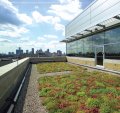
Locher said the overall work involved in the design of the building included, “Architectural Design, Architectural, Site Design, Civil Engineering, LEED Certification,” all by Hamilton Anderson Associates, which took into account longevity, low maintenance, and LEED consideration in designing the school. “A highly reflective roof surface was chosen for the majority of the roof surface to reduce the urban heat island effect that dark color roofs have and to reduce the amount of air conditioning needed for the building by reducing the roof temperature,” Locher said. “A green roof was selected for outside the Media Center as a teaching tool for the students; reduce water runoff from the roof; reduce the urban heat island effect; and to provide a better visual to be viewed from inside the building.”
Firestone Building Products supplied the reflective roof, while Hydrotech was used for the green roof components, Locher said.
“Firestone: SBS-modified bituminous membrane roofing with Firestone aluminum fibered roof coating,” said Locher, noting Hydrotech’s extensive garden roof assembly with monolithic membrane 6125EV to a 90-mil thickness was used. “Green buildings are associated with higher occupant satisfaction, lower operating cost, and higher worker (or in a school’s case, higher student) performance,” Locher continued. “A LEED rating is a way to have a third party validate the decisions and measures that have been implemented into the project (checks and balances). Anyone can say they have a green building, but a LEED rating proves you have one.”

The Detroit School of Arts is a new national prototype built upon the shared strengths of education and business, art and technology, school and community.
A green roof was selected for outside the Media Center as a teaching tool for the students; reduce water runoff from the roof; reduce the urban heat island effect; and to provide better aesthetics.
“The vision was focused on creating new facilities and programs that attract students, establishing schools as resource centers within neighborhood communities, and providing progressive learning environments for Detroit’s youth,” said Paul Locher, Associate and Project Architect from Hamilton Anderson.
The project was completed in August 2006, which marked the completion of the Orchestra Place Master Plan that includes historic Orchestra Hall and the newly completed Max M. Fisher Center for the Performing Arts. A substantial portion of the project was completed in February 2005, when students began moving in. The six-story, 286,219-square-foot facility is now a flagship project for the Detroit Public School District’s $1.5 billion bond program.
Vision
At the onset of the project, the school district challenged Hamilton Anderson to explore Detroit’s legacy of industry as inspiration for creating a building that mirrored the character of Detroit.
“The genesis of the school creation was brought forth by Dr. Denise Cotton and Dr. Kenneth Burnley, with the main emphasis from Dr. Cotton,” Locher said, referring to the school’s principal and the school district's then-superintendent, respectively.
“At the onset of the project, the school district challenged the architecture firm to explore Detroit’s storied legacy of industry and innovation as inspiration for creating a building that embodies the authentic energy and character of this truly unique city.”
The vision, Locher said, was focused on creating new facilities and programs that attracted students, establishing schools as a resource centers within neighborhood communities, and providing a progressive learning environment.
“The intimate urban site presented the design team with opportunities for sustainability, which ultimately led to the school’s LEED registration,” Locher said. “Dr. Cotton, she had started a program in an old vocational school and they were making due with a worn-out public school. Some of the performing spaces was the auto shop, acoustics were horrible, didn’t even have an auditorium. They had a facility not highlighting their talents. This gives them a worthy space to expanded on ability.”
The school district formed partnerships with the Detroit Symphony Orchestra and Detroit Public television to give students direct access to top quality educators and programs, as well as state of the art professional facilities such as the Production Center for WTVS, Detroit’s public television affiliate, and the on-air/production facilities for WRCJ.
Media and Performing Arts professionals participated in the curriculum authorship process, leading to a collection of coursework offerings that are unique at any high school level.
Green buildings are associated with higher occupant satisfaction, lower operating cost, and higher worker performance.
Building Design
The school is a new national prototype built upon the shared strengths of education and business, art and technology, school and community, Locher said. He said the design team worked closely with the client and its partners to identify the best resources from this range of environments with the ultimate goal of creating a place for learning, a place where business professionals, educators and students come together to share knowledge and produce high quality work.Locher said the overall work involved in the design of the building included, “Architectural Design, Architectural, Site Design, Civil Engineering, LEED Certification,” all by Hamilton Anderson Associates, which took into account longevity, low maintenance, and LEED consideration in designing the school. “A highly reflective roof surface was chosen for the majority of the roof surface to reduce the urban heat island effect that dark color roofs have and to reduce the amount of air conditioning needed for the building by reducing the roof temperature,” Locher said. “A green roof was selected for outside the Media Center as a teaching tool for the students; reduce water runoff from the roof; reduce the urban heat island effect; and to provide a better visual to be viewed from inside the building.”
Firestone Building Products supplied the reflective roof, while Hydrotech was used for the green roof components, Locher said.
“Firestone: SBS-modified bituminous membrane roofing with Firestone aluminum fibered roof coating,” said Locher, noting Hydrotech’s extensive garden roof assembly with monolithic membrane 6125EV to a 90-mil thickness was used. “Green buildings are associated with higher occupant satisfaction, lower operating cost, and higher worker (or in a school’s case, higher student) performance,” Locher continued. “A LEED rating is a way to have a third party validate the decisions and measures that have been implemented into the project (checks and balances). Anyone can say they have a green building, but a LEED rating proves you have one.”
Paul Locher, Associate and Project Architect, from Hamilton Anderson Associates of Detroit.
Final Considerations
Safety is always a concern on projects, but in relation to a LEED certification, additional precautions were taken to ensure materials were protected from water and dust exposure.
“Low- to no-VOC paints and finishes were used, and additional ventilation and filtration measures were taken to not only ensure that a high indoor air quality was achieved for the building’s end user but also improved the environment for the contractors as they constructed the project,” Locher said. “The project team delivered this LEED rated project with no cost increase over a traditionally designed project other than the LEED Certification fees. It all comes down to everyone working together as a team to accomplish a goal.”
Locher said since the project is located in the heart of Detroit’s Cultural Center, the school is a new national prototype built upon the “shared strengths of education and business, art and technology, school and community.”
“Low- to no-VOC paints and finishes were used, and additional ventilation and filtration measures were taken to not only ensure that a high indoor air quality was achieved for the building’s end user but also improved the environment for the contractors as they constructed the project,” Locher said. “The project team delivered this LEED rated project with no cost increase over a traditionally designed project other than the LEED Certification fees. It all comes down to everyone working together as a team to accomplish a goal.”
Locher said since the project is located in the heart of Detroit’s Cultural Center, the school is a new national prototype built upon the “shared strengths of education and business, art and technology, school and community.”
“The project strived to emulate this emerging paradigm in education by connecting physical resources through sensitive open space design, innovative communications technology, and an expressive, contemporary architecture,” Locher said. “This bold, fresh, potent project with all of its optimism helped to renew the spirit of its school district and became an important center of the community.”
Looking for a reprint of this article?
From high-res PDFs to custom plaques, order your copy today!
.webp?height=740&t=1767036885&width=auto "Header - BE 1170x658 (002).png")

.webp?height=740&t=1755781744&width=auto "KEE(2).png")