RAMSA Expands the University of Virginia’s McIntire School of Commerce
The new McIntire School invites students to collaborate in shared spaces that promote comfort, connectivity, and creativity

The McIntire School of Commerce, a leading business school at the University of Virginia, has been modernized and expanded with a thoughtful addition, enhancing this dynamic hub for student learning and success. Designed by RAMSA (Robert A.M Stern Architects), the new McIntire School combines the revitalization of Cobb Hall with the addition of Shumway Hall, formally establishing a prominent precinct — including the school’s existing Rouss and Robertson Halls — on the university’s historic grounds.
Rooted in Jeffersonian principles of education, architecture, and landscape, the expanded complex supports the McIntire School’s business education programs, creating new opportunities for interdisciplinary learning and collaboration through active-learning classrooms, data visualization and innovation labs, and a variety of communal gathering spaces. The expansion allows UVA to grow its enrollment while strengthening student life and campus support.
Transforming the McIntire School began by retrofitting Cobb Hall, a classic brick building constructed in 1917 and formerly home to the university’s chemistry department, and later, medical school. Spanning 23,000 square feet, Cobb Hall’s improvements introduced modern spaces, including cluster classrooms tailored to small group learning and a media production studio. Classrooms that had formerly been subdivided were restored as part of the renovation. The historic structure was also updated to comply with the Americans with Disabilities Act (ADA).
Working in collaboration with Glavé & Holmes Architecture, which led the historic preservation of Cobb Hall, original details were preserved or duplicated wherever possible. Crowning Cobb Hall is a striking double-height solarium, created after a historic skylight was uncovered above a closed-off attic space. To re-establish its presence and create a warm, inviting atmosphere in the solarium, the attic was removed and a laylight replicating the original skylight was integrated into the ceiling.
Cobb Hall’s historic frontage was rehabilitated, while a portion of the building’s rear exterior was carefully removed to accommodate Shumway Hall and establish a framed outdoor courtyard. Below grade, a connection to Shumway Hall is made on Cobb Hall’s second level, where a short hallway guides students into the new building, where they emerge onto a balcony overlooking the new McIntire School atrium.
Fronting Jefferson Park Avenue, the 86,200-square-foot Shumway Hall serves as the McIntire School’s latest addition. Rising five stories and clad in Jeffersonian russet brick, the new building seamlessly integrates with the scale and materiality of the existing campus. A crescent-shaped courtyard, made possible by the underground connection between Shumway and Cobb Halls, preserves the surface between the two buildings for outdoor gathering and study space.
 Francis Dzikowski/OTTO
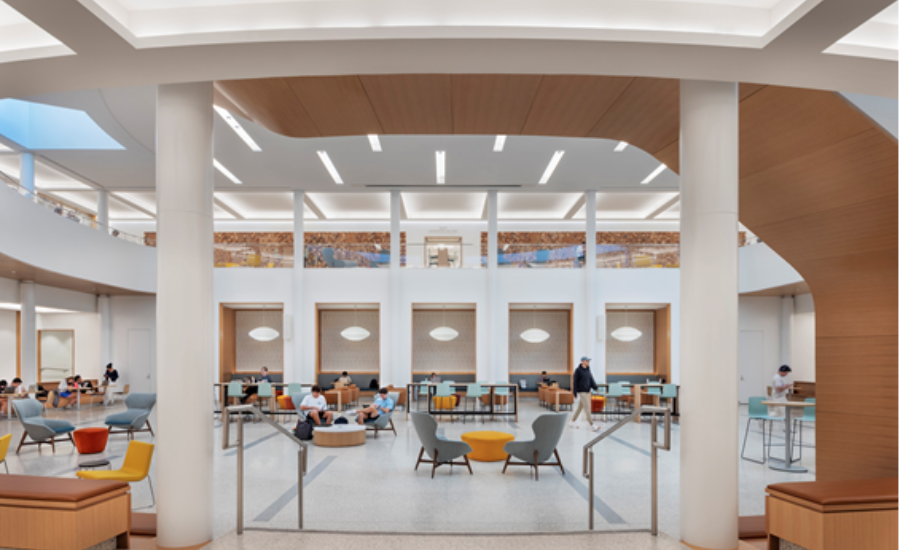
Shumway Hall is anchored by a striking atrium that serves as both a community lounge and an events venue capable of accommodating nearly 300 people.
To expand access to student support, an illuminated, two-story Student Success Center relocates and centralizes academic and career advisory services. A dramatic, curved stairway connects the two levels while encouraging spontaneous interaction and a sense of openness.
Shumway Hall also features a diverse mix of study rooms, lounge spaces and data labs, as well as a grand classroom that doubles as a secondary event space. Advanced building technologies are integrated throughout, including new Wi-Fi and adaptable lighting controls tailored to diverse teaching styles.
"The reimagined McIntire School is a bold academic hub designed to ensure that UVA’s students are thriving, both in their academic and personal lives,” said Jennifer Stone, Partner at RAMSA. “Shumway and Cobb Halls offer a range of distinctive classroom and collaboration spaces designed to support how students learn day-to-day. Just as importantly, by integrating the Student Success Center into Shumway Hall, campus supports are now more visible, immediate, and embedded in the student learning experience. This will make a real difference.”
The architecture of Shumway Hall is further enhanced by a robust art program that incorporates local and globally recognized artists. In particular, “A Life Worth Living” by Ato Ribeiro in the second floor Commons includes salvaged wood from Cobb Hall. The work beautifies the new spaces and elevates the experience of spending time at the McIntire School.
The conversion of Ruppel Drive from a vehicle access road into an accessible pedestrian corridor creates a new gateway to the school, now known as the Breeden Commerce Grounds, further reflecting the McIntire School’s focus on strengthening campus experiences. The park-like space serves as an outdoor focal point and significantly enhances campus connectivity, linking the new building to the McIntire School’s existing Rouss and Robertson Halls and serving as a major pathway to the Grounds from Jefferson Park Avenue. A 35-foot grade change brings prominence to Shumway Hall as Ruppel Drive ascends from the street level into the campus.
“In a moment for higher education where Artificial Intelligence is radically changing how students learn and interact, the newly expanded McIntire School reaffirms our belief in the power of relationships and in-person interactions,” said Bryan Lewis, General Faculty and Assistant Dean for Operations at the McIntire School of Commerce. “Our new facilities continue our tradition of community while providing students with cutting-edge technology and support resources to prepare them for the careers of the future.”
Looking for a reprint of this article?
From high-res PDFs to custom plaques, order your copy today!
.webp?height=740&t=1767036885&width=auto "Header - BE 1170x658 (002).png")

.webp?height=740&t=1755781744&width=auto "KEE(2).png")
.webp?height=200&t=1759158924&width=200 "S-5!(12).png")