Blue Roofs are Essential to Achieve Zero Rainwater Overflow
In their latest Infrastructure Report Card, the American Society of Civil Engineers (ASCE) gave our domestic wastewater infrastructure an average grade of D+ citing 772 communities in the U.S. in which wastewater and rainwater drain into the same treatment system. These combined sewer systems can experience capacity issues following heavy rain events, resulting in overflows containing a combination of rainwater with untreated human and industrial waste, toxic substances, debris and other pollutants. Termed "combined sewer overflows" (CSOs), these events can significantly impair water quality and affect public health and wildlife. In the Great Lakes region alone, a 2016 EPA report to the U.S. Congress identified 184 communities that discharge CSOs into the Great Lakes Basin. The report cited 1,482 CSO events in 2014, discharging an estimated 22 billion gallons of untreated wastewater into the Great Lakes Basin.
Deep Tunnel Systems are Not 100% Effective
This EPA report comes on the heels of a series of lawsuits brought against several municipalities by their respective States in concert with the EPA to spur action to address ineffective CSO infrastructure. In many cases, the municipality signs a consent decree and commits to constructing something akin to a deep tunnel infrastructure system sized to carry the overflow and keep it out of the natural water bodies. Such infrastructural upgrades are extremely expensive. The EPA estimates $271 billion is needed for wastewater infrastructure over the next 25 years.
Disturbingly, the deep tunnel systems are not always effective. Turns out they have capacities as well. Consider the 521 million gallon (MG) deep tunnel system for the Milwaukee Metropolitan Sewerage District (MMSD). The magnitude of the project is staggering: at 300 feet below grade, it is 28.5 miles long with diameters ranging from 17-32 feet. Put into operation in 1994, the deep tunnel system in Milwaukee has had a positive impact. The total volume of overflow has dropped from 8-9 billion gallons per year to volumes typically under 1 billion gallons per year. (Although in 2018 there was over 1.2 billion gallons of overflow due to extremely unusual amounts of rainfall; typically MMSD sees one to two overflows per year.)
For our purposes here, let us call it 1 billion gallons of overflow per year for Milwaukee. How can the city possibly make up the last, say, 10 percent of remaining overflow and truly achieve zero overflow events? There are a multitude of ways to pursue such a goal through green infrastructure:
- Trees
- Good soil
- Deep-rooted plants
- Porous patio or public areas
- Rain gardens
- Rain barrels and cisterns
- Depave hardscape
- Porous pavement
- Ponds
These strategies come with varying degrees of effectiveness but together they constitute a formidable solution to strive toward zero overflows. Milwaukee and other cities have long considered green infrastructure as a primary solution toward realizing effective rainwater management.
However, the biggest contributor to overflow events when a deep tunnel infrastructure is present are acute, heavy rain events where the volume overcomes the conveyance capacity of the deep tunnel system. The solution: the rainwater during these events must be temporarily slowed down. I'll offer that there is one strategy particularly well-suited to help stem the tide of rainwater overflow during an acute, heavy precipitation events: blue roofs with smart drains—or smart blue roofs.
Toward Zero Overflow Events
In order to truly achieve zero overflow events, it is critical that we reconcpeutalize our roofscapes with regard to their role in rainwater management— and it is not as difficult to achieve as you might think.
Blue roofs are membrane assemblies on low-sloped roofs. These roofs are designed to hold pools of water for a period of time not-to-exceed 48-hours, with depths (which are commonly greater than 6 inches) varying greatly based on the structural capacity of the building below. Blue roofs weigh up to 80 percent less than green roofs. The temporary load of the blue roof is already accounted for by codified structural requirements in colder climates (due to the factored-in snow load). Blue roofs require minimal site modifications. You just need a really good roofing membrane and installer and then add smart drains (i.e. drains with electronically automated drainage valves).
Smart Blue Roof Operations
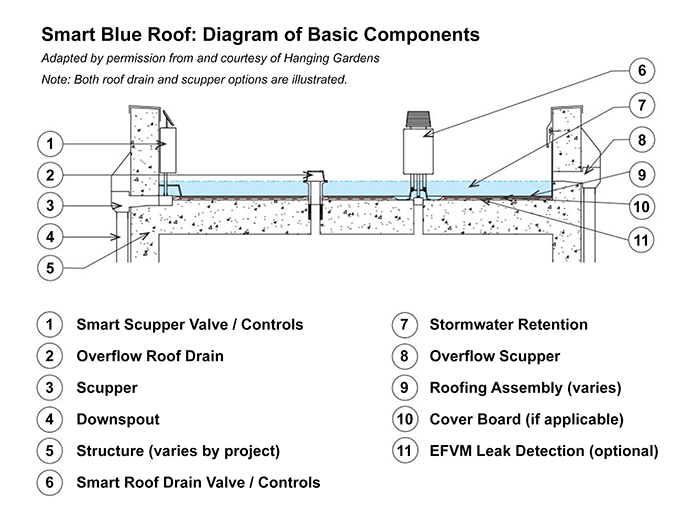
Amid our internet-of-things era, why not have the roof drains tied in? Smart blue roofs (i.e. blue roofs with smart drains) tie into a remote server that determines when a storm event is coming. The server will in turn instruct the rooftop drain valves to close via cellular communication. The closed valves will turn the roof is a shallow retention pond. Rainwater is held throughout the duration of the storm as the server determines when water should be released into the rainwater drains. When the timing is right, the valves are opened and water is released into the drains.
|
|
|
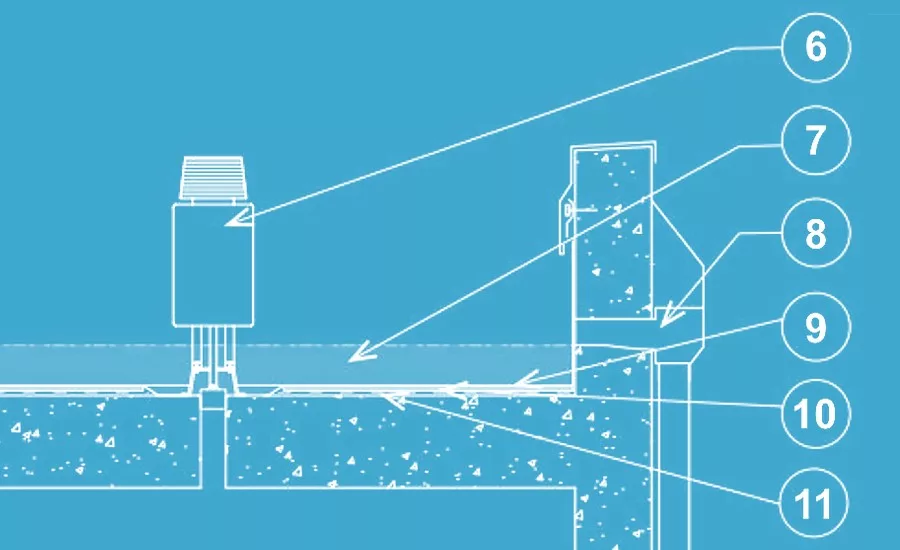
Smart Blue Roof: Diagram of Basic Components. |
|
Image adapted by Daniel Overbey. |
Ensuring the Performance and Safety of Smart Blue Roofs
With regard to ensuring that smart blue roofs are safe and effective, they exhibit the following characteristics:
- Drains have physical overflows in case of malfunction and thus cannot hold more water than specified and engineered.
- The valves are programmed to automatically release water if it has been held for more than 24 hours without communication from the server.
- Each drain is self-diagnosable and notifies the control center and building owner of failure.
- The system has a built-in leak prevention system that is tied into the smart controls.
Green Roofs are Still Preferred, But...
To be clear, I am not advocating for blue roofs in lieu of green roofs. Due to the various additional human health and environmental benefits offered, green roofs are superior to blue roofs. However, smart blue roofs can cost 75-90 percent less than green roof systems. When a green roof is not an option financially, a blue roof should still be within grasp.
Whether green or blue, a city's low-sloped roof real estate offers an enormous opportunity to blunt the strain on wastewater infrastructural capacity experienced during acute, heavy rainfall events. Our roofscapes will play a critical role in any comprehensive municipal strategy to achieve zero overflow events.