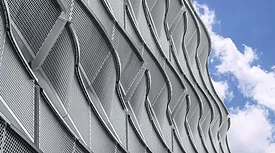
Metalwërks announced the inclusion of its Sculpted 3D on the recently constructed parking garage of Connecticut’s historic Stamford Station, part of a massive overhaul of this key link in rail traffic in the region.
The renovation and retrofit of the Science IV building on the campus of Binghamton University demonstrates how the skillful design, fabrication and application of ALUCOBOND® PLUS can transform an outdated, boring façade.
For each pixel, Linetec finished an 8-by-8-inch extruded aluminum flapper panel in the corresponding color. To achieve the pixelated mural effect, 35 unique colors were chosen to match West’s original artwork.
Sesquicentennial Hall, which is connected to the existing Busby Hall of Engineering, is a 200,000-square-foot new structure, created to support interdisciplinary engineering and computer science. A key to the success of the project was the exterior aesthetics.
Built environments are essential for human health, safety, and comfort. Properly constructed buildings enable us to live and thrive in any natural environment, many of which would be otherwise virtually unlivable.
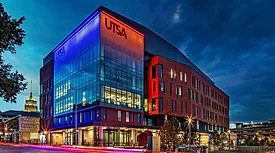
In creating a building befitting of the cutting-edge, high-tech research and cyber security programs taking place at the University of Texas at San Antonio National Security Collaboration Center, a combination of red brick, limestone masonry, metal and high-performance glass were selected for the modern façade.
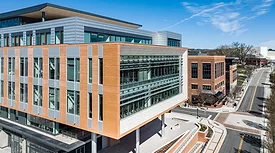
Designing a $100 million, 256,000 square-foot, six-story building that serves both historic downtown Blacksburg, Virginia and Virginia Tech University was no easy feat for Hanbury Architects and developer, W.M. Jordan Company.
3A Composites USA, manufacturer of ALUCOBOND and industry-leading producer of metal facades, announced further modernization of the Benton, KY production facility with the launch of a new coil-coating line.
Adding to the window energy efficiency was the use of trickle ventilators on the operating windows. Trickle ventilators, extensively used in Europe, provide a convenient alternative to opening windows for fresh air exchange without energy loss of the space conditioned interior air.
.webp?height=168&t=1692623481&width=275 "285A1540-HDR (1).jpg")

.webp?height=168&t=1692021462&width=275 "Sesquincentennial16 (002).jpg")


.webp?height=168&t=1687863812&width=275 "Crystal Supplies Greenpt Landing 35 Commercial St (002).jpg")