Building Enclosure logo
search
cart
facebook twitter linkedin youtube instagram Spotify Podcasts Apple Podcasts Spotify Podcasts Apple Podcasts
  • Sign In
  • Create Account
  • Sign Out
  • My Account
Building Enclosure logo
  • NEWS
    • Breaking News
  • SECTIONS
    • Columns
    • Project Profiles
    • Trade Shows
    • Sponsor Insights
  • SYSTEM DESIGNS
    • Low-Slope Roofs
    • Pitched Roofs
    • Metal Roofing Materials
    • Waterproofing
    • Sustainability
    • Insulation
    • Exterior Claddings
    • Wall Systems
    • Building Envelope
  • BLOG
    • The BE Blog
  • MEDIA
    • Podcasts
    • Webinars
    • Quiz
    • Videos
    • Polls
    • Interactive Spotlights
    • Newsletter
    • Photo Galleries
  • DIRECTORIES
    • Directory: Blue Book
    • Directory: Roofing Resource
  • PRODUCTS
  • TECHNICAL
    • Codes
      • Waterproofing
      • Roofing
    • Details
      • Waterproofing
      • Roofing
  • CONTINUING ED
  • ABOUT
    • Advertise
      • Editorial Calendar
    • Contact
    • eMag Archive Issues
  • SIGN UP!
Exterior CladdingsProject ProfilesWall Systems

IMPs Allow Contractor to Quickly Dry-In the Tallest Building in Downtown Blacksburg, Virginia
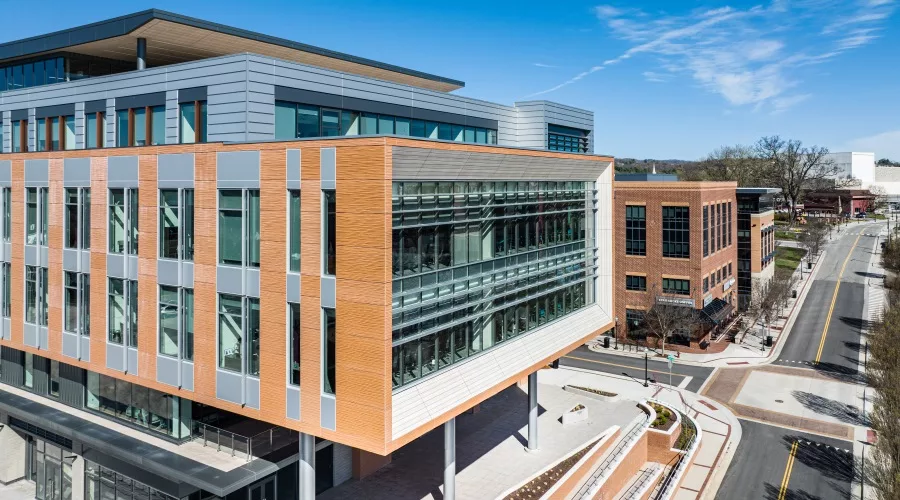
kingspan-virginia-tech-gilbert-st-blacksburg-va-kp-dw2000-case-study-08.jpg
July 21, 2023

Designing a $100 million, 256,000 square-foot, six-story building that serves both historic downtown Blacksburg, Virginia and Virginia Tech University was no easy feat for Hanbury Architects and developer, W.M. Jordan Company.

The new Gilbert Place building is a mixed-use project developed for the Virginia Tech Foundation, a non-profit that supports the Virginia Tech University and its initiatives. It is also the tallest building in downtown Blacksburg. 

Blending the new building with an existing building across the street, and making the building not feel like a six-story building was a challenge for the architects, but successfully accomplished. 

The solution included using a variety of cladding, including traditional brick, thin brick, Kingspan Designwall 2000 and Designwall 4000 insulated metal panels, single skin panels, MCM panels, concrete panels and high-pressure compact panels. The building also incorporates some Hokie Stone, a native limestone sourced from a Virginia Tech-owned quarry that dates back to 1869, commonly used on campus buildings. 

Behind all those different facades is one constant; 95% of the Gilbert Place building’s wall system is Kingspan’s KarrierPanel with QuadCore®, serving as the high-performing air and vapor barrier by providing continuous insulation in an all-in-one product. 

KarrierPanel utilizes Kingspan’ full engineered KarrierRail that facilitates the use of a wide range of facade options. In addition to facilitating the use of several different facade materials, using KarrierPanel also helped with the speed of build; other building envelopes were considered during the design phase.

“I think one of the most compelling reasons we selected KarrierPanel was not having to scaffold the entire building; the contractor quickly came on board to be able to dry-in this building and get multiple trades on the site almost simultaneously,” said David Keith, chief executive officer of Hanbury.

Four floors of office space are leased to the university, in addition to having retail and restaurants on the ground floor, as well as a rooftop restaurant. Two floors are dedicated to the university’s Department of Computer Science and College of Engineering, which have a focus of supplying talent for Amazon’s new HQ2 campus in Northern Virginia.

KEYWORDS: building façade drywall metal panels walls

Share This Story

Looking for a reprint of this article?
From high-res PDFs to custom plaques, order your copy today!


Recommended Content

JOIN TODAY
to unlock your recommendations.

Already have an account? Sign In

  • bar graph shows LEED v4/LEED v5/LEED v6 in various colors

    When Will LEED v4 / v4.1 and LEED v5 Expire?

    The latest version of the LEED rating system, LEED v5, is...
    Sustainability
    By: Daniel Overbey
  • Celebrating Women In AEC-2026

    Celebrating Women in The AEC Industry Part 1

    A round-up of women in the design, engineering and...
    Sustainability
    By: Lindsay Lewis
  • KEE membrane application on a roof

    A Beginner’s Guide to Single-Ply Roofing Membranes

    While PVC and TPO appear extremely similar, the chemistry...
    Low-Slope Roofs
    By: Peter Gross
Manage My Account
  • Sign up for the Newsletter
  • Online Registration
  • Manage My Preferences
  • Registration Customer Service

More Videos

Sponsored Content

Sponsored Content is a special paid section where industry companies provide high quality, objective, non-commercial content around topics of interest to the Building Enclosure audience. All Sponsored Content is supplied by the advertising company and any opinions expressed in this article are those of the author and not necessarily reflect the views of Building Enclosure or its parent company, BNP Media. Interested in participating in our Sponsored Content section? Contact your local rep!

close
  • 2 construction workers and a DEXcell panel
    Sponsored byDEXcell Roof Boards

    Designing Low-Slope Roofs for Resilience

  • Bell Bank headquarters in Fargo, North Dakota
    Sponsored bySto Corp.

    Drained and Back-Ventilated Rainscreens vs Pressurized-Equalized Rainscreens

  • A construction worker using DEXcell roof boards
    Sponsored byDEXcell Roof Boards

    The Hidden Strength of Low-Slope Roof Systems: Why Roof Cover Boards Matter

Popular Stories

construction industry workers in hard hats stand around a city scape

Construction Industry Revolts Over New CSI Licensing Plan

graph shows green, orange and red dot lines going up

LEED v5 and the Cost Impacts of ASHRAE Standard 90.1-2019

2 construction workers and a DEXcell panel

Designing Low-Slope Roofs for Resilience

Building Enclosure Newsletter

BE Poll

Events

April 9, 2026

Strategies for High-Performance Below-Grade Waterproofing

Credits: 1 AIA LU/HSW ; 1 IIBEC CEH; 0.1 IACET CEU

On-Demand Designing a high-performance building enclosure requires more than just surface-level protection; it demands a rigorous, performance-based mastery of below-grade water and gas mitigation. This discussion will provide an expert-level analysis of below-grade waterproofing within the comprehensive framework of the high-performance building enclosure.

April 28, 2026

Roof Design Considerations That Prevent Installation Failures and Change Orders

Credit: 1 AIA LU/HSW; 1 IIBEC CEH; 0.1 ICC CEU

On-Demand This course provides visual examples of actual field conditions. Some good, some not so good; along with design suggestions that can cut installation costs and reduce construction change orders. Upon completion of this course, you will have a better understanding of the requirements the roofing contractor must meet to provide the specified roofing system warranty, and long-term value to the owner.

View All Submit An Event

Products

Plaster and Drywall Assemblies Manual

Plaster and Drywall Assemblies Manual

This is a comprehensive manual that goes beyond codes and standards, providing expert guidance in design, detailing, material selection and troubleshooting for plaster and drywall.

See More Products

Related Articles

  • Breaking News

    Guardian Glass to Clad Tallest Building in the World

    See More
  • LK Architecture.png

    LK Architecture Announces Move to Historic Ruffin Building in Downtown Wichita

    See More
  • HM_Ajax2.jpg

    IMPs Help to Quickly Close Building Envelope Without Sacrificing Aesthetics

    See More

Related Products

See More Products
  • interior design.jpg

    Building Systems in Interior Design

  • ecology.jpg

    Architecture and Systems Ecology: Thermodynamic Principles of Environmental Building Design, in three parts

  • energy modeling.jpg

    Energy Modeling and Computations in the Building Envelope

See More Products

Events

View AllSubmit An Event
  • October 16, 2025

    Development and Adoption of Air Leakage in Building Codes

    Credits: 1 AIA LU/HSW; 0.1 IIBEC CEH; 0.1 ICC CEUOn-Demand This presentation will discuss the development of air leakage requirements in the model energy codes for commercial buildings. It will then describe the status of adoption of model codes by the states. Finally, the implications for enforcement through whole building airtightness testing of the adopted code will be discussed.
View AllSubmit An Event
×

Enhance your expertise with unparalleled insights.

Join thousands of building professionals today. Shouldn’t you know what they know?

SUBSCRIBE TODAY!
  • RESOURCES
    • Advertise
    • Contact Us
    • Store
    • Want More
  • SIGN UP TODAY
    • Create Account
    • Newsletter
    • Customer Service
    • Manage Preferences
  • SERVICES
    • Marketing Services
    • Reprints
    • Market Research
    • List Rental
    • Survey/Respondent Access
  • STAY CONNECTED
    • LinkedIn
    • Facebook
    • Instagram
    • YouTube
    • X
  • PRIVACY
    • PRIVACY POLICY
    • TERMS & CONDITIONS
    • DO NOT SELL MY PERSONAL INFORMATION
    • PRIVACY REQUEST
    • ACCESSIBILITY

Copyright ©2026. All Rights Reserved BNP Media, Inc. and BNP Media II, LLC.

Design, CMS, Hosting & Web Development :: ePublishing