Enclosure Experts
LEED v5 Is Changing the Sustainability Conversation — And Roofing Is Becoming a Critical Design Strategy
As the building industry prepares for the transition from LEED v4 and v4.1 to LEED v5, architects are facing a significant shift in how sustainable buildings will be evaluated. While previous versions of LEED emphasized a broad range of environmental strategies, LEED v5 places a stronger focus on measurable performance outcomes, embodied carbon reduction, operational efficiency and long-term resilience.
In a recent podcast discussion, Jay Saldana of Amrize/Elevate explored how these changes are elevating the role of roofing systems from a traditionally overlooked building component to a strategic asset that can help projects achieve sustainability goals throughout the building lifecycle.

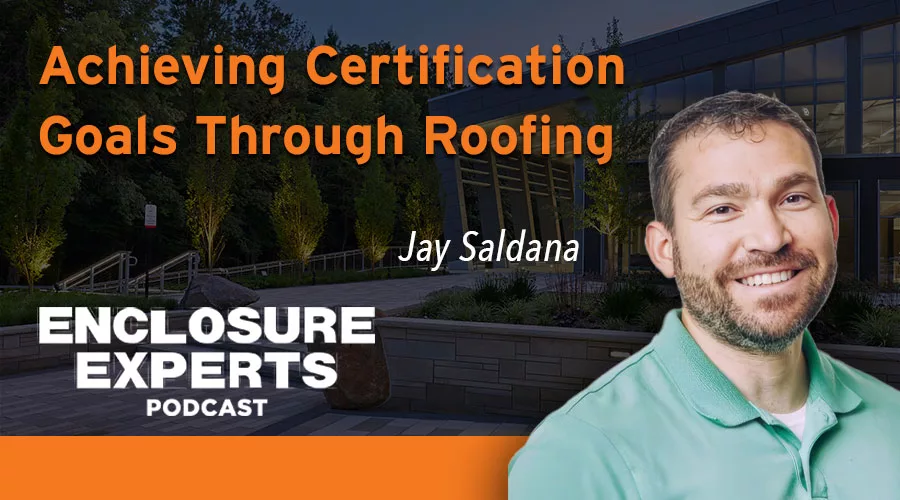
Achieving Certification Goals Through Roofing
As the building industry prepares for the transition to LEED v5, architects are facing a new sustainability landscape focused on embodied carbon, performance outcomes and resilience. In a recent podcast, Jay Saldana of Amrize/Elevate discussed how these changes are elevating roofing from a basic building component to a strategic design asset. Roofing systems now play a critical role in reducing carbon emissions, improving energy efficiency, supporting resilience and helping projects meet LEED goals.
A Shift from Prescriptive Measures to Performance
One of the most significant changes in LEED v5 is its emphasis on reducing carbon emissions across a building's entire lifespan. This includes both operational carbon—the emissions generated during building use—and embodied carbon, which accounts for emissions associated with manufacturing, transporting, installing and maintaining building materials.
For architects, this means roofing decisions can no longer be based solely on initial cost, aesthetics or warranty considerations.
Instead, roofing assemblies are increasingly being evaluated for their contribution to a building's overall environmental performance. Material selection, durability, energy performance and lifecycle impacts are becoming central considerations during design.
As building owners pursue aggressive sustainability goals, architects must demonstrate how every building system contributes to long-term carbon reduction. Roofing is now firmly part of that conversation.
The Transition to LEED v5
With registrations for LEED v4 and v4.1 ending in 2026, many project teams are beginning to evaluate how the new framework will affect future projects.
One challenge is that many professionals remain focused on traditional sustainability metrics while LEED v5 places greater emphasis on measurable outcomes. Rather than simply specifying sustainable products, teams must increasingly document how building systems contribute to performance goals related to energy, carbon and resilience.
This shift requires earlier collaboration among architects, consultants, contractors and manufacturers to ensure that design decisions align with project certification objectives from the outset.
For architects accustomed to treating roofing as a separate discipline managed later in the project delivery process, LEED v5 may require a more integrated design approach.
Building Enclosure Commissioning Gains Importance
LEED v5 also places greater attention on building enclosure performance verification.
Building enclosure commissioning provides a process for evaluating whether roofing, walls, windows and other enclosure components perform as intended before occupancy.
For architects, this reinforces the importance of roofing quality and installation performance—not simply product selection.
Even the most sustainable roofing assembly can fail to deliver expected performance if installation deficiencies create air leakage, moisture intrusion or thermal bridging issues.
As commissioning becomes more integral to achieving project goals, roofing performance will receive greater scrutiny throughout design and construction.
Helping Teams Navigate LEED v5
To support building professionals during the transition, Elevate recently introduced a LEED v5 roofing resource guide designed to help architects, consultants and contractors better understand how roofing systems align with the updated certification framework.
Resources like these are becoming increasingly valuable as teams work to interpret evolving sustainability requirements and identify practical pathways toward compliance.
For architects, having access to tools that connect roofing strategies with LEED objectives can help streamline decision-making and improve coordination across project teams.
Looking Ahead
The introduction of LEED v5 signals more than an update to a rating system—it reflects a broader transformation occurring throughout the building industry.
Carbon accountability, measurable performance and resilience are becoming central drivers of design decisions. As these priorities continue to influence project requirements, roofing systems will play an increasingly important role in helping buildings meet environmental and operational goals.
For architects, the message is clear: roofing is no longer simply a protective layer at the top of the building. Under LEED v5, it has become a critical component of a project's sustainability strategy, carbon reduction efforts and long-term resilience planning.
As the industry adapts to the next generation of green building standards, the firms that integrate roofing performance into early design discussions will be better positioned to deliver buildings that meet both certification requirements and owner expectations.
Looking for a reprint of this article?
From high-res PDFs to custom plaques, order your copy today!


.webp?height=740&t=1767036885&width=auto "Header - BE 1170x658 (002).png")

.webp?height=740&t=1755781744&width=auto "KEE(2).png")