Building Enclosure logo
search
cart
facebook twitter linkedin youtube instagram Spotify Podcasts Apple Podcasts Spotify Podcasts Apple Podcasts
  • Sign In
  • Create Account
  • Sign Out
  • My Account
Building Enclosure logo
  • NEWS
    • Breaking News
  • SECTIONS
    • Columns
    • Project Profiles
    • Trade Shows
    • Sponsor Insights
  • SYSTEM DESIGNS
    • Low-Slope Roofs
    • Pitched Roofs
    • Metal Roofing Materials
    • Waterproofing
    • Sustainability
    • Insulation
    • Exterior Claddings
    • Wall Systems
    • Building Envelope
  • BLOG
    • The BE Blog
  • MEDIA
    • Podcasts
    • Webinars
    • Quiz
    • Videos
    • Polls
    • Interactive Spotlights
    • Newsletter
    • Photo Galleries
  • DIRECTORIES
    • Directory: Blue Book
    • Directory: Roofing Resource
  • PRODUCTS
  • TECHNICAL
    • Codes
      • Waterproofing
      • Roofing
    • Details
      • Waterproofing
      • Roofing
  • CONTINUING ED
  • ABOUT
    • Advertise
      • Editorial Calendar
    • Contact
    • eMag Archive Issues
  • SIGN UP!
Breaking News

Vitro Architectural Glass Announces New Low Embodied Carbon Projects, Updates on Sustainability Objectives
Vitro Glass.jpg

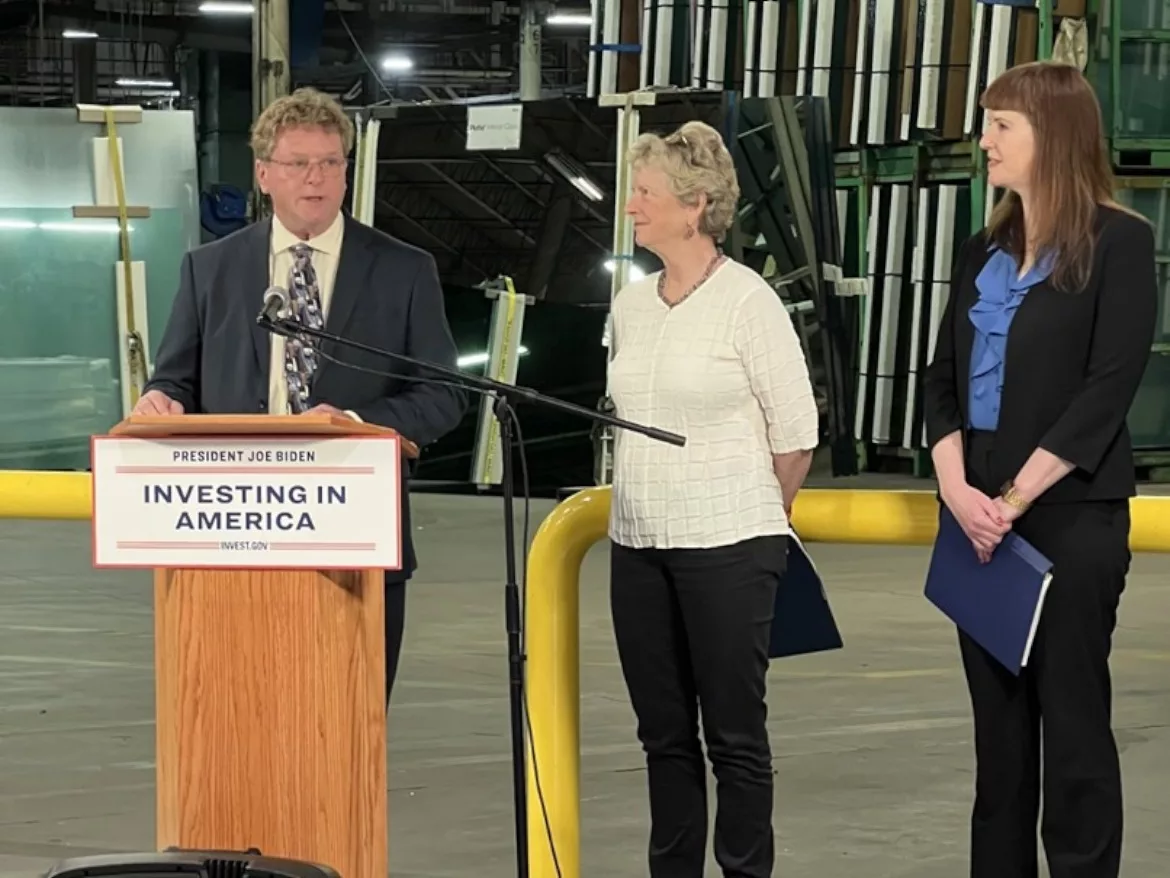
Pictured from L-R: Vitro Architectural Glass Vice President of Technical Services, Sustainability & Government Affairs Paul Bush; GSA Administrator Robin Carnahan; EPA Office of Chemical Safety and Pollution Prevention Deputy Assistant Administrator for Pollution Prevention Jennie Romer. (Photo: Courtesy of Vitro Architectural Glass).

May 18, 2024

Vitro Architectural Glass, the largest glass producer in the Western Hemisphere whose products continually raise the industry standard for sustainability, hosted the U.S. General Services Administration (GSA) and the U.S. Environmental Protection Agency (EPA) at its plant in Carlisle, Pennsylvania, to announce low embodied carbon (LEC) progress, its sustainability objectives and its work to improve environmental performance. 

Vitro proudly announces that the GSA selected its low-embodied carbon, energy-efficient products for a renovation project at the Whittaker Courthouse in Kansas City, Missouri, and a test project at the Cohen Federal Building in Washington, DC.

The Whittaker Courthouse will feature Starphire Ultra-Clear® low iron glass by Vitro, one of the world’s clearest, most transparent float glass products. The Cohen Federal Building project will serve as a GSA Green Proving Ground program testing location. Several windows at the Cohen Federal Building will use one of Vitro’s highest-performing products, VacuMax™ Vacuum Insulating Glass (VIG), which delivers R-values up to R20, rivaling the thermal performance of traditional walls. The Lawrence Berkeley National Laboratory will conduct testing and performance evaluations for this project. Earlier this year, the GSA selected Solarban® solar control, low-e glass by Vitro for the Powell Courthouse and Annex renovations.

These renovation projects are part of President Biden’s Investing in America agenda and funding comes from the Inflation Reduction Act (IRA) of 2022. Additionally, these projects further the Biden-Harris Administration’s Buy Clean Initiative, under which the federal government is, for the first time, prioritizing the purchase of asphalt, concrete, glass and steel that have lower levels of greenhouse gas emissions associated with their production, use and disposal. These investments aim to expand America’s industrial capacity for manufacturing goods and materials of the future, tackle the climate crisis, and create good-paying jobs for workers in the region. 

In 2017, Vitro became the first North American manufacturer to publish third-party verified Environmental Product Declarations (EPDs) for its flat glass and processed glass products. Recently, Vitro updated its EPDs to indicate that all its architectural glass products meet the top 20% LEC material global warming potential (GWP) threshold that GSA established pursuant to IRA and related guidance from the U.S. Environmental Protection Agency. GSA’s IRA requirements for flat glass require that products offer a Type III EPD with a GWP value expressed in kilograms of carbon (CO2) equivalent per metric ton and impose GWP limits that GSA established in May 2023 based on actual product-specific and industry-average EPDs.

With a GWP of 1,240 kilograms of CO2 equivalent, all Vitro architectural glass products meet GSA’s most-stringent “Top 20%” GWP limit of 1,331. This lowest embodied carbon designation applies to all Vitro-produced architectural glass from all Vitro plants manufactured since April 2024.

Vitro was also the first U.S. glass manufacturer to have its entire collection of architectural glass products earn Cradle to Cradle Certified® status. Recently, Vitro earned renewal of its Cradle to Cradle Certified® status, which included an increase in the certification levels of Material Health to the platinum level, the highest achievable certification, and Material Reutilization to the gold level. 

“We are committed to continually raising the industry standard for sustainability and strongly believe in transparency, as shown in our recent updates to our EPDs and Cradle to Cradle Certified® achievements,” said Paul Bush, Vitro Architectural Glass Vice President, Technical Services, Sustainability & Government Affairs. “We’re very pleased that the GSA again selected our low embodied carbon glass for landmark renovation projects to improve the buildings’ energy efficiency and reduce its carbon footprint. Our research and development teams work tirelessly to continually improve our environmental performance so we can continue supporting architects, designers, fabricators and glaziers in meeting their sustainability goals.” 

Vitro's commitment to sustainability transcends certification programs into its responsible manufacturing processes and large-scale energy reduction through its energy-efficient, low-e Solarban® glass products, which deliver a return on carbon by dramatically reducing a building’s operational carbon every year.

Vitro’s continued efforts to improve environmental performance and lower GWP include more efficient use of batch material, implementing furnace efficiency and design improvements, installing energy-efficient lighting and regulating equipment and driving supplier improvements.

Another significant factor in lowering GWP is Vitro’s patented oxy-fuel furnace technology, which melts glass raw materials such as sand and silica by carefully mixing pure oxygen (instead of air) with natural gas, significantly improving energy and environmental performance. This technology reduces energy consumption in glass-melting furnaces by as much as 20% and greenhouse gas emissions by 50%.

Learn more about Vitro’s commitment to sustainability here. For more information about Vitro Architectural Glass products, visit www.vitroglazings.com
KEYWORDS: environmental impacts glass insulated glass

Share This Story

Looking for a reprint of this article?
From high-res PDFs to custom plaques, order your copy today!


Recommended Content

JOIN TODAY
to unlock your recommendations.

Already have an account? Sign In

  • bar graph shows LEED v4/LEED v5/LEED v6 in various colors

    When Will LEED v4 / v4.1 and LEED v5 Expire?

    The latest version of the LEED rating system, LEED v5, is...
    Sustainability
    By: Daniel Overbey
  • Celebrating Women In AEC-2026

    Celebrating Women in The AEC Industry Part 1

    A round-up of women in the design, engineering and...
    Building Envelope
    By: Lindsay Lewis
  • KEE membrane application on a roof

    A Beginner’s Guide to Single-Ply Roofing Membranes

    While PVC and TPO appear extremely similar, the chemistry...
    Low-Slope Roofs
    By: Peter Gross
Manage My Account
  • Sign up for the Newsletter
  • Online Registration
  • Manage My Preferences
  • Registration Customer Service

More Videos

Sponsored Content

Sponsored Content is a special paid section where industry companies provide high quality, objective, non-commercial content around topics of interest to the Building Enclosure audience. All Sponsored Content is supplied by the advertising company and any opinions expressed in this article are those of the author and not necessarily reflect the views of Building Enclosure or its parent company, BNP Media. Interested in participating in our Sponsored Content section? Contact your local rep!

close
  • 2 construction workers and a DEXcell panel
    Sponsored byDEXcell Roof Boards

    Designing Low-Slope Roofs for Resilience

  • Bell Bank headquarters in Fargo, North Dakota
    Sponsored bySto Corp.

    Drained and Back-Ventilated Rainscreens vs Pressurized-Equalized Rainscreens

  • A construction worker using DEXcell roof boards
    Sponsored byDEXcell Roof Boards

    The Hidden Strength of Low-Slope Roof Systems: Why Roof Cover Boards Matter

Popular Stories

a man wearing a mask installs insulation into a wall system

Quiet Rooms and Healthier Air: A Second Look at What Goes Inside the Wall Cavity

Canalino Elementary School and Canalino Family School exterior

Daylighting Design to Support Rapidly Growing Trend in Modular Building Construction

construction workers on a roof, plane flies in background

Why Specifications Are Becoming the Next Critical Layer of Construction Compliance

Building Enclosure Newsletter

BE Poll

Events

June 17, 2025

Addressing Condensation in Low-Slope Roof Assemblies

Credits: 1 AIA LU/HSW; 0.1 ICC CEU; 1 IIBEC CEH; 0.1 IACET CEU

On Demand In modern roofing systems, vapor retarders and air barriers do more than just minimize air leakage—they’re essential to maximizing performance and longevity. This engaging course dives into the next generation of moisture control: permeable vapor retarders and air barriers. Discover how these cutting-edge technologies are transforming low-slope roofing assemblies by improving energy efficiency, managing moisture, and boosting wind uplift resistance.

April 9, 2026

Strategies for High-Performance Below-Grade Waterproofing

Credits: 1 AIA LU/HSW ; 1 IIBEC CEH; 0.1 IACET CEU

On-Demand Designing a high-performance building enclosure requires more than just surface-level protection; it demands a rigorous, performance-based mastery of below-grade water and gas mitigation. This discussion will provide an expert-level analysis of below-grade waterproofing within the comprehensive framework of the high-performance building enclosure.

View All Submit An Event

Products

Plaster and Drywall Assemblies Manual

Plaster and Drywall Assemblies Manual

This is a comprehensive manual that goes beyond codes and standards, providing expert guidance in design, detailing, material selection and troubleshooting for plaster and drywall.

See More Products

Related Articles

  • vit_ucsd-torrey-pines-1.jpg

    Vitro Architectural Glass Updates Environmental Product Declarations to Meet Low Embodied Carbon Standards

    See More
  • VIT_SolarbanNameChange_IMG.jpg

    Vitro Architectural Glass Announces New Names for Three Solarban® Glass Products

    See More
  • Brian Lurie

    Vitro Architectural Glass Announces New National Architectural Manager

    See More

Related Products

See More Products
  • 007145828X.jpeg

    Manual of Low-Slope Roof Systems Fourth Edition

  • 111890950X.jpg

    Architectural Graphic Standards, 12th Edition

See More Products
×

Enhance your expertise with unparalleled insights.

Join thousands of building professionals today. Shouldn’t you know what they know?

SUBSCRIBE TODAY!
  • RESOURCES
    • Advertise
    • Contact Us
    • Store
    • Want More
  • SIGN UP TODAY
    • Create Account
    • Newsletter
    • Customer Service
    • Manage Preferences
  • SERVICES
    • Marketing Services
    • Reprints
    • Market Research
    • List Rental
    • Survey/Respondent Access
  • STAY CONNECTED
    • LinkedIn
    • Facebook
    • Instagram
    • YouTube
    • X
  • PRIVACY
    • PRIVACY POLICY
    • TERMS & CONDITIONS
    • DO NOT SELL MY PERSONAL INFORMATION
    • PRIVACY REQUEST
    • ACCESSIBILITY

Copyright ©2026. All Rights Reserved BNP Media, Inc. and BNP Media II, LLC.

Design, CMS, Hosting & Web Development :: ePublishing