Building Enclosure logo
search
cart
facebook twitter linkedin youtube instagram Spotify Podcasts Apple Podcasts Spotify Podcasts Apple Podcasts
  • Sign In
  • Create Account
  • Sign Out
  • My Account
Building Enclosure logo
  • NEWS
    • Breaking News
  • SECTIONS
    • Columns
    • Project Profiles
    • Trade Shows
    • Sponsor Insights
  • SYSTEM DESIGNS
    • Low-Slope Roofs
    • Pitched Roofs
    • Metal Roofing Materials
    • Waterproofing
    • Sustainability
    • Insulation
    • Exterior Claddings
    • Wall Systems
    • Building Envelope
  • BLOG
    • The BE Blog
  • MEDIA
    • Podcasts
    • Webinars
    • Quiz
    • Videos
    • Polls
    • Interactive Spotlights
    • Newsletter
    • Photo Galleries
  • DIRECTORIES
    • Directory: Blue Book
    • Directory: Roofing Resource
  • PRODUCTS
  • TECHNICAL
    • Codes
      • Waterproofing
      • Roofing
    • Details
      • Waterproofing
      • Roofing
  • CONTINUING ED
  • ABOUT
    • Advertise
      • Editorial Calendar
    • Contact
    • eMag Archive Issues
  • SIGN UP!
Building EnvelopeInsulationWall Systems

The Importance of Air Barriers
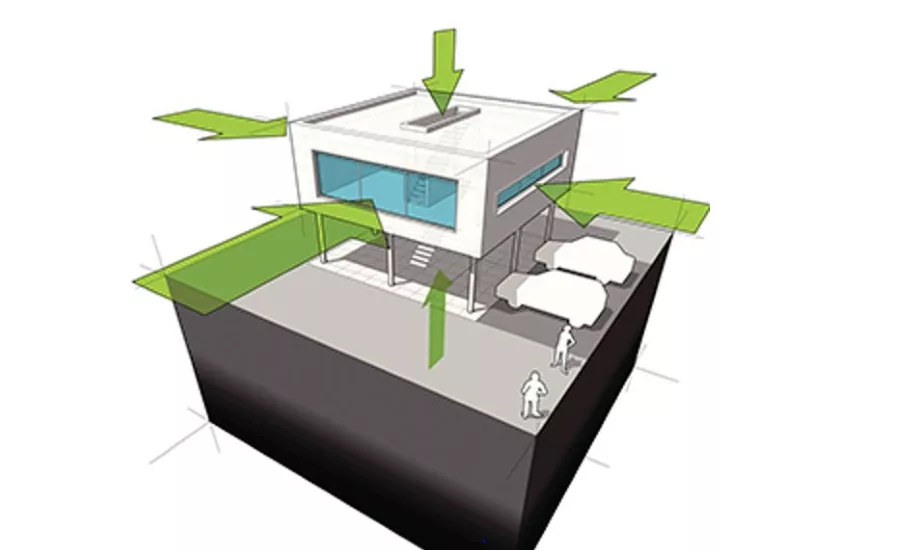
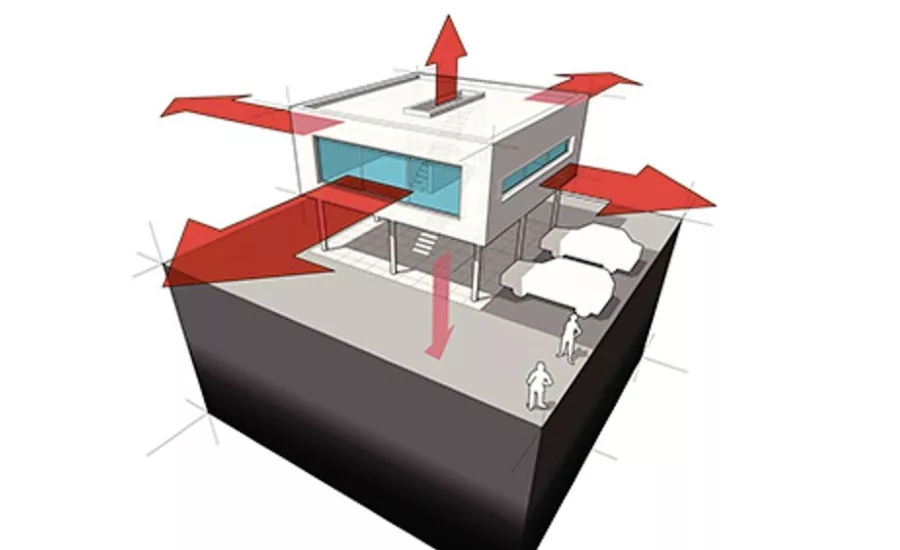
Air barriers
Air barriers stop infiltration into buildings for greater comfort during summer months.
Air barriers
Air barriers stop exfiltration from buildings for greater energy efficiency and savings during winter months.
Air barriers
Air barriers
June 26, 2019

The Importance of Air Barriers

Air within the envelope of a building is subject to air infiltration, exfiltration and the three modes of heat transfer: conduction, convection and radiation.

Insulating materials address heat transfer through all three modes; however, the benefits can be lost, sometimes completely, if air infiltrates the envelope. Combined with other classes of insulation, such as spray foam, batt and rigid board insulation, air barriers can provide a solution—plus additional thermal performance (R-value) for homes and commercial buildings when installed facing an enclosed air cavity and/or air film.

Additionally, the aluminum and polyethylene components used in many air barriers act as vapor retarders. The combined effect reduces heat transfer and moisture within the building envelope. 

And, now with advanced technology in vapor transmitting air barriers, exposed walls are able to dry when needed to reduce risk of moisture accumulation.


Why Air Barriers?

Air can infiltrate or exfiltrate through all sorts of building materials. In humid regions, for example, a sealed building protects temperature-controlled air indoors while keeping hot, moist air outside where it belongs. In colder climates, an airtight strategy protects the building envelope from condensation. In both cases, an air barrier significantly improves thermal performance for greater efficiency and comfort.

“Airflow can carry moisture that impacts a material’s long-term performance (serviceability) and structural integrity (durability),” Building Science Corporation says in “BSD-104: Understanding Air Barriers.” “Airflow also affects building behavior in a fire (spread of smoke and other toxic gases, supply of oxygen), indoor air quality (distribution of pollutants and location of microbial reservoirs) and thermal energy use. One of the key strategies in the control of airflow is the use of air barriers.”

Quality air barriers are designed to seal an entire building envelope, allowing no passage of air into or out of the building save for air conditioning systems and the voluntary opening of doors and windows. 

The complete seal is hugely beneficial in climates with cold winters because it keeps heated air inside living areas. But that doesn’t mean that hot, humid or arid climates don’t also benefit. The same seal keeps cool conditioned air indoors to give occupants in hotter climates relief from the heat.

Air barriers are typically used like a building wrap, enclosing the walls and ceilings of residential and commercial buildings just inside the interior drywall. But other uses go even further toward sealing enclosed living spaces.

The Montana Energy Code Compliance Best Practices Tech Sheet notes that air and thermal barriers also come in handy for:

  • Attics and attic accesses
  • Piping and ducts
  • Drop ceilings and soffits
  • Staircase framing
  • Porch roofs
  • Flue and chimney shafts
  • Recessed lighting
  • Whole-house fans
  • Windows and door
  • Floors
  • Foundations


Contemporary Building Science and Codes

If a theme could be assigned to modern construction practices and standards, it would be energy efficiency. Heating, ventilation and air conditioning (HVAC) equipment and appliances aim to improve the comfort level and quality of indoor air and require a significant amount of electricity or gas to operate. Today’s construction guidelines and regulations attempt to reduce such energy usage by improving thermal insulation.

Air and thermal barriers that meet or exceed the standards set by the U.S. government-backed Energy Star® certification agency must first abide by the guidelines set forth in Energy Star’s Thermal Bypass Checklist Guide.

According to the guide, sealed air barriers are required on all six sides of a building’s insulated spaces: top, bottom, back, front, left and right.

In “Air Barriers Are Essential for a Modern, High-Performance Home,” FineHomeBuilding.com suggests a simple but effective trick to ensure that the finished structure will have a contiguous and continuous air barrier over the entire building envelope. When reviewing building plans, contractors should be able to trace an air barrier around the perimeter without lifting their pencil off the blueprint.

Installed air barriers must comply with a variety of building standards, such as the Air Barrier Association of America’s (ABAA) Code Requirements. ABAA’s standards include international building, energy conservation, residential and green construction guidelines and cover air barrier design, installation, materials, assemblies and testing. Other state and local codes may apply to air and thermal barriers used in construction. Builders are responsible for researching all codes for their locale.

For more information, visit Fi-Foil Company.

KEYWORDS: air barriers building envelope insulation systems WRB (weather resistant barrier)

Share This Story

Looking for a reprint of this article?
From high-res PDFs to custom plaques, order your copy today!


Recommended Content

JOIN TODAY
to unlock your recommendations.

Already have an account? Sign In

  • bar graph shows LEED v4/LEED v5/LEED v6 in various colors

    When Will LEED v4 / v4.1 and LEED v5 Expire?

    The latest version of the LEED rating system, LEED v5, is...
    Sustainability
    By: Daniel Overbey
  • Celebrating Women In AEC-2026

    Celebrating Women in The AEC Industry Part 1

    A round-up of women in the design, engineering and...
    Sustainability
    By: Lindsay Lewis
  • KEE membrane application on a roof

    A Beginner’s Guide to Single-Ply Roofing Membranes

    While PVC and TPO appear extremely similar, the chemistry...
    Low-Slope Roofs
    By: Peter Gross
Manage My Account
  • Sign up for the Newsletter
  • Online Registration
  • Manage My Preferences
  • Registration Customer Service

More Videos

Sponsored Content

Sponsored Content is a special paid section where industry companies provide high quality, objective, non-commercial content around topics of interest to the Building Enclosure audience. All Sponsored Content is supplied by the advertising company and any opinions expressed in this article are those of the author and not necessarily reflect the views of Building Enclosure or its parent company, BNP Media. Interested in participating in our Sponsored Content section? Contact your local rep!

close
  • 2 construction workers and a DEXcell panel
    Sponsored byDEXcell Roof Boards

    Designing Low-Slope Roofs for Resilience

  • Bell Bank headquarters in Fargo, North Dakota
    Sponsored bySto Corp.

    Drained and Back-Ventilated Rainscreens vs Pressurized-Equalized Rainscreens

  • A construction worker using DEXcell roof boards
    Sponsored byDEXcell Roof Boards

    The Hidden Strength of Low-Slope Roof Systems: Why Roof Cover Boards Matter

Popular Stories

construction industry workers in hard hats stand around a city scape

Construction Industry Revolts Over New CSI Licensing Plan

graph shows green, orange and red dot lines going up

LEED v5 and the Cost Impacts of ASHRAE Standard 90.1-2019

2 construction workers and a DEXcell panel

Designing Low-Slope Roofs for Resilience

Building Enclosure Newsletter

BE Poll

Events

June 17, 2025

Addressing Condensation in Low-Slope Roof Assemblies

Credits: 1 AIA LU/HSW; 0.1 ICC CEU; 1 IIBEC CEH; 0.1 IACET CEU

On Demand In modern roofing systems, vapor retarders and air barriers do more than just minimize air leakage—they’re essential to maximizing performance and longevity. This engaging course dives into the next generation of moisture control: permeable vapor retarders and air barriers. Discover how these cutting-edge technologies are transforming low-slope roofing assemblies by improving energy efficiency, managing moisture, and boosting wind uplift resistance.

April 9, 2026

Strategies for High-Performance Below-Grade Waterproofing

Credits: 1 AIA LU/HSW ; 1 IIBEC CEH; 0.1 IACET CEU

On-Demand Designing a high-performance building enclosure requires more than just surface-level protection; it demands a rigorous, performance-based mastery of below-grade water and gas mitigation. This discussion will provide an expert-level analysis of below-grade waterproofing within the comprehensive framework of the high-performance building enclosure.

View All Submit An Event

Products

Plaster and Drywall Assemblies Manual

Plaster and Drywall Assemblies Manual

This is a comprehensive manual that goes beyond codes and standards, providing expert guidance in design, detailing, material selection and troubleshooting for plaster and drywall.

See More Products

Related Articles

  • The Realities of Air Barriers

    See More
  • IWR

    The Importance of Weather-Resistant Barriers

    See More
  • wood framing with fiberglass iinsulation

    The Importance of Low-VOC Insulation

    See More

Related Products

See More Products
  • 41G-JcZWT+L._SX342_SY445_.jpg

    The Architect's Studio Companion: Rules of Thumb for Preliminary Design, 7th Edition

  • 71lmKx8brKL._SY385_.jpg

    A Visual Dictionary of Architecture, 2nd Edition

See More Products
×

Enhance your expertise with unparalleled insights.

Join thousands of building professionals today. Shouldn’t you know what they know?

SUBSCRIBE TODAY!
  • RESOURCES
    • Advertise
    • Contact Us
    • Store
    • Want More
  • SIGN UP TODAY
    • Create Account
    • Newsletter
    • Customer Service
    • Manage Preferences
  • SERVICES
    • Marketing Services
    • Reprints
    • Market Research
    • List Rental
    • Survey/Respondent Access
  • STAY CONNECTED
    • LinkedIn
    • Facebook
    • Instagram
    • YouTube
    • X
  • PRIVACY
    • PRIVACY POLICY
    • TERMS & CONDITIONS
    • DO NOT SELL MY PERSONAL INFORMATION
    • PRIVACY REQUEST
    • ACCESSIBILITY

Copyright ©2026. All Rights Reserved BNP Media, Inc. and BNP Media II, LLC.

Design, CMS, Hosting & Web Development :: ePublishing