Building Enclosure logo
search
cart
facebook twitter linkedin youtube instagram Spotify Podcasts Apple Podcasts Spotify Podcasts Apple Podcasts
  • Sign In
  • Create Account
  • Sign Out
  • My Account
Building Enclosure logo
  • NEWS
    • Breaking News
  • SECTIONS
    • Columns
    • Project Profiles
    • Trade Shows
    • Sponsor Insights
  • SYSTEM DESIGNS
    • Low-Slope Roofs
    • Pitched Roofs
    • Metal Roofing Materials
    • Waterproofing
    • Sustainability
    • Insulation
    • Exterior Claddings
    • Wall Systems
    • Building Envelope
  • BLOG
    • The BE Blog
  • MEDIA
    • Podcasts
    • Webinars
    • Quiz
    • Videos
    • Polls
    • Interactive Spotlights
    • Newsletter
    • Photo Galleries
  • DIRECTORIES
    • Directory: Blue Book
    • Directory: Roofing Resource
  • PRODUCTS
  • TECHNICAL
    • Codes
      • Waterproofing
      • Roofing
    • Details
      • Waterproofing
      • Roofing
  • CONTINUING ED
  • ABOUT
    • Advertise
      • Editorial Calendar
    • Contact
    • eMag Archive Issues
  • SIGN UP!
Exterior Claddings

Restoring Façade of 100-Year-Old Courthouse
Coles County Courthouse
August 3, 2016

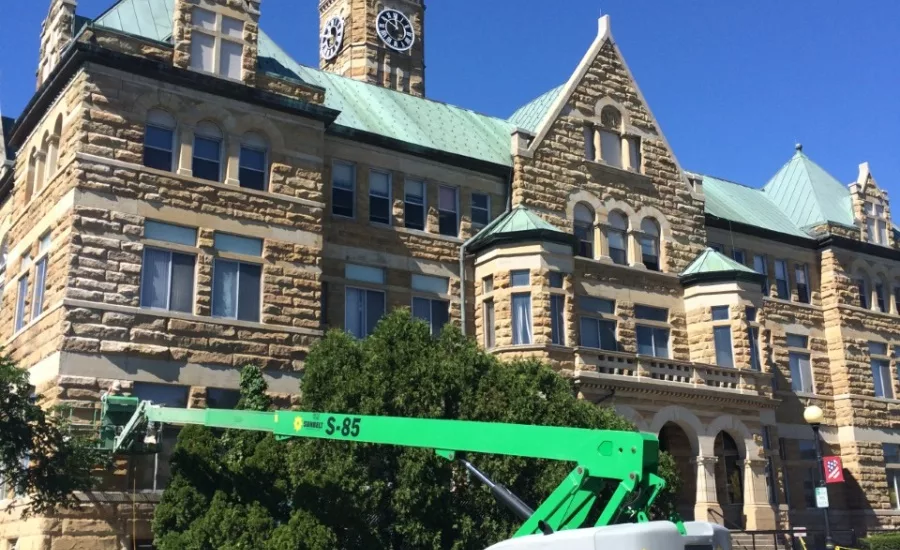
Busy traffic, a steady flow of visitors and unique materials were among the challenges Western Specialty Contractors Springfield, Ill. branch faced when it restored the stone facade of Charleston, Illinois' historic Coles County Courthouse.

Located in the public square in central Charleston and housing most of Coles County's important administrative offices and courts, the Coles County Courthouse is one busy facility. Western Specialty Contractors was contracted to restore the building's stone facade, including its four corner pavilions—each over 40 feet tall. The architect on the restoration project was Hance Design Group of Mattoon, Ill.

Built in 1898 and designed by architect Cornelius W. Rapp in the Richardsonian Romanesque style, the Coles County Courthouse features a clock tower  at its center, four main entrances and a facade constructed of brownstone from the Embarras River. Noted as the courthouse where President Abraham Lincoln tried several civil and criminal cases as a young attorney, the building was added to the National Register of Historic Places in 1978.

The first challenge Western crews faced on the project was removal and replacement of the large, heavy stone pieces near the top of the pavilions. Western worked with the architect to prepare shop drawings to show coursing that would allow crews to use more manageable sized stones as replacements, rather than utilizing the large, original stone pieces. This technique allowed Western to move the stone to the top of the building using a man lift rather than a crane, which would have required that traffic be blocked off around the busy courthouse.

Western also made a conscious decision to use two, 85-foot lifts rather than a single 45-foot lift to access the facade. The two, longer lifts could be placed in parking spaces along the perimeter of the street to reach the work areas, going up and over an underground holding area beneath the courthouse lawn, which posed a risk of collapse if equipment were placed on it.

"Continuing occupation of the courthouse and limiting disruption to the building's vital daily activities was a top priority on the project," said Scott Haas, Springfield branch manager.

When it came to color-matching for the stone patching, Western faced another challenge. Western knew that an exact match would be difficult to achieve due to the variation of coloring throughout the stone. In order to achieve a close match, Western crews created nine separate color mockups, assisted by Cathedral Stone which supplied the stone material for the mockups. Where new stones were needed, Western crews were able to find replacement stones that closely matched the originals.

A final challenge on the project involved the mortar joints, which were not able to be removed to the correct depth with a standard grinder due to the stone face protruding past the mortar joint. Western found a solution by removing as much of the mortar as possible with a grinder, then chiseling out the remaining mortar by hand to achieve the proper depth.

In total, Western crews performed more than 25,000 lineal-feet of tuckpointing; removed and replaced nearly 200 stones from the corner pavilions using four different sizes of stone; performed 150 square-feet of stone patching at various depths; and cleaned 20,000 square-feet of stone facade.

Western crews completed 75 percent of the tuckpointing work in the fall, then completed the balance of the work in the spring.

KEYWORDS: building façade restoration stone

Share This Story

Looking for a reprint of this article?
From high-res PDFs to custom plaques, order your copy today!


Recommended Content

JOIN TODAY
to unlock your recommendations.

Already have an account? Sign In

  • bar graph shows LEED v4/LEED v5/LEED v6 in various colors

    When Will LEED v4 / v4.1 and LEED v5 Expire?

    The latest version of the LEED rating system, LEED v5, is...
    Sustainability
    By: Daniel Overbey
  • Celebrating Women In AEC-2026

    Celebrating Women in The AEC Industry Part 1

    A round-up of women in the design, engineering and...
    Building Envelope
    By: Lindsay Lewis
  • KEE membrane application on a roof

    A Beginner’s Guide to Single-Ply Roofing Membranes

    While PVC and TPO appear extremely similar, the chemistry...
    Low-Slope Roofs
    By: Peter Gross
Manage My Account
  • Sign up for the Newsletter
  • Online Registration
  • Manage My Preferences
  • Registration Customer Service

More Videos

Sponsored Content

Sponsored Content is a special paid section where industry companies provide high quality, objective, non-commercial content around topics of interest to the Building Enclosure audience. All Sponsored Content is supplied by the advertising company and any opinions expressed in this article are those of the author and not necessarily reflect the views of Building Enclosure or its parent company, BNP Media. Interested in participating in our Sponsored Content section? Contact your local rep!

close
  • 2 construction workers and a DEXcell panel
    Sponsored byDEXcell Roof Boards

    Designing Low-Slope Roofs for Resilience

  • Bell Bank headquarters in Fargo, North Dakota
    Sponsored bySto Corp.

    Drained and Back-Ventilated Rainscreens vs Pressurized-Equalized Rainscreens

  • A construction worker using DEXcell roof boards
    Sponsored byDEXcell Roof Boards

    The Hidden Strength of Low-Slope Roof Systems: Why Roof Cover Boards Matter

Popular Stories

construction industry workers in hard hats stand around a city scape

Construction Industry Revolts Over New CSI Licensing Plan

a man wearing a mask installs insulation into a wall system

Quiet Rooms and Healthier Air: A Second Look at What Goes Inside the Wall Cavity

Canalino Elementary School and Canalino Family School exterior

Daylighting Design to Support Rapidly Growing Trend in Modular Building Construction

Building Enclosure Newsletter

BE Poll

Events

June 17, 2025

Addressing Condensation in Low-Slope Roof Assemblies

Credits: 1 AIA LU/HSW; 0.1 ICC CEU; 1 IIBEC CEH; 0.1 IACET CEU

On Demand In modern roofing systems, vapor retarders and air barriers do more than just minimize air leakage—they’re essential to maximizing performance and longevity. This engaging course dives into the next generation of moisture control: permeable vapor retarders and air barriers. Discover how these cutting-edge technologies are transforming low-slope roofing assemblies by improving energy efficiency, managing moisture, and boosting wind uplift resistance.

April 9, 2026

Strategies for High-Performance Below-Grade Waterproofing

Credits: 1 AIA LU/HSW ; 1 IIBEC CEH; 0.1 IACET CEU

On-Demand Designing a high-performance building enclosure requires more than just surface-level protection; it demands a rigorous, performance-based mastery of below-grade water and gas mitigation. This discussion will provide an expert-level analysis of below-grade waterproofing within the comprehensive framework of the high-performance building enclosure.

View All Submit An Event

Products

Plaster and Drywall Assemblies Manual

Plaster and Drywall Assemblies Manual

This is a comprehensive manual that goes beyond codes and standards, providing expert guidance in design, detailing, material selection and troubleshooting for plaster and drywall.

See More Products

Related Articles

  • Photo 1

    Restoration of 100-Year-Old Domed Roof

    See More
  • Western Specialty Shotcrete

    Restoring Exterior Facade

    See More
  • Sands Family YMCA

    100-Year-Old YMCA Replaced with Modern, State-of-the-Art Facility Through the Use of IMPs

    See More

Related Products

See More Products
  • ecology.jpg

    Architecture and Systems Ecology: Thermodynamic Principles of Environmental Building Design, in three parts

  • 41G-JcZWT+L._SX342_SY445_.jpg

    The Architect's Studio Companion: Rules of Thumb for Preliminary Design, 7th Edition

  • 71lmKx8brKL._SY385_.jpg

    A Visual Dictionary of Architecture, 2nd Edition

See More Products
×

Enhance your expertise with unparalleled insights.

Join thousands of building professionals today. Shouldn’t you know what they know?

SUBSCRIBE TODAY!
  • RESOURCES
    • Advertise
    • Contact Us
    • Store
    • Want More
  • SIGN UP TODAY
    • Create Account
    • Newsletter
    • Customer Service
    • Manage Preferences
  • SERVICES
    • Marketing Services
    • Reprints
    • Market Research
    • List Rental
    • Survey/Respondent Access
  • STAY CONNECTED
    • LinkedIn
    • Facebook
    • Instagram
    • YouTube
    • X
  • PRIVACY
    • PRIVACY POLICY
    • TERMS & CONDITIONS
    • DO NOT SELL MY PERSONAL INFORMATION
    • PRIVACY REQUEST
    • ACCESSIBILITY

Copyright ©2026. All Rights Reserved BNP Media, Inc. and BNP Media II, LLC.

Design, CMS, Hosting & Web Development :: ePublishing