The Proper Ventilation Rate for an Indoor Environment
Ventilation rates in our buildings can be a complicated subject and there is no shortage on ways to assess how air is brought into an indoor environment. Yet, a basic question that commonly emerges is simply: How much ventilation should I provide in a building?
ANSI/ASHRAE Standard 62.1
When it comes to defining minimum ventilation rates in buildings (except for low-rise residential), the premiere reference is ANSI/ASHRAE Standard 62.1, Ventilation for Acceptable Indoor Air Quality. The standard specifies minimum ventilation rates and other measures for both new and existing buildings that are intended to foster a level of indoor air quality that is acceptable to occupants and mitigates adverse health effects.
Breathing Zone
Ventilation air only benefits occupants if it reaches them. For this reason, we should consider the minimum ventilation rate within the "breathing zone."
ASHRAE defines the breathing zone as follows:
The breathing zone is the region within an occupied space between 3 and 6 feet above the floor and more than 2 feet from walls or fixed air-conditioning equipment.
Ventilation Rate (Combined Outdoor Air Rate)
Next, let's define the ventilation rate. ASHRAE Standard 62.1 specifies ventilation rates based on cubic feet per minute (cfm) per person and per square-foot of floor area - and both are related to the occupancy type (e.g. offices, museums, supermarkets, and so on). This because ASHRAE considers two types of contaminant sources, either of which may be present in an indoor environment:
- Sources originating from occupants and their activities: response in cfm/person
- Sources originating from the building and its furnishings: response in cfm/sf
If both sources are present and both (for example) produce perceivable odors, then the ventilation rate required for adequate dilution is the sum of the rates needed to handle each source separately. Thus, ASHRAE offers a combined outdoor air rate to simplify matters. For our purposes, we will measure the delivery of outdoor air in cubic feet per minute per person (cfm/person) based on the combined outdoor air rate.
It is important to acknowledge that we are referring to outdoor air specifically. Most HVAC systems will recirculate some component of indoor air (filtered and reconditioned).
Occupant Density Matters
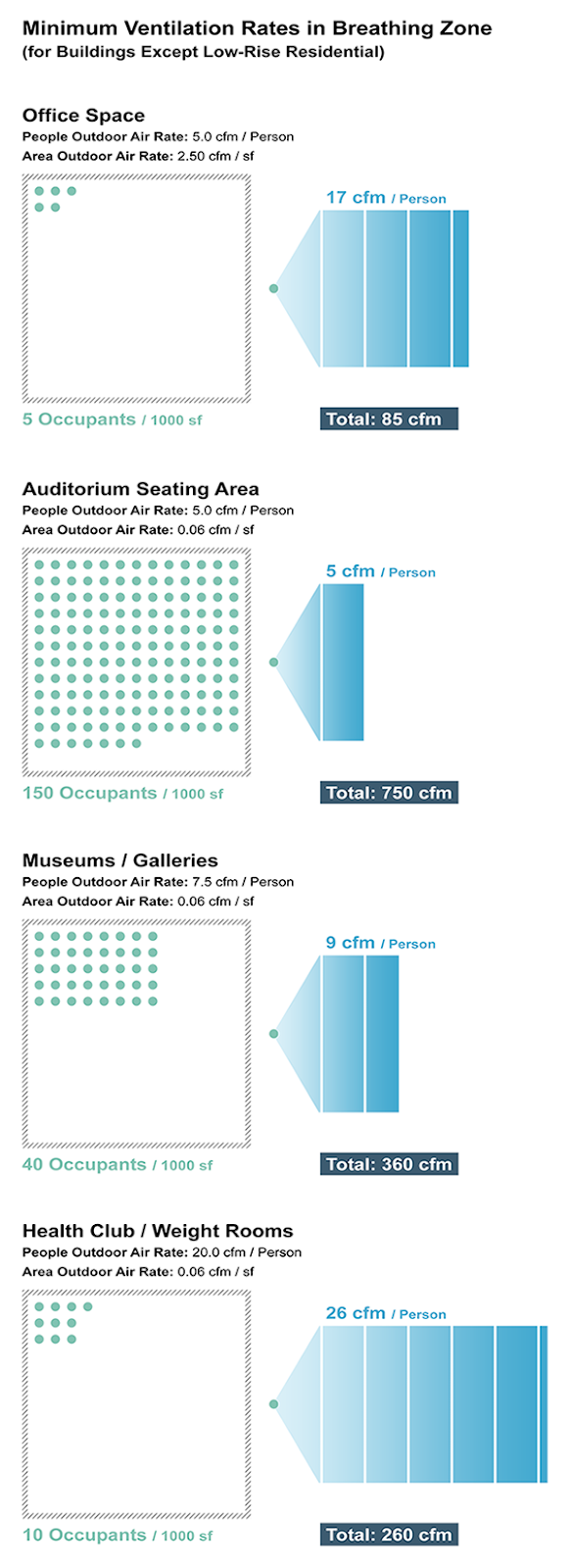
An examination of the minimum combined outdoor air rates from Standard 62.1 reveals that ventilation requirements vary based on occupancy type - which impacts expected activity level (think heavy breathing and perspiration) and the potential for indoor pollution sources. For example, museums/galleries require a minimum combined outdoor air rate of 9 cfm/person, while animal areas in pet shops or weight rooms in health clubs require no less than 26 cfm/person.
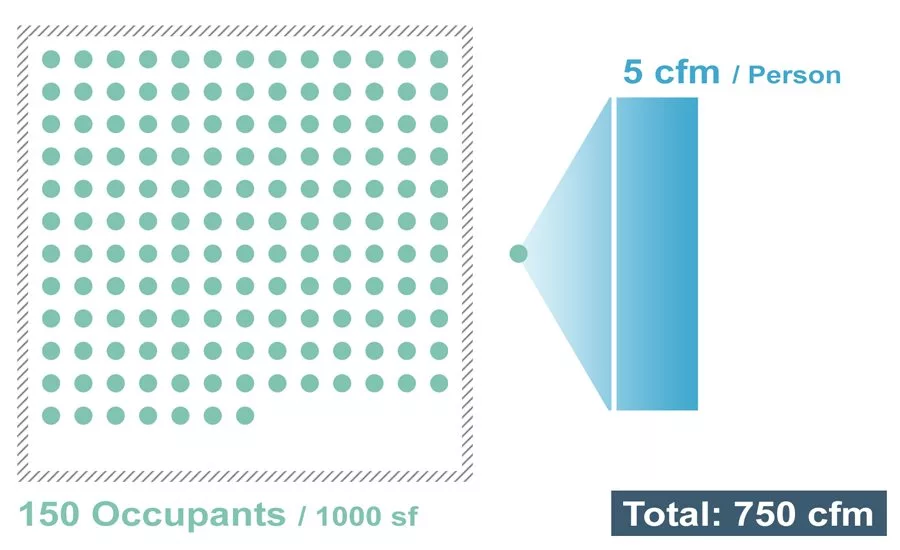
Occupant density is also influenced by occupancy type and plays an important factor in the overall amount of ventilation air needed in a space (Figure 1). Office spaces require 17 cfm/person; however, an auditorium seating area only requires 5 cfm/person. This lower rate might seem counterintuitive at first because a densely occupied area needs more ventilation. But it is the density factor related to the occupancy type that responds to this need:
- Office = 5 people per 1,000-square-feet
- Auditorium seating area = 150 people per 1,000-square feet
Therefore, for a 1,000-square-foot space:
- Office = 85 cfm of ventilation (17 cfm/person x 5 persons)
- Auditorium seating area = 750 cfm of ventilation (5 cfm/person x 150 persons)
A Brief History of Minimum Ventilation Rates
We know that increased amounts of clean, fresh air is a good thing. But what is the base minimum that we need to provide per person? Our standard minimum ventilation rates have varied drastically over time. BuildingGreen did some good legwork on this issue a few years ago and cited that doctors during the Crimean War (1853–1855) observed that diseases spread faster in densely occupied hospitals with poor ventilation. In response, the American Society of Heating and Ventilation Engineers (ASHVE) accepted a minimum ventilation rate of 29 cfm per occupant.
Over the next several decades, hygiene improved and our high ventilation rates came into question; yet soon thereafter, carbon dioxide (CO2) became a measurable proxy associated with poor health effects at high concentrations. The professional community eventually tapered back the minimum ventilation rate. In order to keep CO2 levels at an acceptably low level, 15 cfm per occupant was adopted in the American Standards Association code in 1946.
In response the energy crises of the 1970s, the pendulum swung too far and the minimum rate was cut back to 5 cfm per person—just as the industry started building much more airtight buildings.
Over the next two decades, emerging concern and knowledge regarding VOCs, radon, and other indoor air quality factors prompted the industry to adjust the minimum rates upward. By 1989, ASHRAE published the first edition of Standard 62.1 and brought rates back up to around 20 cfm per person in typical commercial/office buildings, which is generally where we stand today.
Minimum vs Optimum
If Standard 62.1 establishes the minimum ventilation rates, what are the optimal rates?
Researchers from Harvard's Center for Health and the Global Environment (C-CHANGE) recently published the first results of the Cognitive Function (CogFx) study on how green buildings positively affect human health and cognitive function.
In CogFx Study 1 (the first of a series of landmark studies) the research team found cognitive function test scores doubled when participants were in simulated green building environments with enhanced ventilation (as opposed to conventional building environments). The study suggests that when ventilation is increased from 20 cfm of outdoor air per person to 40 cfm, there is an 8 percent increase in employee decision-making (or roughly $6,500/year in improved productivity per person).
Increased outdoor air ventilation rates will come with an energy consequence, but the human health and cognitive function benefits appear to be quite considerable.
|
|
|
Figure 1: Minimum outdoor air ventilation rates in the breathing zone (for buildings except low-rise residential). Rates and occupant density source: ANSI/ASHRAE 62.1-2013, Ventilation for Acceptable Indoor Air Quality. Illustration by Daniel Overbey. |